
Global Market Company Valuation Program
How business valuation how to calculate Determines the company worth the most in Global Markets
Introduction to Global Market Company Valuation Program
The value of a company is one of the questions that always comes into consideration in relation to the investment decision making process in any economy, whether emerging markets or the most sophisticated financial centers in the world, during investment, merger and corporate strategy making decisions. The solution is never arrived at as being by guesswork. It is grounded in structured financial logic, market benchmarking, and disciplined modeling through business valuation how to calculate.
Whether ranking the company worth the most on global stock exchanges, advising high-growth startups, or supporting acquisitions, financial professionals depend on company valuation companies, the company net worth formula, and formal valuation calculation methods to establish defensible enterprise value. This paper is a well-rounded, professional manual to the calculation, validation, and implementation of company value in the real business world.
1. Defining Company Worth and Why It Shapes Global Markets
1.1 What It Means to Be the Company Worth the Most
When markets refer to the company worth the most, they normally refer to publicly listed corporations that have the largest market capitalization. Market capitalization shows the investor agreement regarding a company in future earnings, risk, growth potential, and competitive positioning. Nonetheless, this number does not remain the same. It is continuously reassessed using business valuation how to calculate principles applied across equity markets, institutional portfolios, and investment research.
The label company worth the most represents far more than prestige. It dictates the borrowing power, purchasing power, price power and strategy power in international supply chains. Companies in the list of the most valuable usually have priority financing conditions, regulated positions, and partner networks.
1.2 Company Worth Versus Company Price
It is paramount to differentiate between company value and transacting price. Short term sentiment, liquidity and market volatility are displayed in the share price visible on stock exchange. The genuine economic value is an outcome of the basic valuation models developed with the support of the company net worth formula, cash flow projections, and the basis of assessment based on the measurement of assets. That is the reason why disciplined valuation models, instead of headline stock prices, are used by institutional investors and company valuation companies.
It is critical to distinguish company worth from transactional price. The share price visible on stock exchanges reflects short-term sentiment, liquidity, and market volatility. True economic worth emerges from fundamental valuation models supported by the company net worth formula, cash flow forecasting, and asset-based measurement standards. This is why institutional investors and company valuation companies rely on disciplined valuation frameworks rather than headline stock prices.
2. The Role of Company Valuation Companies in the Global Economy
2.1 What Company Valuation Companies Actually Do
Company valuation companies are financial analysts operating as an independent financial specialist to arrive at business value to transact, litigate, report financial statements, tax, insolvency proceedings, and strategic advisory. They use standardized valuation techniques under accounting systems, financial theory and regulation standards.
When it comes to mergers and acquisitions, company valuation companies offer fairness opinions which shield the boards of directors against legal liability. Courts rely on their estimations in dispute resolution to settle shareholder disputes, divorce settlements with corporate property and contractual damages. Valuations are used in financial reporting to aid in testing impairments, accounting of goodwill, and purchase price allocation.
2.2 Why Independent Valuation Matters
Any valuation exercise is credible depending on independence. The company valuation companies are run with professional standards of conduct which emphasize on objectivity, documentation and methodological consistency. When such checks are not conducted independently, business owners can be tempted to overvalue themselves, overprice mergers and acquisitions, and face costs of control and legal lawsuits by shareholders.
3. Understanding the Company Net Worth Formula in Practice
3.1 The Structure of the Company Net Worth Formula
The company net worth formula at its most basic level is a total assets less total liabilities. This equation is a definition of the equity of shareholders and the remaining interest that the owners have after the payment of all obligations. Though the concept is very straightforward, the company net worth formula requires the proper valuation of the assets and liabilities at the fair market value as opposed to the book value.
Balance sheets do not provide a real market value of many operating companies since intangible assets that include brand equity, intellectual property, relationship with customers, and proprietary technology remain undervalued or not included in the balance sheets at all. This is the point where the valuation techniques go beyond the simple company net worth auto formula.
3.2 Net Worth Versus Enterprise Value
Whilst the company net worth formula is used to measure the equity value, the enterprise value is used to measure the overall economic value of the business, which includes the debt and preferred capital. Most business valuation how to calculate frameworks focus on enterprise value because it represents the full cost to acquire and operate the business. The equity value is then obtained by subtracting the amount of net debt and non-operating assets.
4. Business Valuation How to Calculate Using Core Valuation Approaches
4.1 Income-Based Valuation Method
The income approach under business valuation and how to calculate focuses on the present value of future economic benefits. The discounted cash flow analysis is a projection of the free cash flows within a specified period and discounted them based on a risk-adjusted cost of capital. This approach prevails in valuations of operating firms that have a predictable stream of revenue.
Institutional investors rely heavily on this business valuation how to calculate model when assessing industries such as telecommunications, infrastructure, manufacturing, and financial services. In this case, the accuracy of valuation is based on assumptions made on the growth of revenue, operating margins, expenditure on capital and working capital efficiency.
4.2 Market-Based Valuation Method
The market approach under business valuation how to calculate compares the subject business with similar publicly traded companies or recent transaction benchmarks. Multiples include price-to-earnings, enterprise value to EBITDA and revenue multiples, which convert the sentiment of the market into a valuation standard.
The practice is common among company valuation companies in an attempt to legitimize the income-based performance, and to align their findings with the current market environment, particularly in active management and acquisition markets.
4.3 Asset-Based Valuation Method
The asset-based approach uses the company net worth formula on the basis of fair-market value adjustments to assets and liabilities. This approach is especially applicable to the holding companies, real estate companies, troubled businesses and asset intensive industries. Although it is not the most prevalent with high-growth operating businesses, it is center-stage in the liquidation and restructuring scenarios.
5. How the Company Worth the Most Is Determined in Public Markets
5.1 Market Capitalization as a Reflection of Valuation
Public markets determine the company worth the most through daily trading activity combined with outstanding share counts. Earnings expectations, macroeconomic, interest rates, technological competition and regulatory risks are constantly included in this valuation.
Nevertheless, investors and analysts continue to use business valuation how to calculate fundamentals in gauging whether public prices are based on intrinsic or speculative excess. This difference is essential in the time of market bubbles and recessions.
5.2 The Role of Institutional Analysts and Valuation Models
Big investment banks and asset managers use proprietary business valuation how to calculate models to determine whether a company has earned the position of being the company worth the most. The models combine macroeconomic situations, industry cycle analysis, competitive positioning, and capital structure optimization to evaluate the value of an enterprise in the future.
6. Applications of Business Valuation How to Calculate in Real Transactions
6.1 Mergers and Acquisitions
In M&A transactions, business valuation how to calculate determines offer price, negotiation leverage, and deal success probability. Buyers rely on valuation models to estimate synergies, cost savings, and revenue expansion potential. Sellers depend on fair valuation to protect shareholder value.
Independent company valuation companies are often engaged to provide transaction fairness opinions that support board decisions and regulatory filings.
6.2 Capital Raising and Investment
Venture capital and private equity firms apply business valuation how to calculate principles when determining ownership dilution, governance rights, and exit potential. The company net worth formula is fundamental in the initial financing where balance sheets are mostly occupied by tangible assets.
6.3 Litigation and Shareholder Disputes
Courts rely on formal valuation presented by company valuation companies to resolve disputes involving minority shareholder oppression, divorce settlements, and corporate dissolution. In this case, the accuracy of valuation is a matter of the law and not a bargaining instrument.
7. The Limitations of the Company Net Worth Formula Today
Despite being a fundamental financial tool, the company net worth formula lacks serious potential in contemporary economies that are self-motivated by intellectual capital, data, software and platform ecosystems. Many of the company worth the most institutions today derive the majority of their market value from intangible assets not fully captured by traditional accounting frameworks.
Consequently, company valuation companies are augmenting the company net worth formula with income-based and market-based valuation techniques in an effort to value the company in a more economically realistic manner.
8. The Strategic Importance of Company Valuation Companies
8.1 Risk Management and Corporate Governance
The use of company valuation companies intensifies internal control because the relevant values of assets, impairment testing, and investment decision making are based on proven financial reasoning. This helps shield boards against litigation and increases credibility of regulations.
8.2 Investor Confidence and Capital Market Access
The companies that have transparent valuation governance with institutional investor confidence come with well known company valuation companies. This maximizes liquidity, minimizes cost of capital and maximizes value creation in the long term.
9. Digital Transformation of Business Valuation How to Calculate
9.1 Data Analytics and Valuation Automation
The use of artificial intelligence, machine learning and modern financial analytics in modern valuation is becoming more and more popular. The technologies increase their precision in the forecasting, scenario-based modeling, and market comparability in the business valuation of how to calculate frameworks.
Valuation tools nowadays have automated peer benchmarking, cost of capital estimation, and sensitivity analysis which previously had to be computed manually.
9.2 Visual Dashboards and Executive Reporting
Examples Image alt text: Executive valuation dashboard displaying how to calculate business worth and comparing the ranking of the company worth the most.
Interactive dashboards now allow executives and investors to assess valuation impact in real time as assumptions change, improving strategic agility.
10. Why Understanding Business Valuation How to Calculate Shapes Career Development
Professionals who master business valuation and how to calculate gain access to advanced roles across investment banking, private equity, corporate finance, restructuring, litigation support, and strategic consulting. Mastery of the company net worth formula, income-based valuation, and market benchmarking establishes critical financial credibility.
Graduates who specialize in valuation analysis frequently transition into advisory roles within company valuation companies, where they influence transactions that reshape entire industries.
Conclusion
The idea of the value construction, its measurement, and validation are key to business leadership and investment success nowadays. Whether ranking the company worth the most, evaluating takeover targets, or resolving shareholder disputes, the discipline of business valuation and how to calculate provides the analytical framework that underpins corporate trust and financial transparency. The company net worth formula is still one of the key reference points, and the combination of the income-based, market-based, and asset-based valuation determines the real-world enterprise value. Company valuation companies act as the antagonists of objectivity, governance and transactional integrity in this ecosystem. The future of global trade is still determined by individuals who excel in the science of valuation as capital markets become more advanced.
Frequently Asked Questions
Q1. What does "company worth" mean in business valuation?
Company worth is the estimated economic value of a business based on its assets, liabilities, cash flow, growth potential, and market conditions. It differs from the company’s current share price or market sentiment.
Q2. How do you calculate the value of a business?
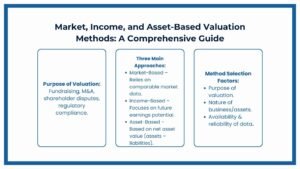
Business value is commonly calculated using three approaches: the income approach (Discounted Cash Flow), the market approach (comparable company multiples), and the asset-based approach (assets minus liabilities adjusted to fair value).
Q3. What is the company net worth formula?
The basic company net worth formula is Total Assets − Total Liabilities = Shareholders’ Equity. While useful, professional valuations often adjust assets and liabilities to fair market value and consider intangible assets.
Q4. Why are professional company valuation services important?
Independent valuation professionals provide objective and reliable business valuations for mergers and acquisitions, fundraising, financial reporting, tax planning, litigation, and strategic decision-making, helping ensure compliance and credibility.
Q5. Why is business valuation important in global markets?
Business valuation supports investment decisions, cross-border transactions, mergers, fundraising, and corporate governance by providing a consistent and transparent assessment of a company’s economic value.