How To Master EBITDA Company Valuation
Company Valuation Using EBITDA: How to Determine Business Value with EBITDA Multiples and the 10x Benchmark
Introduction on How To Master EBITDA Company Valuation
Value appraisal of a company is one of the core activities in corporate finance, mergers and acquisitions, private equity and strategic decision-making. Company valuation using EBITDA is one of the most popular and the most relied valuation strategies among the myriad of valuation strategies in various industries. The reason why it is popular is because it gives a relatively clean view of operating performance regardless of capital structure, the tax environment, and accounting policies.
To investors, corporate managers, and valuation analysts, it is important to know how company valuation on the basis of EBITDA works in practice in order to interpret transaction prices, negotiate transactions, as well as to measure enterprise value. The paper is a detailed and systematic framework to EBITDA-based valuation and the application of multiples, the situations in which a company value of 10 times EBITDA is appropriate, and the application of the approach in practice.
1. Understanding EBITDA as a Valuation Foundation
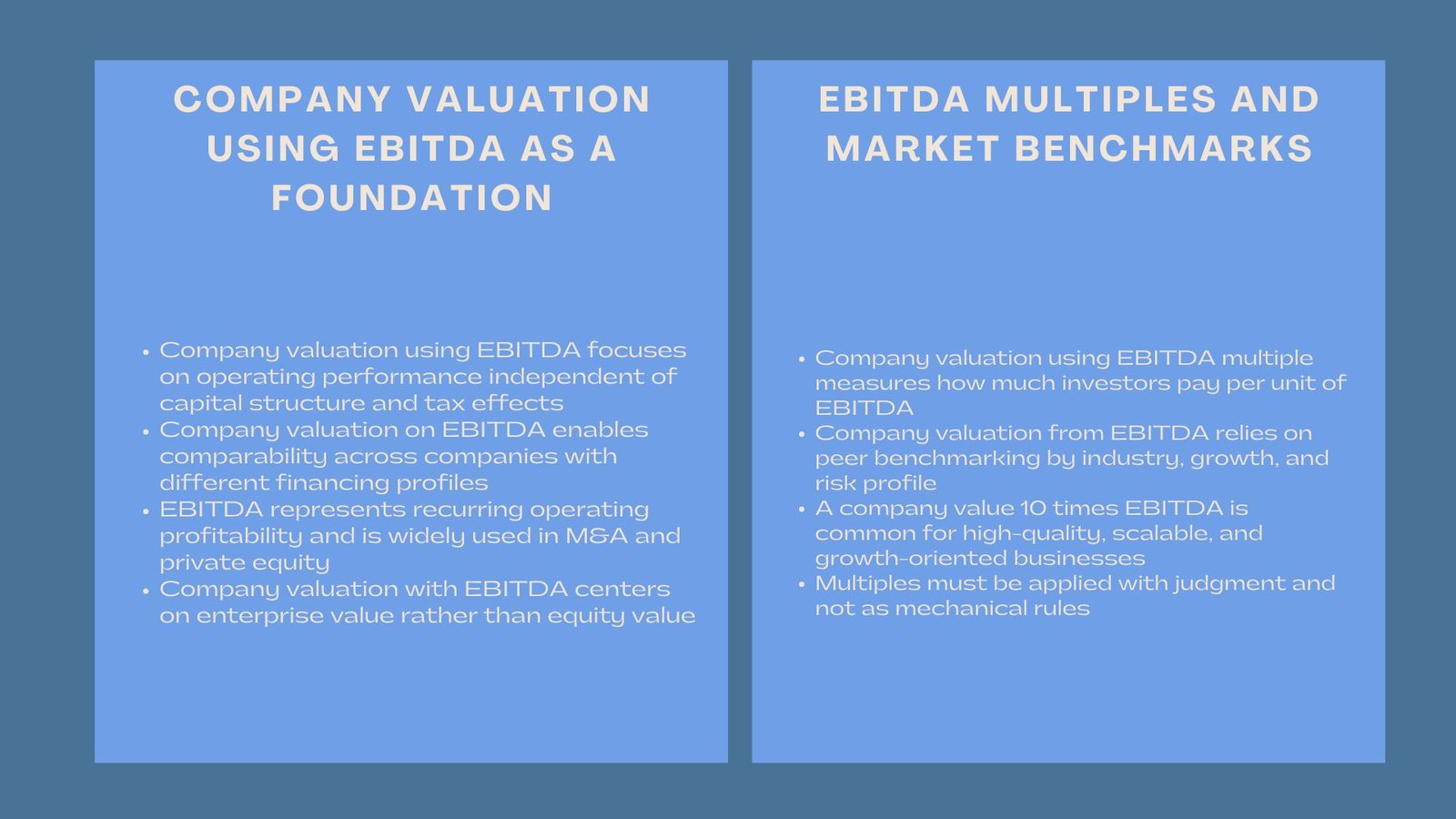
The reasons why EBITDA is so common and the meaning of the same in valuation are important to consider before implementing the use of multiples to valuate a company. Company valuation on EBITDA is based on its capacity to represent recurrent facility profitability prior to financing and accounting perversities.
1.1 What EBITDA Represents in Valuation
EBITDA is an acronym that means earnings before interest and taxes, depreciation, and amortisation. It is also commonly used as a proxy of operating cash flow in valuation, especially in mature businesses with unchanging capital expenditure needs. Whenever analysts do company valuation using EBITDA, they are addressing the earning potential of the business through the normal operations and not the financial makeup of the business.
Considering the example of two companies that operate in the same way, but have different sizes of debts, there may be vast differences in net profits shown by these companies. EBITDA cancels or neutralises this difference making the businesses comparable to investors on a more consistent basis.
1.2 Why EBITDA Is Preferred in Deal-Making
EBITDA commonly occurs in the case of mergers and acquisitions since buyers and sellers may be in varied tax and/or financing positions after the deal. Valuing the company valuation using ebitda can ensure both the parties talk about the value of the company in terms of operating performance as opposed to the capital structure of the deal. This renders EBITDA especially useful in the bargaining with the strategic buyers, the private equity and cross-border deals.
2. Company Valuation Using EBITDA Multiples
Multiples are the most widely used EBITDA in valuation. EBITDA multiple Company valuation compares the EBITDA of a company with the ones sold or traded in the market.
2.1 Concept of EBITDA Multiples
EBITDA multiple is a reflection of the amount that investors are willing to pay one unit of EBITDA. An example is that an enterprise with USD 80 million in enterprise value is a firm that produces USD 10 million of EBITDA and has a 8x multiple. This method is the foundation of company valuation from EBITDA in both the analysis of the market and the personal transactions.
Multiples are determined by aspects like growth opportunities, industry forces, competitive strategy and risk profile. Consequently, the right multiple application involves critical consideration and not calculative measures.
2.2 Selecting the Appropriate Multiple
The most important step in company valuation on EBITDA is the selection of multiple. The comparison benchmarking is usually carried out by the analysts on comparative companies in terms of the same industry, geography, and growth stage. The software companies that have recurring revenue models tend to trade on higher EBITDA multiples compared to the traditional manufacturing company because of the reasons of scalability and margin stability.
Practically, valuations professionals tend to use multiples to the point, typically using many multiples. This is an act of uncertainty and gives a more realistic range of valuation.
3. Practical Application: Company Valuation from EBITDA
Understanding theory alone is insufficient; valuation must be grounded in practical application. Company valuation from EBITDA is widely used in real-world deal analysis, investment screening, and strategic planning.
3.1 Adjusted EBITDA and Normalisation
Prior to using multiples, EBITDA may have to be adjusted to sustainable operating performance. Changes can be done in the form of eliminating one off expense, restructuring costs or non recurring income. These changes are necessary in order to make the valuation of companies based on EBITDA reflect underlying profitability.
As an example, a firm that is in a one-time restructuring can report low EBITDA. Normalisation of EBITDA prevents the underpricing of business due to short-term factors.
3.2 Enterprise Value Versus Equity Value
The valuation of EBITDA leads to the valuation of enterprise, rather than equity value. In order to come with equity value, net debt and other non-operating needs to be subtracted. Companies valuation with EBITDA also require professionals to draw clear distinctions between the two concepts in order to prevent result misinterpretation.
4. Interpreting the 10x EBITDA Benchmark
Company value 10 times EBITDA benchmark is one of the most common rules of thumbs in valuation. This rule is popular, but it has to be interpreted with caution.
4.1 When 10x EBITDA Is Reasonable
A 10 times EBITDA is common in a good quality business with good competitive advantage, steady cash flows and future growth. Such multiples are often found in technology firms, healthcare firms and consumer brands with defensible positions in the market.
A 10x multiple can also be an indicator of future increase in operations, leverage optimisation or potential future exit at a higher valuation in a private equity transaction.
4.2 Risks of Blindly Applying the Rule
The mispricing that may result may be caused by applying the company value 10 times EBITDA without context. Firms in cyclical industries, where there is regulatory uncertainty, or which are experiencing falling margins might warrant much lower multiples. The analysis of sound company valuation through EBITDA multiple analysis never takes heuristics alone but takes into consideration business fundamentals.
5. Industry-Specific Considerations in EBITDA Valuation
Success of company valuation using EBITDA is very much dependent on industry nature. Growth patterns and capital intensity of various sectors vary, as is the cost structure.
5.1 Asset-Light Versus Capital-Intensive Businesses
Asset-light companies like professional services or other software companies tend to convert EBITDA into cash in a more efficient way. This warrants premiums in company valuation on EBITDA. Conversely, a capital-intensive industry like utilities or manufacturing can need a major reinvestment so that the free cash flow is restricted even though EBITDA is high.
5.2 Impact of Growth and Scalability
The expectations of growth are poised in the central position of the company valuation based on EBITDA. An expanding company that is experiencing a growth in its margins might attract a high premium multiplier despite the existing low EBITDA levels. On the other hand, a business that is mature, and growth is flat can be traded at a low multiple even though it has stable earnings.
6. EBITDA Valuation in M&A and Private Equity
The EBITDA based valuation is entrenched in M&A and in private equity practice. It is used by buyers to determine the potential of value creation and by sellers to excuse asking prices.
6.1 Private Equity Perspective
The use of company valuation with EBITDA is crucial to the activities of the private equity firms owing to its compatibility with the leveraged buyouts models. Debt capacity is directly dependent on EBITDA because it is a very important input in structuring transactions and analysing returns.
An increase in the EBITDA multiple can be warranted when the investor anticipates that the earnings can be increased by operation enhancement or by acquisition.
6.2 Strategic Buyer Considerations
Strategic buyers tend to use EBITDA and synergy analysis when assessing the valuation of a company. Anticipated cost of revenue synergies may be implemented successfully to enhance EBITDA after the acquisition, which is able to substantiate a greater valuation multiples compared with those during individual transactions.
7. Limitations of Company Valuation Using EBITDA
Regardless of its popularity, the EBITDA as a method to value the company has certain limitations that experts are to be aware of.
7.1 Ignoring Capital Expenditure and Working Capital
EBITDA does not take into consideration capital expenditure or working capital changes. A firm that has the same EBITDA can have a cash flow profile that is completely different. The use of company valuation on EBITDA alone without the addition of any other analysis may thus result in misleading conclusions.
7.2 Sensitivity to Accounting Policies
Although EBITDA eliminates certain accounting variations it is not entirely immune to being manipulated. EBITDA may be inflated by aggressive revenue recognition, or capitalisation policies which influence the valuation of companies based on the results of EBITDA. Good due diligence will be required to confirm the quality of underlying earnings.
8. Integrating EBITDA Valuation with Other Methods
BEST practice valuation hardly depends on one approach. The most effective company valuation with EBITDA multiple is its combination with discounted cash flow, precedent transactions, and strategic analysis.
It is possible to triangulate value through various methods and create a more thorough understanding of what business is worth and address the limitations of any given methodology.
9. Conclusion: Using EBITDA Wisely in Company Valuation
When used carefully and stringently, EBITDA is still a potent and useful device of calculating the enterprise value. The comparison of operating performance across businesses and industries through company valuation using EBITDA gives an accurate perspective of the company performance. Its usefulness, however, lies in sound adjustments, multiple selection informed and sensitivity to the industry context.
Whenever using company valuation based on EBITDA when acquiring, raising capital or conducting strategic analysis, the professionals have to leave behind rules of thumb like a company worth 10 times EBITDA and base their analysis on the business basics. Combined with other complementary valuation techniques, company valuation using EBITDA remains one of the foundations of contemporary corporate finance and deal-making.
Frequently Asked Questions
Q1. What is EBITDA and why is it used in business valuation?
EBITDA (Earnings Before Interest, Taxes, Depreciation, and Amortization) measures a company’s operating performance before financing and accounting differences. It is widely used because it allows investors to compare businesses on a consistent basis.
Q2. How is a company valued using EBITDA?
A company is typically valued by multiplying its normalized EBITDA by an appropriate EBITDA multiple based on comparable companies, industry conditions, growth prospects, and risk profile. This produces the enterprise value, which can then be adjusted for debt and cash to determine equity value.
Q3. Is a 10× EBITDA valuation always appropriate?
No. A 10× EBITDA multiple may be suitable for businesses with strong growth, stable cash flows, and competitive advantages, but the appropriate multiple depends on factors such as industry, profitability, market conditions, and future growth potential.
Q4. What are the limitations of using EBITDA for valuation?
EBITDA does not account for capital expenditures, working capital requirements, debt levels, or cash flow differences. For this reason, it should be used alongside other valuation methods, such as Discounted Cash Flow (DCF) analysis and market comparisons.
Q5. Why do investors and private equity firms use EBITDA multiples?
EBITDA multiples provide a simple and widely accepted way to compare businesses, assess acquisition opportunities, evaluate enterprise value, and support mergers, acquisitions, fundraising, and investment decisions across different industries.