Advance Company Valuation for Listings
Company Valuation for IPO: Methods, Revenue Multiples, and Professional Valuation Report Standards
Introduction to Advance Company Valuation for Listings
One of the most complicated financial steps in the life of the company is the preparation of the company to an initial public offering. Of all the strategic, regulatory and financial factors, company valuation for IPO is the most reviewed and a key variable that impacts investor confidence, pricing success and long term performance in the market. An IPO valuation is a story, not a figure, and it has financial reasoning, justifiable assumptions, and evidence in the market.
The article is the narrow and deep discussion of IPO-oriented valuation and specifically focuses on the valuation methodology, revenue multiple analysis, and the format of professional valuation documentation. It combines effective knowledge that is reflective of what investors, regulators and underwriters would like to find within a sample of a company valuation report, and is clear enough so that the executives, finance teams and advisors required to prepare IPOs can understand.
1. Understanding Company Valuation for IPO
1.1 The Purpose of Valuation in an IPO Context
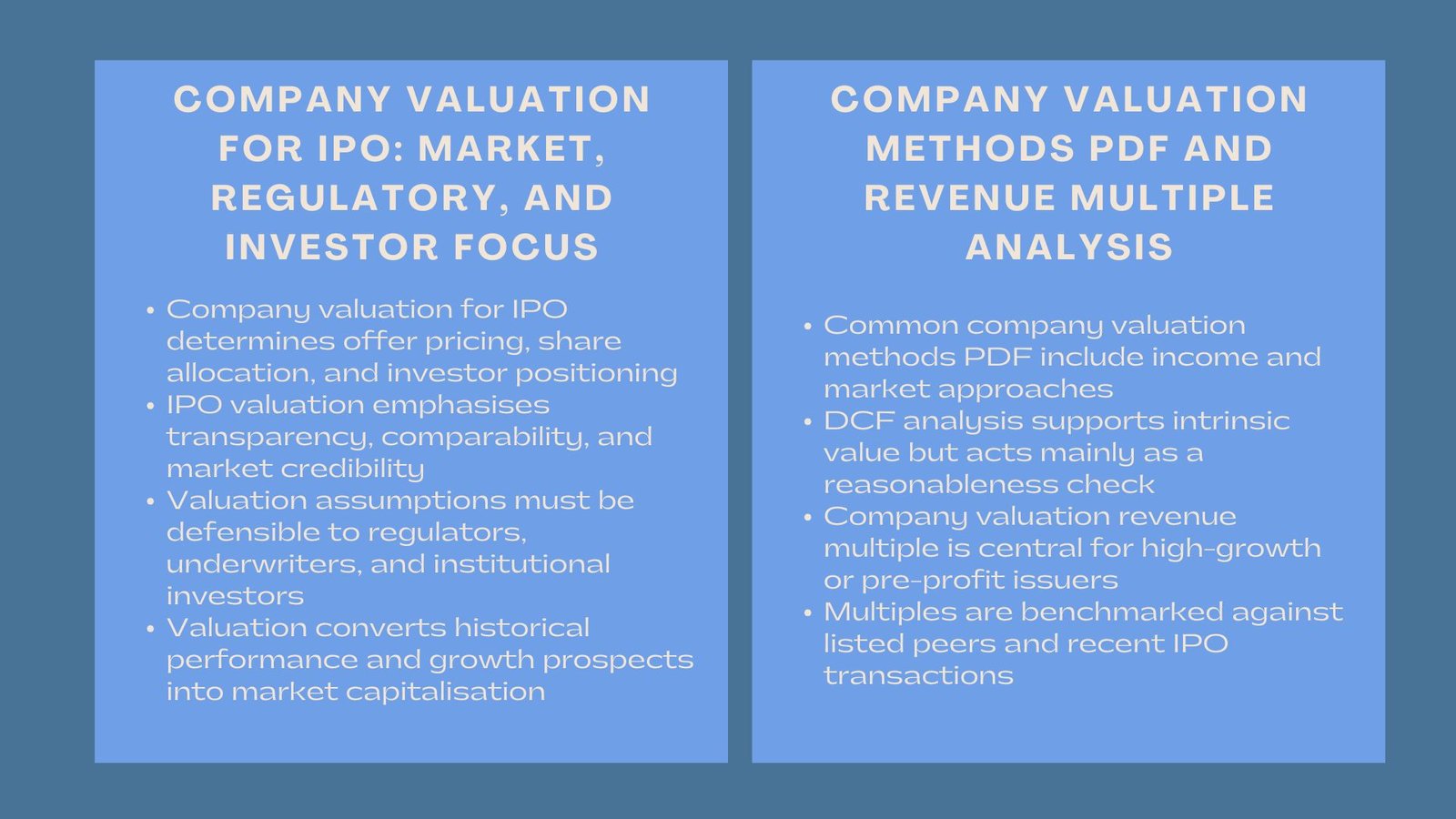
The valuation of companies in terms of IPO is fundamentally different as compared with internal or transactional valuations. Valuation is used in determining the offer price, the allocation of shares and the positioning of the investors in an IPO. It has to survive regulatory examination, analyst examination and the turmoil of the market.
The IPO valuation, as opposed to the private, focuses on transparency, consistency, and comparability by the market. Valuation should also provide a clear path to how historical performance, growth opportunities as well as risks are converted into valid market capitalization. This in reality translates to using valuation logic in alignment with publicly observable standards as opposed to purely theoretical assumptions.
1.2 Regulatory and Market Expectations
Regulators in most capital markets do not dictate a particular valuation technique, but they ask that the valuation assumptions should be sensible, defensible, and uniformly used. Aggressive projections will be questioned by underwriters and institutional investors in case it is not in line with peer performance. Consequently, IPO valuation of companies should be based on approaches that are acceptable and comprehensible in the market.
2. Company Valuation Methods Applied in IPOs
2.1 Overview of Accepted Valuation Approaches
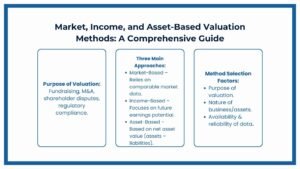
The most widely accepted company valuation methods PDF employed in IPO engagements are the income approach, market approach and in rare instances, the asset-based approaches. Nevertheless, market-oriented methods are usually very important in the estimation of IPO valuations because the public investors are more interested in comparability and price-adjusted liquidity.
Although financial advisors can individually examine many different valuation points of view, the ultimate discussion of IPO pricing often focuses on a limited number of justifiable approaches that are consistent with the overall market mood.
2.2 Income-Based Valuation in IPO Preparation
The discounted cash flow analysis is one such pillar of reference point of valuation of a company in the IPO readiness preparedness. It assists in the valuation of intrinsic value considering the anticipated cash flows and discount rates which are risk adjusted. But in IPOs, the outcomes of DCF are not utilized individually. Rather, they can be viewed as a reasonableness test of market-based results.
In the case of a high growth rate enterprise, particularly in the fields of technology or healthcare, DCF assumptions tend to be low, because long term projections are not well received by public investors.
3. Company Valuation Revenue Multiple Analysis
3.1 Why Revenue Multiples Dominate IPO Pricing
One of the most impactful tools in IPO valuation is a company valuation revenue multiple analysis especially when it comes to companies that have not yet become stable in regard to their profitability. Revenue multiples enable investors to rank issuers in comparable industries, development and geographic markets.
Practicing underwriters examine similar listed companies and recent IPOs to come up with a fair range of revenue multiple. This limit is then adjusted on the basis of the growth rates, margins, concentration of customers and scalability.
3.2 Applying Revenue Multiples in Real IPO Scenarios
A technology firm that is about to go public will find that similar listed companies that are already listed will trade five to eight times revenue. In case the issuer can prove outstanding growth and protectable intellectual property a significantly higher company valuation revenue multiple can be considered justified. On the other hand, a discount may be appropriate with operational risks or market concentration.
The revenue multiple analysis is particularly strong as the results of the valuation are correlated with the way the companies are actually priced in the public market, which adds to the credibility in the course of roadshows and meetings with investors.
4. Structure of a Company Valuation Report Sample PDF
4.1 Purpose and Audience of the Valuation Report
A well prepared sample of a company valuation report in the form of a PDF document will have varied audiences such as underwriters, regulators, auditors, and internal stakeholders. The main purpose of it is to record the rationale of the valuation, the assumptions, methodologies, and conclusions in a transparent and auditable format.
As compared to internal management analyses, the IPO valuation reports should be formal, structured and defendable by external scrutiny.
4.2 Key Components of an IPO Valuation Report
A typical sample of a company valuation report in the form of a PDF starts with an executive summary, which summarizes the valuation findings and critical assumptions. This is preceded by business overview, industry analysis, financial performance and valuation methodology. All the valuation methodologies are described with detail of the inputs, assumptions, and sensitivity.
Reconciliation of the various valuation methods as well as reasons as to why some of the methods have been weighted more is also reported. This story is essential in showing professional judgment as opposed to mechanical calculation.
5. Using Company Valuation Methods PDF for IPO Readiness
5.1 Internal Alignment Before External Review
Prior to going to underwriters or regulators, companies usually draw internal company valuation methods PDF documents in order to make the management expectations in line with the market reality. The documents assist boards to learn about valuation drivers, dilution and pricing trade-offs.
Early internal valuation activities also enable companies to discover poor financial reporting forecast processes, or strategic positioning which may adversely impact IPO valuation.
5.2 Bridging Internal Valuation and IPO Pricing
Among the most widespread issues in valuing companies to be listed in IPO is tracking the discrepancy between internal expectations of valuation and market-driven pricing results. Professional valuation reporting assists in facilitating this transition by grounding the discussion on data, comparables and standard approaches.
6. Common Challenges in IPO Valuation
6.1 Managing Growth Expectations
Growing businesses find it hard to balance between hope and reality. Exaggerated estimations will destroy confidence, and assumptions that are too conservative will hold down valuation. Capable company valuation revenue multiple analysis will assist in the moderation of these extremes by making reference to observable market behavior.
6.2 Consistency Across Documents
Different assumptions in various prospectuses, valuation reports, and financial models will be a red flag during due diligence. An ample company valuation report sample PDF can be used to coordinate all IPO paperwork.
7. Strategic Implications of Company Valuation for IPO
7.1 Impact on Long-Term Market Performance
IPO valuation is not solely limited to maximization of initial pricing. IPO underpricing turns into an overprinflated performance in the post-listing phase which tarnishes reputation and investor relations. Strict company valuation approach in IPO favors sustainable aftermarket performance and capital market access in the long run.
7.2 Valuation as a Communication Tool
In addition to pricing, valuation conveys the strategy of the company, growth narrative and risk profile. Proper expression of valuation logic through accepted company valuation techniques is a stronger investor knowledge and confidence enhancing method.
Conclusion
Overall, IPO valuation in companies is a complex endeavor, which integrates financial soundness, market knowledge and experience. It is necessary to use the established methods of company valuation as a recognized company valuation methods pdf, and a disciplined company valuation revenue multiple analysis along with the well-structured company valuation report sample pdf documentation in order to obtain the credible and successful IPO outcome.
Firms which plan IPO valuation not opportunistically but strategically are in a better position to achieve the regulatory expectations, attract quality investors as well as be able to create long-term values in the public markets.