IFRS-Compliant Company Valuation Requirements in Singapore: A Practical Guide
Introduction to Company Valuation Requirements in Singapore
Value of IFRS Compliance in Valuation
The quality of company valuation is not a technical whim in Singapore in the advanced and internationally networked financial reporting condition, but rather a regulatory and business necessity. The IFRS standards of company valuation regulate the measurement, reporting, and disclosure of fair value of all the assets, liabilities, and business combinations of the company on all the cycles of financial reporting. These standards are supported by the audit process, which are scrutinised by regulators and are becoming more and more assessed by investors and lenders as a relative measure of the quality of management and financial governance.
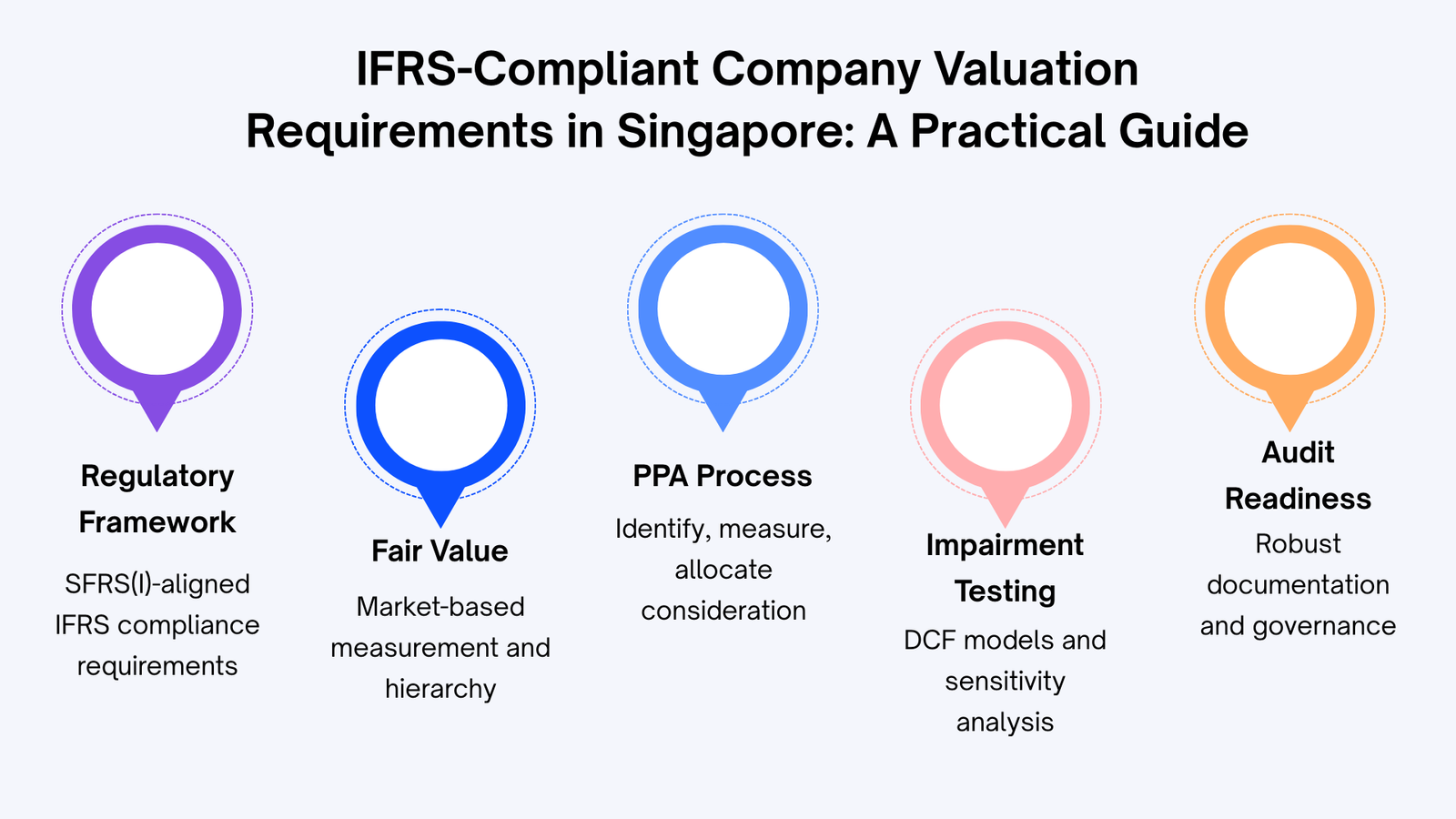
the International Financial Reporting Standards, which are embraced in Singapore under the Singapore Financial Reporting Standards (International) SFRS(I) is a vast array of standards, which go way beyond mere asset measurement. The IFRS company valuation requirements apply to listed companies, the public interest entities and the MNEs operating in Singapore to recognize and measure the acquired intangible assets, the determination of impairment charges, goodwill and impairment charges, measurement of lease liabilities and disclosure of fair value of financial instruments. All these measuring exercises have an influence on reported earnings, balance sheet strength, and adherence to debt covenants and regulatory capital requirements.
In the case of finance professionals, board directors, and business owners that have to operate in the reporting environment of Singapore, it is not optional to understand the requirements that Singapore has put up in valuing the company as provided under IFRS. The financial results of non-compliance, namely, qualified audit opinions, financial statement restatement, Accounting and Corporate Regulatory Authority (ACRA) regulation inquiry, reputation loss, are substantial and can be prevented with due preparation.
Singapore Regulatory Environment
Singapore has a financial reporting system that is based on SFRS(I) that is substantively similar to IFRS published by the International Accounting Standards Board (IASB). The Singapore Exchange (SGX) requires listed companies and other large entities with a lot of public interest to use SFRS(I). The Singapore Financial Reporting Standards (SFRS) may be used by smaller, privately-owned firms and is mostly similar to SFRS(I) with few simplifications.
In the case of regional organizations that have subsidiaries or operations in Indonesia, Pernyataan Standar Akuntansi Keuangan (PSAK) is the country-level accounting standards in Indonesia which are highly converged with IFRS, which generates alignment in cross-border reporting. The practitioners should, however, be watchful of divergences in particular areas, especially those of depreciation methods, revaluation policies, and treatment of some financial instruments, where PSAK and SFRS(I) may differ in specifics.
The financial reporting quality regulatory environment in Singapore consists of ACRA (conducting the Practice Monitoring Programme and audit quality review), SGX Regulation (reviewing listed company disclosures and potentially issuing query letters on valuation-related issues) and the Monetary Authority of Singapore (MAS), which regulates financial institutions and their prudential reporting standards. This collection of bodies will create a multi-layered accountability mechanism, which will compensate diligent, written valuation and penalize short-cuts.
The importance of Valuation in IFRS Reporting
Financial Statements Impact
Financial reporting quality has far-reaching and long-term impact on financial statement of a company. As compared to operational choices, which only impact one reporting period, valuation choices that occur at the time of an acquisition, asset revaluation or impairment test impact a series of years of financial statements, reported earnings per share, returns on assets, adherence to debt covenants, and management compensation measures, which relate to financial performance.
There are three areas that are valuation-intensive, and their effects on financial statements are exceptionally notable. The IFRS 3 acquisition accounting approach would dictate the assigning of the purchase price of an acquisition to tangible and intangible assets and goodwill – a move that predetermines the amortisation expenses to be charged in the years following the acquisition. Under IAS 36, impairment testing identifies recoverability of goodwill and long-lived assets and gives rise to potentially significant one time charges when recoverable amounts are below carrying values. The fair value of financial instruments, investment property and biological assets under the IFRS 13 directly influences the value of these assets that are reported in the face of every balance sheet.
In the case of Singapore companies, the valuation decisions translate to more significant effects on the financial statements because listed companies are required to prepare quarterly reports, and the IFRS 13 and IFRS 3 have made the detailed disclosure obligations. The scrutiny investors and analysts give fair value disclosures, goodwill allocation notes, and impairment test assumption is growing more sophisticated in nature: as a result the quality of company valuation requirements Singapore compliance directly impacts market perception and share price.
Association with Business Combinations, Impairments and Disclosures
Business combinations, impairment testing, and fair value disclosures – The three major causes of complexity in valuation in Singapore corporate reporting are:
Business combinations (IFRS 3): All acquisitions result in a Purchase Price Allocation (PPA) exercise during which the total consideration paid should be allocated to all identifiable assets and liabilities at fair value at the date of acquisition. This practice, which is explained in great detail in Section 7, is the most technically challenging thing occurring in corporate reporting, involving the identification and measure of the intangibles that may never have been reflected on the balance sheet of the acquiree.
Impairment testing (IAS 36): Indefinite-life intangible assets that are treated as goodwill should be impaired at most at least once per year. Assets whose useful lives are finite have to be tested at any time when there are indicators of impairment. In impairment testing, the amount of recoverable using discounted cash flow models that are highly subject to judgement needs to be the higher between fair value less disposal costs and value in use.
Disclosures about fair value (IFRS 13): The companies that have financial instruments, investment property and other assets and liabilities that have to be measured at fair value need to disclose in detail the method of measurement of fair value and the degree of the fair value hierarchy where such measurements are made, and the major assumptions of Level 3 measurements.
Standards of IFRS that are applicable in valuation
IFRS 13 — Fair Value Measurement
Under the international reporting framework, the fair value measurement IFRS is based on IFRS 13. It provides a unified, unique meaning of fair value and a unified model of measurement and disclosure in all standards using the IFRS which either requires fair value measurement or permits it. The standard identifies fair value as the amount that would be obtained to sell an asset or given to transfer a liability in a market orderly transaction between market participants on the date of measurement – an exit price concept that is not entity-specific.
Under the IFRS 13 framework, the companies should ensure that they maximise on observable inputs or minimise on unobservable inputs. It defines the three-level fair value hierarchy, i.e. inputs of Level 1 (quoted in active markets), Level 2 (observable but not quoted), or Level 3 (unobservable) that are the source of measurement rigour and disclosure rules. In the case of Singapore companies, most of the complex fair value measurements, such as intangible assets, probing the impairment of goodwill, and the unlisted equity interests, are at Level 3, the largest documentation and disclosure.
The most important IFRS 13 requirements that have a practical bearing on Singapore reporters are: the highest and best use requirement; the requirement to use the highest and best market as the reference market; the need to take into account market participant assumptions but not entity specific plans; and the need to disclose the valuation techniques and inputs which were used associated with each class of asset or liability measured at fair value.
IFRS 3 Business Combinations and PPA
The IFRS 3 regulates the accounting of business combinations, which is a transaction where one organization gains control over another. Its requirements are not only technically challenging but also financially implicative, so IFRS-wise, it is one of the most valuation-consequential standards. The standard requires the method of acquisition where the acquirer is supposed to recognise and estimate all identifiable assets that are acquired and liabilities assumed at fair values of the acquisition-date.
Of particular importance are the IFRS 3 requirements of intangible assets recognition. The standard has the acquirer to identify intangible assets separately of goodwill where they satisfy either the contractual-legal criterion or the separability criterion- even by the purchasee that never recognised the intangible assets on its own balance sheet. This implies that the customer relationship, brand equity, proprietary technology and favourable contracts obtained internally by the acquirer should be located, measured IFRS fair value measurement and recognised as separate assets in the consolidated financial statements of the acquirer.
The measurement period of IFRS 3 (that lasts up to 12 months since the date of acquisition) provides the opportunity to fairly resolve provisional fair values in the case of the discovery of additional information. Any corrections to be made after the measurement period can only be reported in accordance with the error correction provisions of IAS 8. This urgency implies that companies have to initiate their PPA exercise immediately they close their deals, and in most cases, integration processes are also keeping the management busy.
IAS 36 — Impairment Testing
IAS 36 Impairment of Assets places on companies the obligation of ensuring that they do not carry their assets at a greater amount than they can recover. The goodwill that has been obtained in a business combination shall be impaired at least once in a year; the rest of the assets shall be impaired once signs of impairment are detected. The standard is specifically applicable to the Singapore firms which have high balances of goodwill which have been caused by historical acquisitions – a typical characteristic of the balance sheets of the acquirers that have been active in the Asian acquiring intensive industries.
A fair value measurement IFRS exercise in its turn is impairment testing under IAS 36: the amount of a cash-generating unit (CGU) that should be recovered is the fair value of the cash-generating unit less expenditures on the unit (a market-participant fair value estimate is required), or the recoverable amount of the cash-generating unit value in use (a discounted cash flow model should be estimated using entity-specific cash flow estimates). A major basis of assumptions which have motivated these models (Revenue growth rates, operating margins, discount rates, and terminal values) is highly liable to management judgement and would need strong documentation and sensitivity analysis.
Implications of IFRS 16 — Lease Valuation
Under IFRS 16 Leases, most of the leases will be recognised as right-of use (ROU) assets and lease liabilities to eliminate the operating and finance lease distinction and adopt one lessee accounting model. Although IFRS 16 is not a fair value measurement standard but a recognition standard, it has significant valuation implications on the valuation requirements of companies in Singapore in various situations.
Assessing lease liabilities which have been already assumed by the acquiree in business combinations should be at the present value of the remaining lease payments with the incremental borrowing rate of the acquiree at the acquisition date – a fair value measurement exercise which can have a significant impact on net asset values in business which are rich in assets or in retail business. ROU assets are used in CGU carrying amounts in impairment testing and must also be factored in the recoverable amount assessment. And in standalone company valuations of M&A, lending or reporting, IFRS 16 lease liabilities are included in the net debt bridge, which reconciles enterprise value to equity value.
Under IFRS, the major valuation requirements include the following
Market Participant Assumptions
Among the most significant, and most commonly used, principles of fair value measurement in IFRS is the obligation to use assumptions by the participants of the market to measure fair values rather than entity-specific plans or expectations. Under IFRS 13, fair value is the price that would be obtained in a hypothetical orderly transaction by market participants not the price to a particular acquirer who forecasts certain synergies realised, nor the price in case a liquidation, nor the historical cost at which the asset was originally originated.
Practically, this principle generates a continuous tension in PPA purchases: an acquirer that paid a premium based upon the anticipated post-acquisition synergies will still be required to measure recognized intangible assets at their fair market-participant values, but not the acquirer-specific synergies. The synergy premium the amount in excess of the fair value of the identifiable net assets of the company, excluding synergy intangible valuations, is recognised as goodwill.
Market participant assumption also stipulates that the revenue and cash flow prediction contained in the income-based fair value model will reflect what a typical participant in the market would forecast, given the available information about the asset and the entity, and not what the management think they have the unique capacity to extract. To Singapore firms, this usually involves citing growth rates in the industries, visible levels in margins and sector-based discount rates as opposed to using in-house estimates.
Highest and Best Use Concept
In the case of the non-financial assets, IFRS 13 stipulates that fair value should be based on the highest and best use (HBU) of the asset – the use which would ensure that the value of the asset or the group of assets and liabilities to which the asset is used are maximised. The HBU concept would call upon companies to ask themselves whether such current use of an asset is its highest and best use, or whether some other use of the asset could create more value to market participants, e.g. redeveloping a property, converting manufacturing equipment to a different production process or licensing of technology instead of deploying it internally.
HBU assessment is most effective in the case of real estate and property assets, as the difference in value of existing use and the value of alternative use (residential or commercial redevelopment) may be significant. The HBU analysis has the potential to significantly impact the fair value of investment property and property owned by operating businesses in the Singapore high-end real estate landscape, and has direct impacts on balance sheet values and IFRS 16 right-of-use asset determination.
Principle-Based Measurement
The IFRS is not a rule-based approach but a principle based approach, implying that financial reporting valuation under IFRS must be based on professional judgment as opposed to the application of set rules. The approach(s) companies adopt is that they are supposed to choose the most applicable valuation method or combination of methods that best fits their situation to use observable relevant inputs to the maximum, and use them uniformly.
There are strengths and weaknesses of Singapore reporters concerning this principle-based approach. The flexibility to choose the right methodologies allows companies to generate economically meaningful measurements compared to a prescriptive rule-based system that will not allow. It can also imply that the quality of valuation is very reliant on the judgement and expertise and independence of the concerned professionals – and that auditors need to consider not only whether the correct number has been produced, but whether the correct process, methodology and assumptions have been followed.
Fair Value Hierarchy and Valuation Inputs
Level 1, Level 2, and Level 3 Inputs
The fair value measurement inputs of IFRS 13 have a three-level hierarchy of fair value measurement, which is ranked according to observability and reliability:
| Level | Input Type | Examples | Disclosure Requirement |
| Level 1 | Quoted prices in active markets for identical assets or liabilities | Listed equity securities; exchange-traded derivatives; active commodity markets | Minimal — price is observable and objective |
| Level 2 | Observable inputs other than Level 1 quoted prices | Comparable company multiples; observable royalty rates; interest rate curves; quoted prices for similar (not identical) assets | Moderate — techniques and key observable inputs must be disclosed |
| Level 3 | Unobservable inputs reflecting management assumptions calibrated to market participant expectations | DCF revenue projections; intangible asset attrition rates; entity-specific discount rates; private company valuations | Extensive — techniques, inputs, sensitivity analysis, and reconciliation of opening to closing balances required |
The hierarchy does not dictate the level of inputs they must utilize – instead it demands that firms utilise all observable (Level 1 and Level 2) inputs maximally and ensure that they do not utilise any unobservable (Level 3) inputs. The most onerous disclosure requirements are found at Level 3 where there are quantitative statements of the unobservable inputs and sensitivity analysis of how the fair value of the inputs would be, had the inputs been different.
Pay attention to Unobservable Singaporean Situation
Level 3 inputs are inevitable, especially when most of the Singapore firms are involved in complex fair value measurement IFRS exercises, especially to intangible assets, private equity interest, and goodwill impairment measurements. The assets in question are unique, they have no active markets on the similar or near similar assets, and the measurement has to depend considerably on the own judgment of the management on the future cash flows, discount rates, and market conditions.
The following are some of the Level 3 input areas that are problematic in the context of Singapore. The discount rates on the intangible assets will involve the creation of asset-specific cost of capital estimates including the Singapore risk-free rate, equity risk premiums of the applicable sector, size premiums of small size assets, and the asset-specific risk premiums. The rates of revenue growth should be based on the macroeconomic conditions and the specifics of the industry in Singapore instead of world standards that can be irrelevant to local specifics. Customer attrition rates of intangibles related to relationships need to be calculated using internal history of the acquirer, which is in turn backed by Singapore benchmarks or regional industry benchmarks where the internal data is lacking.
The additional level of complexity is created by the IFRS 13 related requirement to calibrate unobservable inputs to market participant assumptions which are not entity-specific views. A Singapore acquirer that forecasts super-market growth in an acquired business must be ready to justify why a market participant will share the same forecast rather than why he or she thinks the acquirer itself can perform above the market. Auditors normally investigate this distinction when they are reviewing financial reporting valuation exercises.
Valuation Methodologies in Action
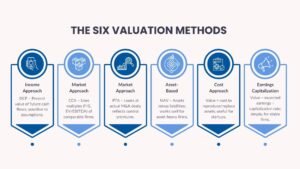
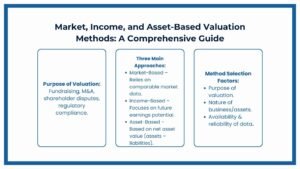
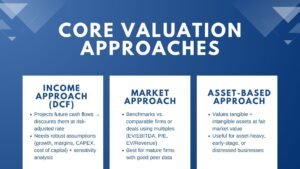
The IFRS company valuation practice applies three major valuation approaches and each has a different level of application depending on the asset, purpose of the measurement, and availability of market data.
Market Approach
The market approach measures fair value based on prices that are recorded in real-life transactions of similar assets. In the case of equity valuation, this comprises of similar company trading multiples (EV/EBITDA, EV/Revenue, P/E) of the peers of listed companies and similar transaction multiples of observed M&A transactions in the same industry. In the case of intangible assets, royalty rates that have been market-generated out of licensing databases form the basis of relief-from-royalty valuations.
The market approach is most effectively used in the financial reporting valuation practice in Singapore when: the subject entity or asset being valued has actual listed peer or transaction comparators the market data available is current and relevant enough to be representative; and that any differences between the subject and the comparators (in size, growth profile, leverage and risk) can be satisfactorily adjust.
The major difficulty in implementing the market approach to the Singapore private company and intangible assets value is the availability of data. The smaller market of the private transaction in Singapore implies that the market can need to source out to the ASEAN regional or international data, with country-specific differences being produced on the basis of the deal multiples. Practitioners should record in a clear way how comparables were chosen, why they are deemed as representative and what they have done to them.
Income Approach (DCF)
The most commonly used fair value measurement IFRS methodology of business valuation, intangible asset valuation and impairment testing in Singapore is the income approach and the discounted cash flow (DCF) method. The method calculates fair value using projections of future cash flows that can be qualified to the subject entity or asset and discounting the cash flows to the present value at a risk-adjusted discount rate.
In its implementation, the income approach under IFRS 13 should take into consideration a number of key discipline requirements. The assumptions about the cash flows in the market participants need to be reflected in the cash flows projections and not the synergies that are unique to an entity and optimism of the management. The discount rate should be similar to the risk profile of projected cash flows, nominal, pre-tax or post-tax rate, based on whether cash flows are projected on a nominal or real basis, and pre-tax or post-tax basis. The terminal value – the capitalised value of the cash flows beyond the explicit forecast period – should represent a sustainable steady-state growth rate, rather than the short-term growth curve of the high growth business.
The major inputs to the DCF in relation to Singapore IFRS company valuation exercises would be: the Singapore Government Securities (SGS) yield, as the risk-free rate base; the Singapore country equity risk premium estimates given by Damodaran, as the starting point of the cost of equity; industry-specific beta estimates, taken out of the listed peer analysis; and Singapore-specific growth forecasts, provided by the Ministry of Trade and Industry (MTI) and industry research reports. The resulting inputs of the Weighted Average Cost of Capital (WACC) should be balanced against actual market results and sensitivity-tested using sensitivity analysis.
Cost Approach
Cost approach determines fair value by considering the cost to reproduce or replace an asset, depreciation and obsolescence. The cost approach is most useful to assets where market and income approaches provide inadequate information – especially those of specialised plant and equipment, custom-built technology platforms and assembled work forces (as a contributory asset in PPA exercises).
Two types of cost are used: reproduction cost (the cost to reproduce an exact replica of the asset), and replacement cost (the cost to substitute the asset with a functionally equivalent substitute, and to allow technological and functional obsolescence). In the case of technology assets, replacement cost method is a more suitable method, since it is a measure of the cost of the similar functionality with the current technology as compared to cost of re-creating obsolete architecture.
Application Examples
Possible methodology: This depends on the asset type and situation:
| Asset / Measurement Context | Primary Approach | Secondary / Corroborative Approach |
| Listed equity investment | Market (quoted price — Level 1) | N/A — Level 1 input is definitive |
| Unlisted equity investment | Income (DCF) | Market (comparable company multiples) |
| Customer relationships (PPA) | Income (MEEM) | Market (comparable customer list multiples) |
| Brand / trade name (PPA) | Income (Relief-from-Royalty) | Market (royalty rate benchmarking) |
| Proprietary technology (PPA) | Income (Relief-from-Royalty / MEEM) | Cost (replacement cost) |
| Investment property | Market (comparable sales / capitalisation rate) | Income (DCF — discounted rent roll) |
| Goodwill impairment (IAS 36) | Income (DCF value in use) | Market (fair value less costs of disposal) |
| Specialised equipment | Cost (replacement cost new less depreciation) | Market (comparable equipment sales) |
Business Combinations (IFRS 3): valuation
Determining Assets and Liabilities
The initial and most essential process in a IFRS 3 Purchase Price Allocation is the full identification of all the assets obtained and liabilities incurred. This exercise does far exceed the balance sheet of the acquiree: IFRS 3 mandates the recognition of intangible assets that qualify as identifiable, such as assets that the acquiree internally generated and hence never under IAS 38, and recognition of contingent liabilities that are present obligations at the acquisition date.
In a PPA, assets identification is that of tangible assets (property, plant, equipment, inventories, receivables), financial assets (investments, derivatives), identifiable intangible assets (brands, customer relationships, technology, contracts, licences), assumed liabilities (debt, deferred revenue, contingent liabilities, lease obligations of IFRS 16). Under fair value measurement IFRS principles, every identified asset and liability has to be quantified at its fair value at their date of acquisition.
The most technical part of the exercise is intangible asset identification. The practitioners have to evaluate each possible intangible under the contractual-legal and separability criterion, relying on the experience of the business model, position and sources of the revenue of the acquiree. Customer relationship (financial services, B2B technology, professional services), brand equity (consumer, retail, F&B), technology platforms (fintech, healthtech, SaaS), regulatory licences (MAS-issued CMS and FA licences), non-competition agreements by selling founders or managers are common PPA intangibles in Singapore.
The Basics of Purchase Price Allocation
Under IFRS 3, PPA process follows a four-step sequential process:
Calculate the total consideration transferred: Cash paid at closing, fair value of the equity instruments issued, evaluation of the contingent consideration at the fair value as of the acquisition date and any equity interests held earlier but is determined at fair value (In case of step acquisitions). Transactions are not allowed to accrue, and they are treated straight off.
Measure all identifiable assets and liabilities: Each of the identified assets and liabilities is measured using the methodologies of Section 6 at fair value at the date of acquisition. The step delivers the overall financial reporting valuation analysis upon which the whole PPA is based.
Computation of goodwill or bargain purchase gain: The goodwill is the total consideration plus non-controlling interest (quantity of interest charged at fair value or proportionate share of net assets) less the fair value of identifiable net assets. In case of a negative, a gain on bargain purchase shall be recorded in profit or loss, and all the identified assets and liabilities shall be reassessed on a mandatory basis.
Prepare a complete PPA reporting: Preparation of a report on all identifications, valuations, and allocation with a comprehensive merchandise of all identifications, valuations and allocations, and disclose the same in the first set of consolidated financial reports after the acquisition.
General Reporting and Audit Issues
Documentation Expectations
In IFRS company valuation reviews the most frequent source of audit friction is poor documentation. The auditors must only examine the extent to which the valuation conclusion was reasonable but assess the methodology used, the justifiable assumptions and the independence and rigor of the process are adequate. All these assessments must be documented – and that which has been compiled post hoc, under audit pressure, is less credible than documentation which has been prepared as and when it was made as part of the valuation process.
A defensible financial reporting valuation documentation package of either a PPA or impairment test must consist of: written valuation report: scope of coverage, selection of methodology reasons, and key conclusions; detailed financial models with clearly marked-up inputs, formulae, and outputs; documentation of source of all key assumptions (management projections, industry research, royalty rate database exports, WACC derivation); sensitivity analysis tables; a WARA reconciliation (in PPA exercise); and the engagement letter and credentials of any independent valuation specialist involved.
The use of independent, qualified valuers is also paramount to material company valuation requirements Singapore is involved in. The report of an independent expert sorts of Chartered Valuer and Appraiser (CVA), CFA charterholder or RIC member is inherently credible where a valuation undertaken by management is not. In the case of listed companies and entities of public interest, it is more likely that the use of an independent specialist is a condition of fair value measurements with significant fair value that can be signed by a clean audit.
Auditor Scrutiny Areas
The audit environment in Singapore is characterized by a number of spheres of IFRS company valuation being subject to a higher level of audit scrutiny:
Completeness of intangible assets: Auditors evaluate the completeness of all identifiable intangibles that were reflected in the PPA. The most frequent occurrence is that intangibles have either been combined with goodwill without proper identification analysis especially that of customer relationships, brand names and favourable contracts in service and consumer firms.
Derivation of discount rates: WACC and asset specific discount rates applied to income-based appraisals is a conventional battlefield. The valuation experts of the auditors themselves consistently conduct independent WACC estimates and compare them with those of the management. Unaccounted variances – especially discount rates that seem unrealistically low, overstated asset values will raise audit questions.
Revenue projection support: According to IFRS 13 and IFRS 3, the revenue projections should reflect the assumptions of the market participants. Auditors compare the PPA forecasts of the acquiree and the actual performance of the acquiree in the past, the forecasts made in the process of due diligence of a deal and actual performance during the period of acquisition. Divergences on material need to be explained.
Goodwill impairment test rigour: In companies with high balances of goodwill, auditors need comprehensive support of the key assumptions in value-in-use models, especially long-term growth rates and discount rates. Sensitivity analysis defining the amount of headroom before impairment would be instigated is a common audit report.
Level 3 completeness of input disclosure: In the case of assets and liabilities where the measurements rely on Level 3 inputs, IFRS 13 mandates the quantitative disclosure of the important unobservable inputs and sensitivity analysis. The auditors examine completeness, accuracy and consistency of the disclosures in relation to the valuations it records.
Realizing Pragmatic Measures to IFRS-Compliant Valuation
Pre-Engagement Checklist
The following checklist should be used before embarking on a major IFRS company valuation exercise such as PPA, impairment test, and fair value disclosure, to ensure that the process is established on sound grounds:
| Step | Action | Responsible Party |
| 1 | Define the valuation purpose and applicable IFRS standard(s) | CFO / Finance team |
| 2 | Identify the assets and liabilities requiring fair value measurement | Finance team + legal counsel |
| 3 | Engage an independent, credentialed valuation specialist for material items | CFO / Audit committee |
| 4 | Agree valuation approach and methodology with auditors in advance of fieldwork | Valuation specialist + auditor |
| 5 | Compile information package: financial projections, contracts, IP documentation, market data | Finance team + management |
| 6 | Prepare valuation models with clearly documented assumptions and sources | Valuation specialist |
| 7 | Perform WARA reconciliation (for PPA) and sensitivity analysis for all material inputs | Valuation specialist |
| 8 | Prepare written valuation report with full documentation and conclusions | Valuation specialist |
| 9 | Present report to auditors and respond to queries; update for any agreed revisions | Valuation specialist + CFO |
| 10 | Prepare IFRS 3 / IFRS 13 disclosure notes consistent with valuation report | Finance team + auditor |
Cooperation with Auditors and Valuation Experts
The most successful company valuation requirements Singapore applies are based on the early and open cooperation of three parties that include the finance team of the company, independent valuation specialist and its auditor. Having auditors involved in pre-valuation discussions, which is not after the valuation report is prepared but before, can enable the agreement of methodology and assumption frameworks which can minimize the risk of late-stage audit issues to the completion of the financial statements.
The time of this partnership is especially crucial in the case of PPA exercises. Preferably, the specialist of the company and the auditing firm should communicate at the initial point of the measurement period, exchange early methodological opinion and come to an agreement of the extent of the intangible identification exercise, so that the end PPA report will not reflect a one-sided management decision that the auditor must make and prove anew.
The companies should also have a distinct escalation route on valuation differences between the management and the auditors. In situations where the management and the specialist of the auditor have material differences in their key assumptions; which may include the discount rate or the rate of revenue growth, the audit committee should be brought in as the independent control body. Openness to the audit committee regarding valuation uncertainty and the supportable outputs is an indicator of governance maturity and creates trust in the audit committee regarding how the management manages the financial reporting valuation process.
Conclusion
Assurance of Defensible Valuation in Singapore Reporting
The valuation requirements of Singapore in the IFRS cannot be viewed as administrative obstacles – they are the structure of financial reporting integrity. The collective sum of IFRS valuation standards is a globally accepted set of standards that are used to measure and report the economic value of assets, liabilities, and business combinations in a manner that will allow investors, lenders, and regulators among other stakeholders to make informed decisions.
The use of IFRS company valuation requirements under IFRS 13, IFRS 3, IAS 36 and IFRS 16 requires a mixture of technical skills, professional judgment and well-documented information far beyond the capabilities of most companies without the assistance of a specialist. When it comes to material valuations i.e. PPA exercises and goodwill impairment tests, and complicated Level 3 fair value measurements, the use of independent, credentialed valuation experts is not, in fact, optional: it is practically necessitated by the pressure of regulatory and auditor expectation in Singapore market.
The benefits of the companies investing in fair value measurement of IFRS quality (early process design, involvement of independent specialists and open collaboration with auditors) are benefits of great non-compliance scale. They increasingly generate financial reporting that is more economic, they generate investor confidence through disclosures that are transparent, they lower audit pressures and time pressure, and they exhibit the governance discipline that is the expectation and reward of the sophisticated capital markets of Singapore.
In a regulation-driven reporting context in which regulators are directly giving ever more focus to the quality of acquisition accounting, in which investors are becoming ever more analytical in their approach to fair value disclosures, and in which the complexity of transactions is becoming increasingly more widespread, the adherence to financial reporting valuation excellence has become a regulation imperative, as well as a real competitive benefit. By doing so Singapore businesses who fulfill this promise in a regular, rigorous, and transparent manner will be in a better position to raise capital, conduct transactions, and develop long-term reputations that are the core in ensuring sustainability in the Singapore most advanced business environment.