
Company Valuation Through Revenue
and Cash Flow
Introduction to Company Valuation Through Revenue and Cash Flow
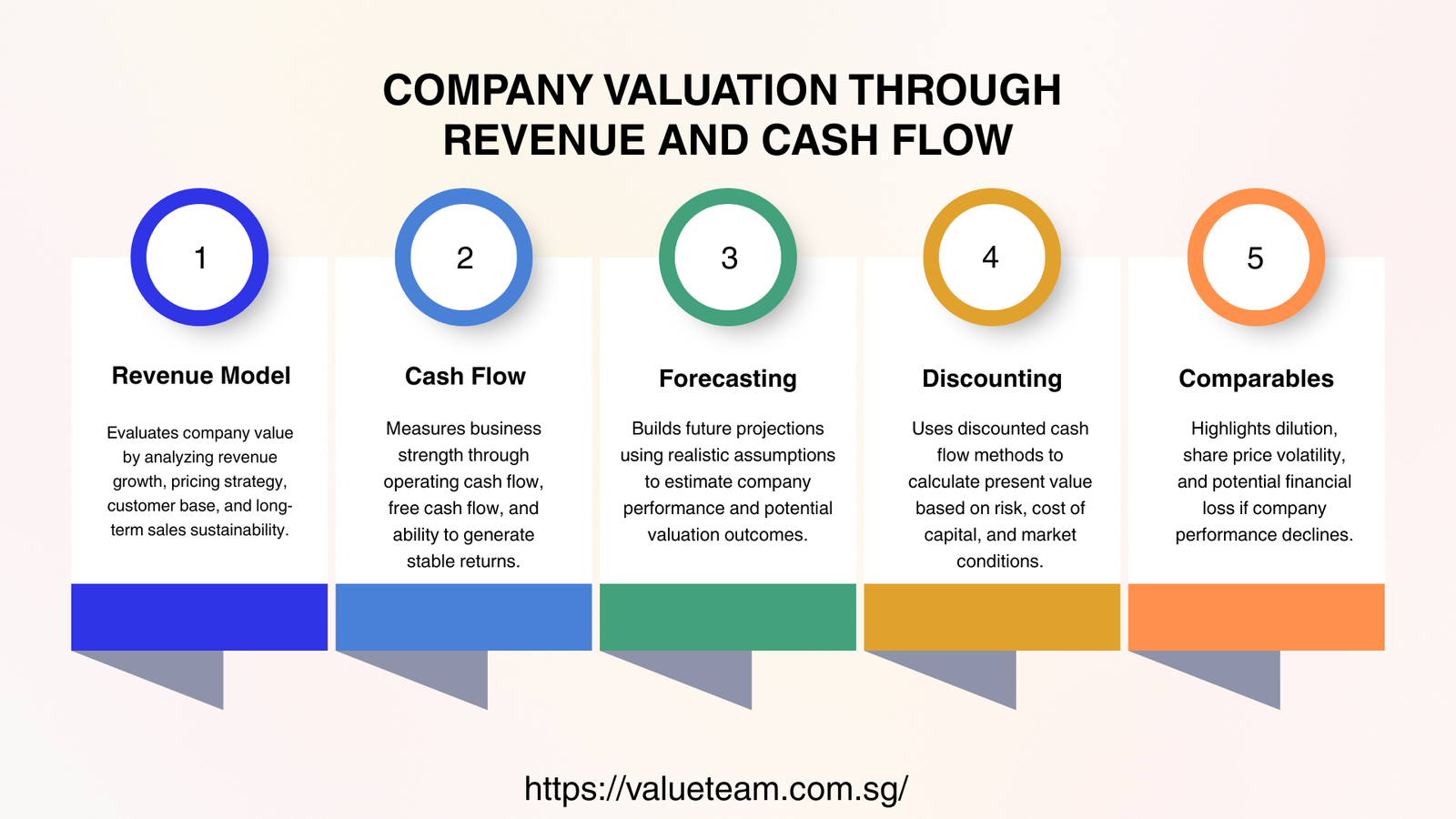
Valuation of companies has become one of the most important critical analytical disciplines in modern finance, investment and corporate decision-making. With business environments becoming more complex and more transparency are required by capital markets, organizations are increasingly relying on structured valuation methods in order to establish enterprise value. The company valuation of annual revenue, company valuation of cash flow and the company valuation of free cash flow method are among the most used approaches that provide a unique approach to value creation and financial sustainability.
Valuation is not a process of fits all. The revenue-based models are often used when a company is in its early stages or is of high growth whereas the cash flow-based models offer a more in depth look at the financial fundamental and the long term performance. Specifically, the method of company valuation free cash flow has integrated to become a paradigm of professional valuation since it focuses on economic value creation as opposed to accounting results only.The article reviews theoretical basis of valuation methods based on revenues and cash flows, practical use, benefits, and drawbacks of these methods to facilitate informed decision-making in transaction, strategic planning and analysis of investments.
The Importance of Valuation in Business Decision-Making
Valuation bridges the gap between financial performance and strategic decision-making. It favors acquisitions and mergers, raising of capital, shareholder reporting, litigation, and internal planning. An effective valuation is one that converts the performance of the business to an economic value which is subject to comparison, negotiation and defense.
In this framework, company valuation based on annual revenueis the market-driven view and the valuation of companies in terms of cash flow is the intrinsic view of financial status. The company valuation free cash flow approach is a single approach that incorporates these points of view by targeting the capacity of the company to produce the sustainable long-term cash.
The choice of the right method of valuation is dependent on the dynamics in the industry, the maturity of the business, the availability of data, and the purpose of the valuation. These factors need to be understood to generate plausible and practical results of valuation.
Valuation of Company on the annual revenue
High growth industries like technology, e-commerce and digital services are often valued on annual revenue, often referred to as company valuation. This is a methodology that approximates the value of enterprises using revenue multiples based on other similar businesses or prior deals.
This is especially applicable when the profitability is low or fluctuating such that revenue-based valuation is useful. Small startups have a tendency to focus on growth rather than profitability and therefore revenue becomes a convenient measure of market share, scalability and potential future earnings.
Nonetheless, there are significant limitations of the company valuation as formed using annual revenue. Cost structure, capital efficiency or cash generation are not expressed in terms of revenue alone. Two companies that are similar as far as revenue is concerned, can be very different in terms of their margins, risk profile and long term sustainability. Thus, this technique must be utilised with great care and generally in conjunction with other valuation techniques.
Revenue-Based Valuation Strategic Applications
Although it has its drawbacks, annual revenue based company valuation is strategically applicable. It is mostly applied in initial deal negotiation, market benchmarking, and valuation screening drills. When investors and acquirers are making preliminary valuation estimates, they usually use revenue multiples to determine the range of the valuation.
Software-as-a-service industries are considered as having recurrent revenue pattern, which may result in the reason why they receive higher revenue multiples and risk perception. Excess reliance on revenue may however result in overvaluation in instances where the underlying quality of profitability and cash flow is poor. In that manner, revenue based valuation is best supported by cash flow analysis.
Valuation of Company, in terms of Cash Flow
Company valuation based on cash flow is concerned with real liquidity produced by a business and not top-line performance. The practice shows the capacity of a company to service the debt, reinvest its operations and create value to the shareholders.
The cash flow-based valuation is usually stronger than the revenue-based techniques in that it considers the operating efficiency, cost control, as well as, capital spending requirements. Through valuation of cash inflows and outflows, valuation professionals are able to obtain an understanding of the actual economic substance of the business.
Company valuation on the basis of cash flow is common in professional valuation, credit analysis and investment decision making, because it is not very sensitive to accounting policies and non-cash adjustments.
Valuation Cash Flow Metrics
A few cash flow measures are used in the valuation of the company in terms of cash flow such as the operating cash flow to the company, free cash flow to the company, and free cash flow to the equity. Each measure has various valuation functions and has different perspectives of the stakeholders.
Cash flow operating indicates the basic business performance whereas the cash flow free is used to show the capital expenditure needed to maintain the growth. The most detailed model in this category is the company valuation free cash flow approach that explicitly describes the creation of value over the long term.
The decision on cash flow measure is determined according to the valuation goals, capital structure, and the accessibility of sound financial information.
Company Valuation Free Cash Flow Method Explained
The enterprise value of the company is estimated using the company valuation of free cash flow, which is a discounted cash flow technique that forecasts both future free cash flows and discounts them to the present value. This is applied on the basis that the value of a company is the present value of the cash that can be obtained by the capital providers of an enterprise.
Free cash flow is the cash available after subtracting expenses of operation and capital investments that are required. Employing this metric, the company value of free cash flow methodology would address the issue of profitability as well as reinvestment need.
The method is generally considered to be among the most theoretically sound valuation methodologies and is used in a variety of situations in mergers and acquisitions, fairness opinions, financial reporting, and strategic planning.
The main assumptions on the Free Cash Flow Valuation
The quality of the assumptions of the company valuation free cash flow methoddetermines the reliability of the method. The forecasts to be made on the matters of revenue growth, operating margin, capital expenditure and working capital have to be realistic and internally consistent.
Discount rate is a measure of risk profile of the business. Sensitivity analysis is a vital part of valuation as the valuation results are very sensitive to the change of assumptions.
The free cash flow methodology is more tedious and more specialized in terms of data and professionalism needed, yet the end product of the valuation is more comprehensive and defendable than company valuation based on annual revenue.
The Revenue-Based and Cash Flow-Based Comparison of Valuation
All the valuation methods have a different purpose. Valuation of companies in terms of annual revenue is fast and easy and it is therefore appropriate when the benchmarking is of high level. Cash flow based valuation gives a better understanding of the financial performance and sustainability of the company.
The company valuation free cash flow approach is a combination of growth, profitability, and risk into one valuation model. Although more complicated, it is well within the range of investor and capital market valuations.
As a matter of fact, professional valuers tend to utilize several approaches and balance the outcomes to increase credibility and minimize the dependence on one set of assumptions.
Industry Factors in the choice of the valuation method
The nature of the industry highly determines the choice of the valuation. Industries of low income have a high concentration of capital-intensive firms that company valuation based on cash flow, because the capital expenditure requirements have a significant impact on the value.
The high growth areas can be initially dependent on annual revenue-based company valuation and then shift to cash flows-based methods with the stabilization of profitability. The method of company valuation free cash flow is mainly suitable when a business is mature and the cash generation of the business is predictable.
To make the correct use of valuation, the norms of industries and market expectations must be learned.
Valuation Risks and Pitfalls
All the valuation methods have their own risks. Valuation based on revenue can ignore inefficiency in the operations, and cash flow based valuation is vulnerable to forecasting error. The valuation free cash flow method of determining company value can also give deceptive results in the case of too optimistic or unsubstantiated assumptions.
These risks will be averted by strong governance, documentation, as well as transparency. Disclosure of assumptions is a way of increasing credibility and audit defensibility.
Incorporating Valuation as a Strategic Decision-Making
Valuation cannot be an independent practice. Strategic planning, capital allocation, and performance management can be informed using insider knowledge of the company based on the annual revenue and cash flow as well as the company valuation free cash flow method.
Valuation when incorporated in the decision making process assists in the more effective assessment of growth initiatives, acquisition opportunities and stakeholder communication.
Company Valuation Trends in the Future
The accuracy of cash flow-based valuation is still enhanced by the development of data analytics, predictive tools, scenario modeling, and so on. Meanwhile, investors require more transparency and rigorous methods.
Although the company valuation in terms of annual revenue is applicable in the interpretation of the early stage of the company, the emphasis on sustainable value creation strengthens the value of the company valuation in terms of cash flow and the company valuation free cash flow approach.
Conclusion
Company valuation is a very basic aspect of financial analysis and strategy making. Annual revenue based valuation of companies will give relevant market metrics, whereas cash flow based valuation of companies will give a more intrinsic valuation of financial output. The most holistic method of valuing the company is the valuation using the free cash flow approach, in which the long-term value creation can be seen using disciplined cash flow analysis.
Knowing the advantages and constraints of either approach, organizations are able to increase credibility of valuation, assist in the process of making informed decisions, and promote sustainable long-term development.