Undervaluing Your Business: Risks and Lost Opportunities Explained
Introduction to Undervaluing Your Business Risks and Lost Opportunities Explained
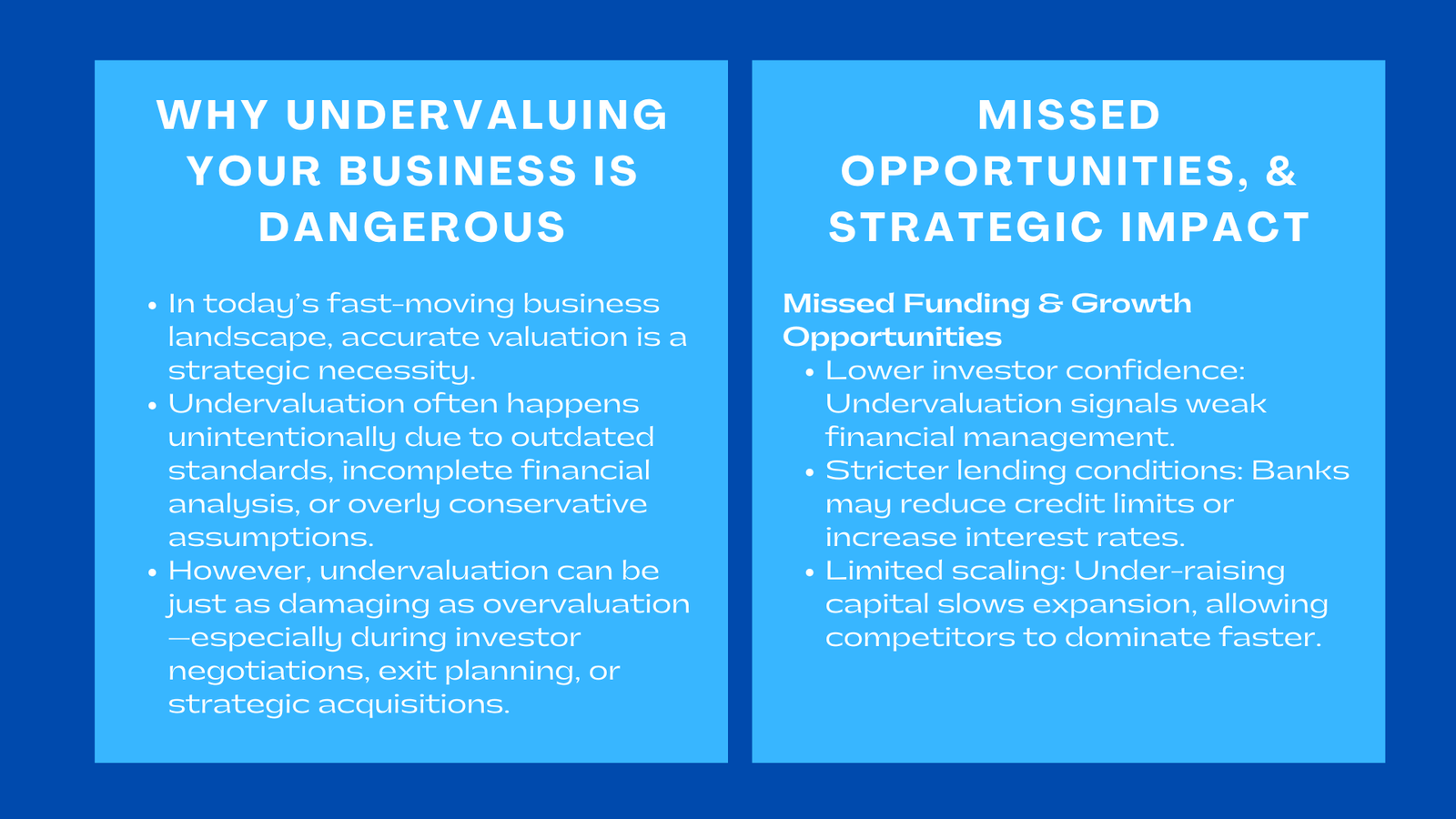
In the modern business world where business is driven by the pace of change, the nature of correct valuation is now more strategic, than a technical practice to determine growth, investment opportunities, and long-term competitiveness. However, underestimation is one of the most neglected risks of the financial future of a company. More frequently than not, when the business owners do not value their company, they do so without realizing it- they are using old standards, or doing incomplete financial analysis, or making assumptions that are conservative in nature and aimed to prevent overconfidence. Nevertheless, underestimation is as destructive as overestimation and the consequences are felt at crucial times like investor dealings, exit strategies or strategic takeovers, especially for companies that rely on corporate valuation services Singapore to ensure accuracy and competitiveness.
This paper specifically looks at the negative impact of undervaluation on growth and financial opportunity, considering the examples of real life situations and why any business looking to expand, partners or reposition in the market requires accurate valuation.
1. The role of Undervaluation to cause Weak Negotiating Power.
1.1 The first reason is that investors can provide lower terms.
The loss of negotiation leverage is one of the short-term effects that can be caused by the underestimation of a business. At the initial stages of preparation of a company, investors and acquirers depend on the financial information and presentation of the company itself. Investors view such actions as a bid to justify low bids when the owners are projecting conservative earnings, dim prospects of growth, or employ valued comparisons to low valuations.
This is particularly susceptible to startups. Once a technology-enabled services company got into a seed round, its valuation was extremely low compared to the rest of the industry since the founders only counted current revenue without accounting the contracted pipeline sales. Consequently, they swapped more of their equity, at the same capital, not at long-term dilution which would have been prevented by proper valuation.
1.2 Strategic Buyers Achieve Negotiation Advantage.
In the case of maturing companies, undervaluation provides unwarranted bargaining power to the strategic buyers. Acquirers can have high-tech analytics and industry benchmarks. In cases where the seller is unaware of the actual market worth of their assets or technology or customer base acquirers may defend lower bids by pointing to risks which need not have a material impact on value. It is especially typical in sectors where the intangible resource (such as brand strength or proprietary systems) is a significant factor.
In such cases, businesses that fail to incorporate value-based financial modeling into their negotiations often accept prices that do not reflect their long-term cash-flow potential.
2. Missing Out on Funding and Growth Opportunities
2.1 Banks and Investors May Question Business Viability
Wrong valuation is an indicator of poor financial management and lack of investor confidence. As an example, when a business value is highly low in comparison with the market fundamentally, lenders may infer that the margins are not stable or that there is poor prospects of the industry. Such a perception results into stricter lending conditions, reduced credit limits or an increased interest rate.
Venture capitalists are also careful. When a company that has high market penetration values itself lowly, investors might think that there is some concealed operational risk, or lapse in management. In competitive industries, such as renewable energy or automation of logistics, undervalued founders can be pushed aside in funding rounds where investors prefer data-driven valuations of confidence.
2.2 Reduced Growth Owing to the lack of raised capital.
In case of undervaluation followed by the constrained fundraising, the capacity of the business to scale is greatly impaired. A growing retail brand across the region, say, might require new working capital to stock, market and transport. In case the company underestimates itself and raises half of the amount of capital needed, the growth will be less effective and fast. With better capabilities to fund, the competitors might capture a larger market share at a faster rate, and the undervalued business will be unable to keep up.
It goes to show that imprecise valuation of the company will lead to a ripple effect- limited funding, decreased growth, and eventual loss of the value of the enterprise in the long term.
3. Under Assessment of Intangible Assets and Future Prospects.
3.1 Disregarding Brand Values and Customer loyalty.
Most of the businesses underestimate themselves since they do not appreciate the economic value of intangible assets. The consumer goods, professional services, and digital platform companies have a higher valuation because of the brand name, customer loyalty, and repeat relationship. Yet without proper analysis using brand valuation methodologies, these assets are left out of formal valuation reports.
The example of a boutique consulting firm is that they may be getting a lot of repeat business and high retention, but the business itself is not as valuable as it may be because they are not measuring the lifetime value of their customers. This lapse will deter investors who would like to have predictable and recurring revenue models.
3.2 Technology, Data, and Proprietary IP Rarely Valued.
The economy of the future of 2025 is highly technological in nature and data assets, proprietary software and automated systems tend to create high long-term value. However, there are still numerous SMEs who rely on conventional valuation models that do not take into consideration digital competitiveness. Companies that have advanced analytics, or platform-based operating models are supposed to adopt valuation methods that highlight their distinguished market standing.
Lack of this will lead to poor pricing when exiting or acquiring, because buyers will not have to believe in elements of value which the sellers have not defined to them.
4. The Competitive Disadvantages that are caused by Undervaluation.
4.1 Underpricing Products and Services.
The effect of undervaluation is a minor yet important factor in that businesses underprice themselves. When the owners feel that they are generally of low value, they tend to use the same rationale in the products and develop a pricing strategy that does not maximise the profit.
As an illustration, when a manufacturer whose valuation fails to capture the appropriate specialised engineering expertise sets the prices of the products too low in comparison to the commodity pricing rivals. This pricing problem of underestimation of value squeezes the margins, shrinks the cash flow, and eventually negatively influences further downward valuation- a dangerous cycle.
4.2 Slowed M&A Strategy and Very Little Expansion.
Firms interested in acquiring other firms are required to have excellent valuation fundamentals to appeal to investors and obtain favorable financing conditions. A company that is not self-valued seems inferior in its ability to accomplish acquisitions or expansions. Moreover, its prospective targets also might not be keen on working with a firm that appears to be less robust.
This limits strategic positioning in the long run. Companies with proper valuation evaluations can engage in mergers, market share or joint ventures with a lot of confidence and credibility.
5. Protecting Long-Term Strategic Value through Accurate Valuation.
5.1 Markedly better Stakeholder and Investor Relationships.
Valuation reports are important to the investors, lenders, and strategic partners to evaluate the viability in the long term. Trust and credibility is developed when businesses have well supported, up to date valuation that is based on clear assumptions and realistic financial forecasts.
With sturdy valuation also enhances good governance decisions including capital budgeting and dividend policies. It also makes sure the management groups distribute resources using the right information and not the old fashioned or too conservative views.
5.2 Better Exit, Succession or IPO Planning.
One of the spheres of undervaluation that leads to the greatest loss of money is exit planning. Proprietors planning to retire or sell should be in a position of seeing through enterprise value in a bid to strike a favourable bargain. On the same note, firms looking at IPOs have to provide valuations that curb the potential to incur earnings in the future, its relevance in the market and its ability to be differentiated.
Businesses that avoid undervaluation through rigorous financial modelling, transaction-ready valuation practices, and ongoing performance tracking position themselves for significantly higher exit multiples.
Conclusion
It might seem conservative or even cautious when one undervalues a business, but the effects of such a move in the long term are not innocent. It contributes to reduced bargaining strength, lost sources of funding, lack of appreciation on intangible resources and a reduction in strategic development. In the modern day competitive markets, proper valuation is no longer a financial mate, rather it is a strategic need that determines how firms grow, how they are funded as well as how they can position themselves in the future economic landscape.
Through adopting data-based valuation, companies will not leave value on the table and will become available to opportunities that are more representative of their potential.