Why Business Valuation Crucial for Company
Why Business Valuation is Crucial for Every Company in 2025
Introduction: Why Business Valuation Crucial for Company
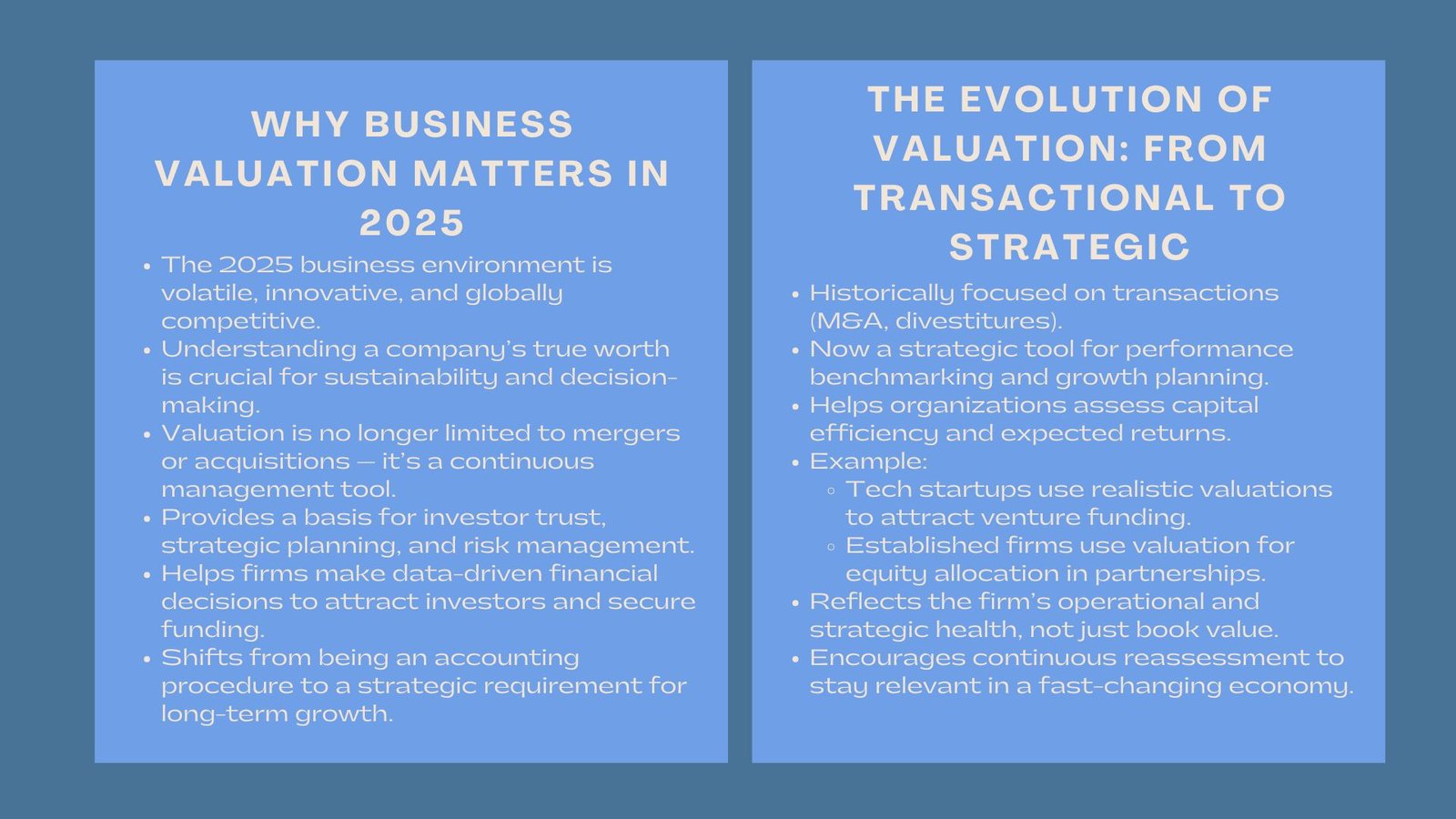
We live in a volatile, innovative, and global competitive world where the issue of knowing the true worth of a company has never been more important. Business valuation which was thought to be most applicable in the case of mergers or sales is now an ongoing requirement to the companies in the 2025 complexities. Valuation offers a basis of sound judgment and sustainability of a firm whether it is in the process of attracting investors, obtaining financing or even strategic growth. Precise valuation is no longer a mere accounting exercise in this fast changing business environment, but it is a strategic requirement.
1. The Changing Immigration of Business Valuation.
1.1 Transactional to Strategic Utilization.
Historically, business valuation was considered as a tool to be utilised in individual cases of mergers, acquisitions or divestitures. By 2025, however, it has become an operation of strategic management that facilitates the continued corporate decisions. Valuation insights provide information to organizations on their efficiency in using capital, on future expected returns, and allow them to compare performance with competitors.
As an example, a technology start-up that is entering a funding round must show a realistic but growth-oriented valuation in order to appeal to venture capital investors. On the other hand, a well-established firm that is planning a strategic partnership can apply valuation models to calculate the allocation of equity and terms of partnership. These situations demonstrate that valuation has a wider application nowadays to control operational and strategic programs.
1.2 Valuation in a dynamic Economic Environment.
The modern economic climate is characterized by dynamic interest rates, inflation rate, and rapid digitalization. These circumstances require more than the conventional financial statements. The analysts are progressively incorporating future information like market predictions, environmental ecofinancial achievements, and innovation possibilities in their models.
This shift underscores why valuation professionals and business leaders must adapt to data-driven business valuation frameworks for strategic decision-making, ensuring that their assessments reflect future earnings potential and not merely historical performance.
2. Business Valuation as a Tool for Investor Confidence
2.1 Building Credibility in Capital Markets
In the case of publicly listed firms, investor confidence is pegged on valuation. Any well-substantiated and clear valuation framework would give the shareholders assurance that the management knows and explains the financial position of the company. Poor or excessive optimistic valuation can result in loss of credibility, stock volatility or even regulatory attention.
As an example, consider the example of rapidly growing fintech companies in Southeast Asia. A lot of such firms were taken public with valuations pegged on user projections and technological scalability. The ones that supported their figures through solid valuation strategies were in a position to keep the investors at the stock irrespective of the market ups and downs in the short term. This example demonstrates that the credibility of valuation has a direct impact on the access to capital and reputation on the market.
2.2 Investing in Private and Family-Owned Businesses.
In the case of the privately owned businesses, valuation is crucial as well. The worth of many small and medium-sized businesses is not as high as they are not formally valued due to lack of their valuation processes. Nevertheless, knowledge on enterprise value allows an owner to negotiate well with investors, acquire better loan facilities, and strategize on succession.
Formal valuation practices are also becoming a common way of managing generational transitions in markets such as Singapore and Indonesia where family-owned firms prevail in the business environment. Proper valuation would also mean that equity transfers, acquisitions as well as agreements between shareholders would take place on just and clear terms.
3. Strategic Growth Planning and Valuation.
3.1 Valuation as a Means of Decision Making Expansion.
Business valuation offers a quantitative understanding of operations, products or markets that earn the greatest return on capital. Through segment-level valuation data analysis, the executives will be able to make investment and dispose of non-performing assets.
An example is where a consumer goods firm finds by doing a valuation that its e-commerce department, which is the newer one, adds more enterprise value multiple to the business than the retail. Such an understanding would inform the management to invest more in digital infrastructure, which would bring the future strategy close to the market potential.
3.2 Merger and Acquisition Valuation.
By 2025, consolidation in the areas of technology, healthcare, and renewable energy is the driver in the global M&A landscape. Proper valuation does not only fix the price of a deal but also the success of the deal in the long term. The problem with overvalued acquisitions is that they normally result in impairments of goodwill and dissatisfaction by shareholders and the target is just likely to lose to competitors when undervalued.
The famous example is the purchase of mobile payment startups by bigger banking organizations. Such deals have worked when valuation teams have taken into account synergies, user retention rates and data monetization potential which are the elements reflecting the actual economic value and not mere multiples of revenue. Hence, M&A valuation techniques for cross-border transactions have become essential for ensuring deals remain strategically and financially sound.
4. The Role of Technology in Modern Valuation
4.1 Automation and Data Analytics
The emergence of artificial intelligence (AI) and big data analytics has changed the process of valuation. It is now possible to analyze large data sets in real time with advanced algorithms which identify the relationship between operational efficiency and enterprise value. The tools minimize human bias and limit calculation errors as well as raise industry comparability.
Indicatively, AI-powered systems deployed by valuation companies in London and Singapore combine financial reports, market information, and sentiment of news to provide almost real-time valuation advice. This dynamic ability is especially useful in businesses that work in the volatile business sector such as cryptocurrency, logistical, and renewable energy, and the value changes every day.
4.2 Scenario and Sensitivity Analysis.
More advanced scenario planning is also made possible through technology. Through simulations, analysts will be able to estimate the effect on determination of the valuation of exchange rates, prices of raw materials or changes in policy. Such flexibility assists the companies to be ready to face uncertainties and make decisions in the best way possible under various scenarios in the future.
Practically, multinational manufacturers apply these simulations to know whether it is worthwhile to expand to a new region based on risk-adjusted targets of valuation. Strategic usefulness of the contemporary valuation tools is supported by the capacity to visualize possible results.
5. Risk Management and Valuation.
5.1 Determining Value Drivers and Vulnerabilities.
A strong valuation exercise does not only bring about the strengths of a company, but also reveals its weak points. A comprehensive source of asset and cash flow analysis would help the management find areas that risk reduction is required. As an example, when the risk of a customer concentration lowers the enterprise value, the company can diversify its customer base or venture into another market.
On the same note, it can be noted that operational inefficiencies which influence profitability can be discovered through valuation. This knowledge can be particularly significant to companies that are going through the process of digital transformation, and the proportion between the expense of innovation and long-term payoff should be maintained with caution.
5.2 Financial Reporting and Compliance Support.
There has been a rise in the requirement of regulators and auditors to disclose transparent valuation especially in listed companies. Measurement of fair value, impairment tests and purchase price allocation rely on proper valuation data. Malpractices may lead to loss of money or conflict with investors.
With more regulatory scrutiny in the year 2025, companies with consistent and well-documented valuation approaches will certainly meet the standards but also create an impression of a greater maturity of governance.
6. Future of Business Valuation.
Valuation is facing its future in integration, which is the combination of financial analytics, sustainability measures, and digital transformation insights into a single framework. As the intangible assets like intellectual property, brand equity and human capital keep influencing the enterprise value, the valuation models will more accurately reflect these elements.
Besides, with the increasing globalization of capital markets, consistency in valuation across borders will be necessary. The cross-border cooperation on standards and methodologies is likely to go faster allowing investors to offer fair comparisons at the global level.
Conclusion
By 2025, business valuation ceases to be a small field, the preserve of financial experts, it is an essential part of the strategy of every business aiming to grow, achieve transparency, and become more resilient. To lead the M&A processes, to improve the relations with investors, or to influence the long-term strategy, valuation is the piece of information that helps to make right business choices in an unstable world.
Organisations which invest in sound valuation practices are today placed in a position of attracting investors, risk management, and taking opportunities in the global market. With the changes in the business model and the increasing role of data in the value of a company, the knowledge of what a company is actually worth will be the key to long-term success.