How to Adjust DCF Valuation for Business Risk
Understanding How to Adjust DCF Valuation for Business Risk
Even if the math in a discounted cash flow analysis is perfect, it may give a false result if it ignores the real risks embedded within the business that’s being valued. One of the more useful skills to learn as a junior analyst is how to adjust DCF Valuation for Business Risk – two companies with identical projected cash flows can have vastly different values if the real differences in risk are properly accounted for. The idea behind DCF valuation is straightforward: The value of a business is equal to the present value of the cash that it will produce over the course of time. But what discount rate, cash flow adjustment, or scenario weighting to use to reflect the real risk of the business is a judgment call, not a formula. This article covers the elements of DCF business risk, the most important adjustments, and the added difficulty of adding in the value of intellectual property, as well as some lessons learned from applying these adjustments to actual businesses.
How to Adjust DCF Valuation for Business Risk in the Discount Rate?
The most frequent first step anyone takes in adjusting a DCF for business risk is to adjust the discount rate, as this one number encompasses a considerable portion of the business risk. The lower the discount rate, the greater the uncertainty that future cash flows will be realized as expected, and the higher the discount rate, the more predictable and defensible the earnings of a business. The rate that is typically built from the bottom up begins with a risk-free rate and an equity risk premium based on broad market data before adding an equity risk premium unique to the company that reflects such things as customer concentration, competitive intensity, regulatory exposure, and management depth that don’t show up automatically in a standard cost of capital calculation pulled from a database. The key to doing proper DCF business risk management is really in getting this company-specific layer right, as the broad market inputs are really very similar for all companies within a sector, and the company-specific premium is where real analytical judgment is to be found. This is exactly what makes a well-researched valuation thoughtfully different from a spreadsheet that is blindly used for every firm an analyst may be assigned to.
One of the biggest pitfalls of newer analysts is using the discount rate as a mathematical result of a formula instead of an honest judgment of the business. Two companies in the same business with comparable revenues and profitability can justifiably demand significantly different discount rates if one sells 40% of its business to a single customer, and the other sells its business to thousands of smaller customers. The absence of such an adjustment in DCF will overvalue a truly risky business or undervalue an unusually stable business, and either will result in a bad investment or negotiation decision based upon a number that seems correct, but is not. The valuers who always err on the low side when figuring in DCF business risk will o overr time ,experience some disconnect between their valuations and actual deal prices as they become adept at comparing the valuers who are doing this early work versus what they see transacted in the real world. One of the more effective ways for an analyst to “calibrate”, over the course of a career, their own judgments, is to build up a personal habit of looking at this divergence over time, comparing the early valuation conclusions against what a company ended up subsequently being sold for, or bought.
How Does DCF Business Risk Show Up in Cash Flow Projections?
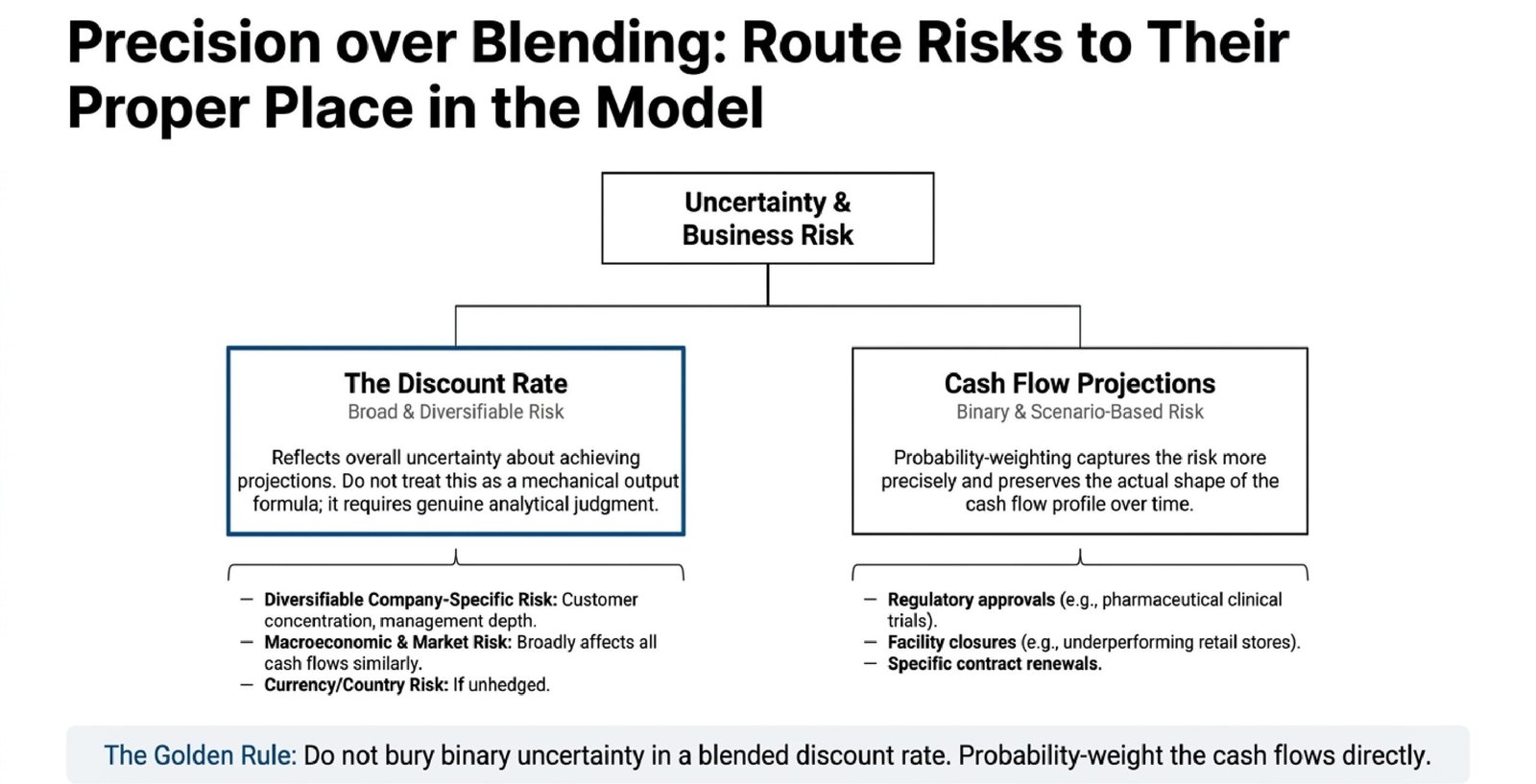
The discount rate does reflect the business risk of the DCF, but not every type of uncertainty should be reflected in the discount rate; some risk should be included in the cash flow projections. It is one of the subtler aspects of the business risk management skill, and should only be developed after building and examining a significant number of real models. One example of this is a pharmaceutical company that is waiting for regulatory approval for a major product that then does not simply discount the complete expected revenue at a higher level to account for the risk of approval. The more accurate method is the cash flow approach, which involves making an assessment of how likely or unlikely a project is to be approved based on the estimated probability (somewhat like the coin tosses), and then creating two scenarios, one that assumes the project will be approved, and the second that it won’t be approved, and then weighting the cash flows of the two scenarios based on the probability estimates. Constructing this type of scenario model takes longer than making just an adjustment to the discount rate, but it creates a much more useful tool for management and investors who are attempting to comprehend just how much value in the company relies on this single binary outcome.
The difference between discount rate risk and cash flow risk is important because the combination of discount rate and cash flow risk can result in double- or uundercountingof the discount rate risk. Building explicit store-closure scenarios into the cash flow projections is more appropriate for a retail chain that is genuinely uncertain whether a subset of underperforming stores will be closed, for example, than to try and capture that binary uncertainty using a single blended discount rate, which cannot really differentiate between the cases of a successful close and a failure. The ability to differentiate between these nuances early in the process can enable analysts to develop far more defensible and transparent models because the reviewer can easily determine where specific risks were treated and not be lost in one monolithic discount rate assumption. This transparency also greatly facilitates the ability to update a model in the future, as a reader of the model a few months later can easily identify which of the assumptions need to be updated. The firms that have had a good internal review culture have actually gone out of their way to train new analysts to inquire before completing the risk adjustment, if this impact could be better captured on the cash flows, instead of on the discount rate.
Table 1: Where DCF Business Risk Belongs in a Model
| Type of Risk | Where It Belongs | Why |
|---|---|---|
| Diversifiable company-specific risk | Discount rate | Reflects overall uncertainty about achieving projections |
| Binary or scenario-based risk | Cash flow projections | Probability-weighting captures the risk more precisely |
| Macroeconomic and market risk | Discount rate | Broadly affects all cash flows similarly |
| Terminal value assumptions | Boththe discountt rate and the growth rate | Long-term risk compounds significantly over time |
| Currency or country risk | Discount rate or cash flow, depending on hedging | Ld ksyaahu on whether the risk is hedged or embedded in cash flows |
What Does Business Risk Valuation Look Like Across Five Key Adjustments?
The following five bullet points outline the key changes most practitioners would make when conducting business risk valuation in a DCF framework. A checklist approach to business risk valuation is more likely to yield consistent results from similar analysts on the same business in the same firm than is an intuitive approach. First, the risk of concentration of customers, which usually results in an increased discount rate or a more conservative revenue growth assumption, particularly when a few customers bring in a significant portion of a company’s revenue. Secondly, competitive positioning risk – how easy it is for a competitor to steal market share or pricing power – should shape margin assumptions and terminal growth rate. Third, management/execution risk – especially for businesses that rely heavily on the founder, such as when a key individual is set to leave, affecting the future performance of the business. Fourth, regulatory and legal risk, which can be an explicit scenario model rather than a single rate discount due to the nature of the industries, particularly in regulated industries. Fifth, financial leverage ris:s a highly leveraged business has a higher equity risk than an otherwise identical business with a more conservative capital structure, meaning that the equity discount rate applied to it should likewise be higher. A less systematic approach, in which the risks are identified intuitively, based on which are most visible, will most likely fail to identify risk factors completely. It is more likely to catch risk factors by working through these five categories systematically at the beginning of each engagement.
A great real-life example of this is that a logistics company is worth more than a PE deal. The company’s historical financials were very favorable, but a more in-depth assessment of business risk showed that there was some meaningful customer concentration – in particular, three logistics contracts that accounted for more than half of the company’s revenue and were up for renewal within eighteen months of closing of the proposed transaction. Instead, the valuation team created explicit cash flow scenarios for the business based on various possible future renewals to provide investors with a much better understanding of the sensitivity of the company’s value to actual renewals (as opposed to a single blended figure that masks the true risk source). The case was, in fact, a benchmark example for the firm’s business risk valuation process – it was a good illustration of the power of scenario-based modeling to convey risk in a much more transparent manner than an overall adjusted discount rate.
How Does Intellectual Property Valuation Affect How to Adjust DCF Valuation for Business Risk?
If a substantial portion of the company’s value is based on patents, proprietary technology, or trade secrets, then valuing the company using intellectual property will not be separate from adjusting Dthe CF valuation for business risk; the strength and durability of the company’s intellectual property directly influence the level of confidence in projecting future cash flows. It is one of the more specialized corners of business risk valuation work and, indeed, where finance professionals most commonly must seek outside technical or legal assistance, beyond pure financial modeling. A tech firm that derives its business risk from a single, narrow patent claim is a company with a much greater level of risk than one with a broad, well-defended patent portfolio that covers multiple aspects of its key product — at least in the short term — if it has the same financial forecast, even though both firms seem to be in the same position. The intellectual property valuation work, along with a realistic appraisal of the ease with which a competitor could design around the IP protection, should also be used to directly inform both the terminal growth rate assumption and the company-specific risk premium added to the discount rate. Those analysts who don’t do this and simply extrapolate a company’s current growth rate into perpetuity but never ask if the underlying intellectual property can actually support that growth rate are in danger of creating a terminal value that has more weight in the overall valuation than the underlying analysis deserves.
The advantage of having IP valuation done as part of the DCF process, not as a stand-alone value exercise with another value team, is that this process will truly reflect the strength and longevity of the underlying competitive advantage. The challenge is that financial analysts and technical/legal professionals with a deep understanding of the IP will have to work closely together, which is not always found in one group, especially when the firm is developing its first complex valuation model. Possibly one of the most important lessons learned is to include intellectual property experts in the preliminary DCF process instead of having them add their thoughts to an otherwise completed valuation model. Companies that incorporate this as part of their workflow, not just part of the larger and more technologically advanced transactions, have solid valuations throughout their entire range of business.
What Lessons Improve How to Adjust DCF Valuation for Business Risk in Practice?
In many valuations already completed, a few points emerge so frequently that they can be considered a valuable general rule of thumb for anyone trying to learn how to adjust DCF valuation for business risk. In the first place, do not accept all risks with the discount rate only, as all the risks will be embedded in one single number, and the model becomes extremely difficult to explain, defend, and update when the risk changes. Second, record the specific rationale for each risk assumption in the discount rate or cash flow assumptions – a reviewer or counterparty will always question why a specific discount rate was selected and why a specific cash flow was determined – a well-documented model will be a much better explanation of why and will be more convincing. Third, review the risk adjustments as new information emerges, as it may rapidly become inappropriate to use a discount rate or scenario weighting that was determined at the beginning of an engagemen, if the diligence work reveals new information about the business. Fourth, if a risk adjustment seems unusually high or unusually low as compared to other companies, request a second opinion, because the outlier risk adjustments should be examined carefully, especially because they have the greatest influence on the final valuation conclusion.
But the most important thing to learn is that, properly applied, a DCF is more of a communication exercise than a mathematical one. This value may be defensible, but if it cannot be clearly explained as addressing specific risks, it is not likely to be the value that investors, board,s or negotiating partners will trust in a negotiation. Those professionalwhoat develop the practice of explaining their risk adjustments in simple terms and in clear terms that tie each assumption to a real business risk, not a discount rate percentage, create work that lasts a lot longer and moves their careers a lot faster than thosewhot regard the model as a black box that they don’t understand. This communication skill is more important than any individual technical skill and is frequently what leads to the long-term acceptance and confidence of a junior analyst’s valuation effort by both senior analysts and clients.
Conclusion: Key Takeaways on How to Adjust DCF Valuation for Business Risk
A knowledge of Hhowto adjust DCF valuation for business risk is a learnable skill, and it is a real skill that makes the difference between a real and a showily-souped-up valuation. The next (actionable) step for professionals on the career path of valuations, finance, or investing is to practice identifying specific risks in a real or hypothetical company, to be confident and deliberate about whether these risks are to be included in the discount rate or in the cash flow projections — and to be comfortable in making the answers to these questions clear to someone who doesn’t have a finance background. When reading the value of a public company, one of the quickest ways to observe these principles is to examine how the company treats the reporting of risks that are disclosed, like a concentration of customers, regulatory exposure, or the strength of its intellectual property. The exercise of tracing through the finalised IP valuation conclusion to the disclosed discount rate or terminal growth assumption is particularly useful for those who hope to specialise in the valuation of technology or life sciences. When done this way, DCF valuation is a very useful way of looking at how risky a business is, not its value stuffed into a template with numbers and left to chance. Do this for one company, note down all the material risks you can think of, and make a conscious choice for where each one goes in the model; doing this for different sorts of companies and industries develops better judgment that you can transfer to other situations than you’re likely to get from memorising a formula for a discount rate.