How to Value a Private Company in Singapore
Understanding How to Value a Private Company in Singapore?
A private company does not have a public market quote only the stock price, the conversation is more technical and subjective to a private company. Corporate Finance, Accounting, or advisory professionals in Singapore must know How to Value a Private Company, because the city-state has a unique combination of family-run enterprises, rapid-growing startups, and trading firms from the region, making valuation work hardly ever come in the same shape and form. For professionals early in their careers, or those preparing for interviews in this space, it’s much more useful to not only know how to apply the formulas, but to know how private company valuers actually value private companies in Singapore. This article covers the fundamentals of the valuation methods, the differences between valuation engagements for companies and public market valuation, the application of private business valuation methods in different scenarios, and some lessons learnt from actual engagements by local practitioners.
How to Value a Private Company in Singapore Using Recognized Valuation Approaches?
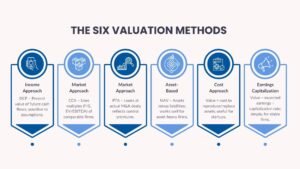
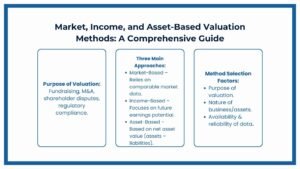
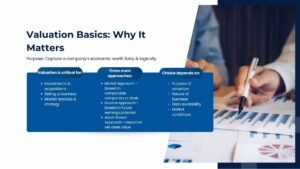
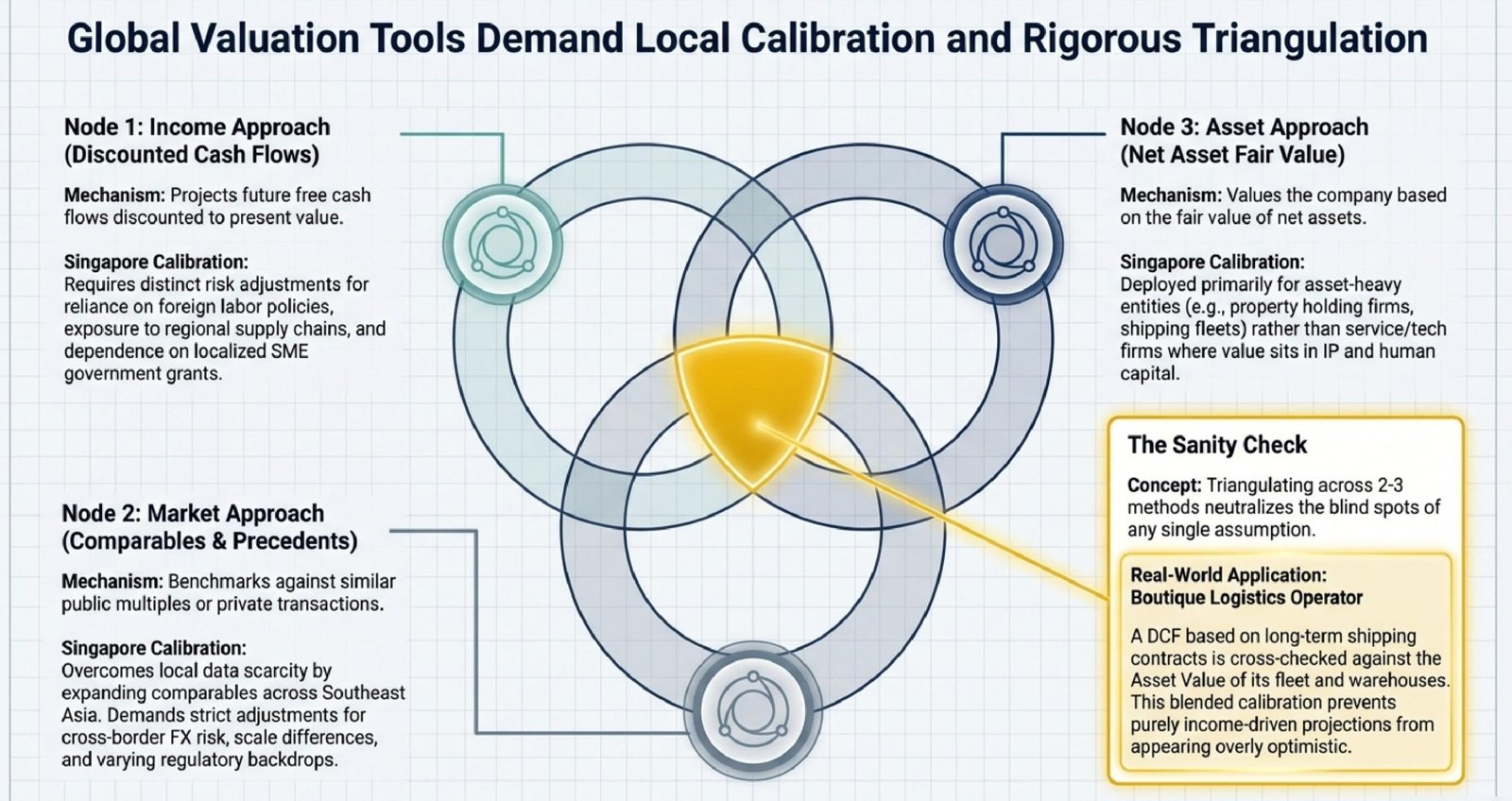
The three basic approaches used by most professionals in Singapore to value a Private Company are essentially the same as in other parts of the world: the income approach, the market approach, and the asset approach, with adaptations to suit the local context. The income approach is most frequently used in Singapore by using a discounted cash flow model to forecast the future free cash flow of the company, and then discounting these cash flows using a rate which reflects the company’s general risk profile, including adjustments for sector-specific issues such as reliance on foreign labour policy, exposure to regional supply chains, or dependence on government grants that are prevalent across the Singaporean SME landscape. The market approach examines the valuation of similar companies in the market either by using the market’s valuation of similar public companies, or through precedent private transactions, although finding truly similar private transactions within a more limited market, such as Singapore, may prove more difficult than in larger markets with more transaction data. This is one of the initial practical practical problems that one will encounter in learning how to value a private company in Singapore, and frequently involves expanding the range of comparable companies used to the other companies in the wider Southeast Asian region with careful adjustments to make sure that the comparisons are appropriate. This bigger comparable set will need judgment as well as data access, as a company in another market might seem comparable on the surface but actually have a distinctly different competitive or regulatory environment.
The asset approach is more suited to asset-heavy companies like a property holding company or shipping company than to a service company or startup in the technology business, where the majority of the value is in people, contracts and intellectual property. In reality, the more reliable private company valuation Singapore valuations are typically conducted using two or three of these methods, with each method having its own limitations that can be filled in by the others. A discounted cash flow model based on shipping contracts that the company has for the future might be the first valuation model used and then cross-checked with the asset values of the company’s shipping fleet and its warehouse portfolio to provide the valuator with a sanity check on an income-only valuation that might otherwise appear to be too good to be true. This type of triangulation is characteristic of a solid private business valuation methodology; a methodology where one of the triangulation steps is used leaves the final valuation result more susceptible to the influence of one flawed assumption than a triangulated, cross-checked conclusion.
What Makes Private Company Valuation Singapore Different From Public Market Valuation?
The most significant difference between private company valuation Singapore work is that no one has a market price for the companies they are valuing continuously, and thus every valuation is an informed estimate and not a fact. Lack of marketability is also a factor because an investor can’t sell shares in a private company on the public markets the following morning if the situation changes; hence, a discount for a lack of marketability is usually applied to account for the increased risk and flexibility restrictions of a privately held position. While Singapore’s regulatory environment is clear, it is also complex, with key rules from the Accounting and Corporate Regulatory Authority that affect the reporting of earnings, Inland Revenue Corporation that affects the reporting of related-party transactions and intercompany pricing, and others that a well-informed valuator will need to unravel before believing the numbers on the face of the page. When valuating a private company in Singapore, valuators who are new to the field tend to miss the fact that this layer of regulation affects the meaning of the financials that are filed, and often view the financials as a final product rather than a point of departure for further enquiry. Getting used to these filing / tax rules early in a career will be repaid many times over because they will be required for nearly all engagements.
The structure of family ownership is also prevalent in many private companies in Singapore and is an additional layer of complexity not faced by public market valuations. A family business may be involved in loans to other family businesses at favourable rates, have employees who are paid less or more than the market, own non-operating assets like investment properties in addition to the business or have numerous other factors that must be adjusted before a valuator can calculate the company’s actual going concern value. Company valuation Singapore professionals quickly realize that a significant portion of the work they do involves this type of forensic normalization work, removing one-off items, and related-party distortions, before any discounted cash flow model or multiple is applied. This normalization process can be the slowest as it involves having patient discussions with company owners who may not grasp the need for the accountant to ask pointed questions about a family member’s salary or a below-market lease. But when conducted with sensitivity, such discussions can often uncover valuable context that can help improve the valuation, as owners are often the first to know where the numbers are reflecting actual business performance and where they are reflecting personal or family arrangements over and above that.
Table 1: Common Adjustments in Private Company Valuation Singapore Engagements
| Adjustment Type | Example | Why It Matters |
|---|---|---|
| Related-party transactions | Below-market rent paid to a family-owned property | Distorts true operating margin |
| Owner compensation | Above-market salary paid to founder | Overstates or understates real profitability |
| Non-operating assets | Investment property held on the balance sheet | Should be valued and treated separately from core operations |
| One-off items | Grant income or COVID-related relief payments | Not representative of sustainable future earnings |
| Lack of marketability | No active market for private shares | Justifies a valuation discount versus public comparables |
Which Private Business Valuation Method Works Best for Different Industries?
Applying the right private business valuation approach is dependent on the type of business and the point at which the business is valued and it is one of the more frequent errors that junior analysts make early in their careers. The following 5 points outline the typical scenarios of the choice in various kinds of businesses that are commonly valued in Singapore. The first is that when there are stable, predictable cash flows for regular manufacturing or trading companies, they are typically suitable for a discounted cash flow approach because their earnings history provides something to support the model. Second, the market approach is more suitable for technology startups in their early stages, who may not have a cash flow model since it relies on assumptions that are very difficult to predict. In their early stages, a technology startup may have limited operating history and may rely more on recent funding rounds or similar transactions. Thirdly, asset driven companies, like property or marine, normally choose the asset route, especially if the background involves liquidation or asset backed loans. Fourth, professional services firms, which rely heavily on key people and client relationships for their value, must be mindful of key-person risk, which can have a material impact on the future earning power of the business if one of its key people and/or partner relationships is lost. Fifth, when holding companies have several subsidiaries with different types of businesses, they will typically use a sum-of-the-parts valuation where each business is valued separately using another method of private business valuation and then the results are added together. Investors who have learned to think this way in segments tend to give more credible valuations than those who apply a one-size-fits-all discounted cash flow model to every business, no matter what the business is and what its characteristics are. This is also a more useful approach to having a conversation with company owners in that it allows a valuator to explain clearly the rationale for the different values of different parts of the business, and it is not as likely to raise more questions than it answers by presenting a single blended number.
A practical example: a regional F&B franchise business operator who was being valued prior to a partial sale. The company’s core franchise segment was cash generating and relatively mature, while the delivery segment was a newer loss-leaking business that was still in growth mode – using a single valuation approach would have either undervalued the mature business, or overvalued the newer business. The valuation team, however, applied a discounted cash flow model to the franchise segment, and a market-based approach, using data from comparable transactions of delivery platforms, to the newer segment, and then re-combined the two valuations in a blended valuation to better reflect the actual risk profile of the group. The examples demonstrate how knowledge of the most appropriate private business valuation method for the relevant part of the business, rather than relying on a method that is well understood, can be a valuable skill for anyone engaged in this area. It also shows the importance of thinking about blended, segment-by-segment rather than a single headline number that either party will not necessarily agree with entirely.
What Challenges Arise During Company Valuation Singapore Engagements?
Data quality is one of the most prevalent problems when valuing companies in Singapore, especially for smaller, closely held businesses that might not have financial records that are geared towards management decision-making or investor reporting; rather, financial records might be kept mostly for tax filing reasons. A valuator that is using incomplete or informally maintained records must invest a considerable amount of time in trying to figure out a clear historical earnings picture before he or she can go forward with any confidence in constructing a forward-looking model, and this is something that is frequently underestimated when valuating engagements are scoped and priced. Another challenge is currency exposure and cross-border exposure, as many private companies in Singapore have operations in other parts of Southeast Asia and have significant revenue in foreign currencies, so there is a need to pay attention to the foreign exchange risk and the political or regulatory risk in the region when determining the discount rates and cash flow assumptions. This regional dimension gives company valuation Singapore work its distinguishing edge from valuation work in larger domestic economies which is less cross-border in complexity. The more one is aware of the economic and regulatory environment beyond Singapore, and not just Singapore, the better the cash flow assumptions that can be estimated for companies that explicitly rely on growth outside Singapore.
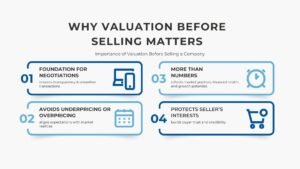
The upside of getting these issues right is having a valuation that is legitimate and can stand the test of a prospective investor, court in a shareholder dispute or tax authority in a related party transaction. The dilemma is that it’s not something that can be done quickly, and shortcuts that are taken to finish the work on time often re-emerge as conflicts over the final count. One common theme for experienced valuators is that the more time spent at the outset clarifying the purpose of the valuation (fundraising round, estate planning, litigation), the more each subsequent methodology choice will be dependent on the purpose.
What Lessons Improve How to Value a Private Company in Singapore?
Many times in completed battles, certain lessons arise repeatedly and are enough to be considered as a rule in Singapore’s How to Value a Private Company. The first step is to always define the valuation purpose and to consider that a valuation for a fundraising, tax and divorce or shareholder dispute may have different standards of value and levels of conservatism. Second, fully normalize the financials before creating any model, as it is the one most frequently agreed-upon source of disputes later in the process. Third, even if possible, compare across multiple methods, as a single result, unsanitized, is much easier to argue with than a range backed up by multiple methods. Fourth, make sure to clearly document assumptions at each step because a valuation conclusion that is not based on a specific, defensible assumption is hard to defend months later if ever questioned by a counterparty, an auditor or tax authority. Fifth, be mindful of the price at which similar transactions in the region are actually transacted, as multiples that seemed appropriate a couple of years ago can change significantly over time as market conditions, interest rates, and investor sentiment change.
The biggest take-away, however, is that the private company valuation Singapore market values those who can perform the technical modelling and have a genuine understanding of the industry and regulations, and not just those who can build a spreadsheet. A professional who invests the time needed to understand a client’s industry trends, regulatory requirements and family ownership dynamics will generate a valuation that is better able to withstand the test of time than a generic template valuation that is applied without any deviations. The best method for gaining this judgement is for a junior analyst to have a wide exposure to different industries and different deal types early in a career, before they become too specialized to know that they would not be able to apply the broad base of skills they have developed to a specific private business valuation model in a specific situation. One of the more practical ways to speed up this kind of learning is to find mentors who have worked with various types of engagements – fundraising, family succession planning, etc. It’s also important to delve into a variety of areas beyond simply the domain in which the first job is oriented, to develop this pattern recognition that helps make the unusual feel familiar, rather than intimidating.
Conclusion: Key Takeaways on How to Value a Private Company in Singapore
Learning how to value a private company in Singapore is not just about knowing the formula, it’s about knowing the right formula, the right adjustments, and the right level of scrutiny to each situation. The next step in enhancing your career path is to perform the regular practice of normalizing financial statements for a real or fictional family business, and understand how a discounted cash flow valuation and a market-based valuation approach yield different results for the same family business and be comfortable discussing results clearly with clients who may have emotional relationships with the numbers. Even though the methodology used to value the target varies a little from a merger conducted with a Singapore-listed company, it is helpful to have a look at publicly available reports of such mergers to see how these principles are applied in practice. When done with the correct blend of technical expertise and local experience, company valuation Singapore work is a real satisfying exercise rather than an intimidating technical exercise only a small band of specialists can perform. Be humble, take one hypothetical family business scenario and run with it, normalizing the business, and finally valuating and presenting a blended valuation; and then do each additional engagement as a further refinement of that same process. This kind of conscious reflection develops the same ‘sense’ that an experienced evaluator has that a number is misplaced before a formal evaluation is performed, and it is this sense that is acquired over time.