How to Value a Private Company? Complete Guide
Understanding How to Value a Private Company
Valuation of a private company is important because, in contrast to listed companies, there is no public share price for a private company to be used as a benchmark; it is therefore necessary to use a structured approach to valuation for private companies. This comprehensive guide goes through the basic valuation techniques for private companies in practice, including income based techniques as well as market comparables, and provides insight into the share valuation of a private company where only part of its business is being sold. Whether it’s a buyout or a sale, a round of investment or even an estate planning process, understanding this process is essential for anyone in the corporate finance, M&A, or accounting field who is building a career in corporate finance. This private company valuation guide is designed to be used as a basic reference with real world examples and a step-by-step process for how to value a private company, and some of the common pitfalls that valuers face as they begin the process.
What Does It Mean to Value a Private Company?
The valuation of a private company is the process of determining the economic value of a business with unregistered shares that are not listed on the stock exchange. The value of a private company is different from that of a public company in several important aspects. No market price to compare to, far lighter disclosure requirements and shares in a private company are usually far less liquid, so that a willing buyer cannot immediately sell off a stake in the company as a public shareholder would be able to do. These disparities make it necessary for professionals to make the value estimate almost entirely from the financial statements and industry data and other information from comparable transactions, when they make a judgment at nearly every step in the process, as opposed to fixing on an observable price. This is the first lesson to learn as a person gets into any corporate finance or transaction advisory career as it influences all the methods and adjustments thereafter. It also puts into perspective how two analysts can come up with two significantly different numbers based on the same set of financial data – in a listed company, the market price would have a much bigger influence on the number than it would in this case.
In practice, the implications of this are dependent on the variety of contexts that need a defensible number. A private company valuation is essential to the success of a variety of situations where a company may be sold, capital raised from investors, an employee share ownership plan is set up and administered, a succession or estate plan is put in place, or a dispute is going before the courts. Each of these circumstances may have a different definition of value, such as fair market value for tax purposes, fair value for statutory buyouts, or investment value for a particular buyer who possesses special value synergies and characteristics that result in a technically correct but value-irrelevant number. A typical early-career error is combining elements of different types of valuations, such as one for a tax filing that is based on assumptions very different from what a strategic buyer might assume in paying for a company for synergies that are specific to his own operations. One of the most frequently missed steps in the process is in knowing what standard to follow before any calculations are made, and it is generally the first question that an experienced reviewer asks when reviewing a junior analyst’s work. Early in a professional career, it may seem like the number is the assignment, but more often, the explanation of the number, and its suitability to the task at hand, is a client or reviewer’s primary concern.
What Are the Main Private Company Valuation Methods?
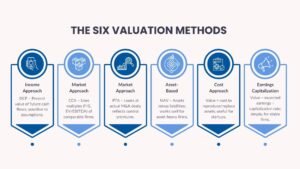
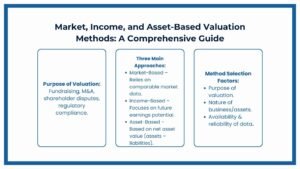
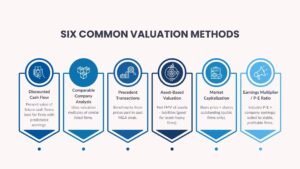
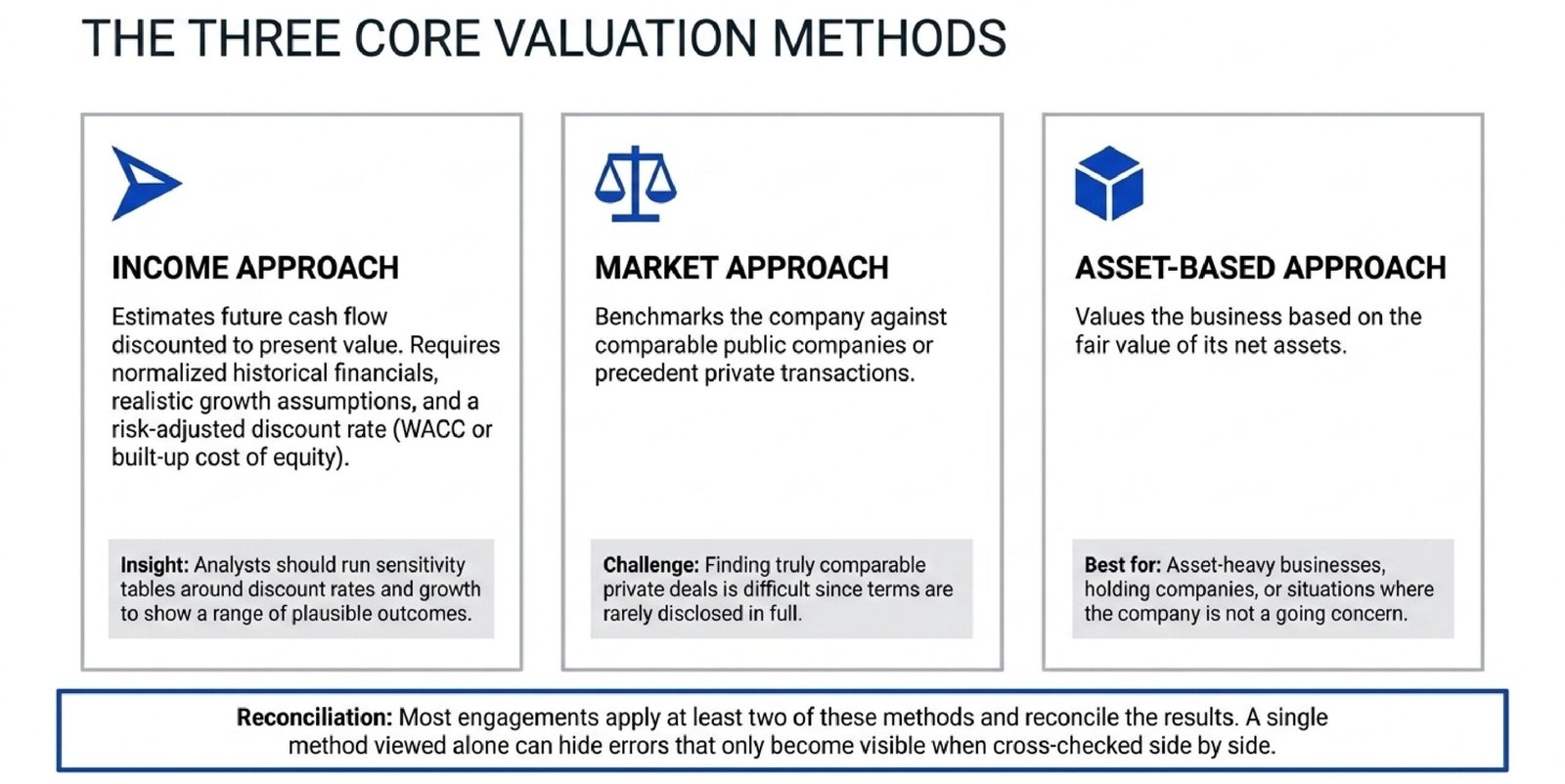
There are three families of methods used to value private companies in general, each appropriate for a different set of data availability and business situation. The income approach is a method that is most commonly used to estimate the current value of cash flows the business is expected to produce in the future, discounted to the present value using a discount rate based on the risk of that cash flow. The market approach involves comparing the company with similar public companies or with precedent private sales, taking into account, through adjustments, the differences in size, growth and profitability of the two. This approach can be difficult to do because there are few comparable private transactions, and terms are rarely fully disclosed. The asset based approach is usually used when the business is asset heavy, or a holding company, or in any case if the company is not a going concern. Most engagements use at least two of these techniques and compare the result of each technique and not just one of them as that technique used alone may mask any errors that may be present.
The income approach is much more than a spreadsheet, and involves not only normalizing historical financials but also making realistic assumptions about growth rates and using a discount rate, typically the weighted average cost of capital or an appropriate built-up cost of equity, that reflects the particular risk of an unlisted business model. Private companies are unlisted and as such are not valued as regularly by valuers who add additional adjustments to the valuation, most of which would not be included in the valuation of public companies, such as a discount for lack of marketability to account for the fact that it is difficult to sell an illiquid stake, and in some cases a control premium or a discount for lack of control depending on the size of the stake being valued. These changes can make a significant difference to the final number, so it is just as significant to record the rationale behind each of these adjustments as it is to record the underlying financial model. A good practice for JAs is to create a sensitivity table around the discount rate and growth assumptions as this provides a range of possible outcomes and provides reviewers and counterparties with a better understanding of the level of sensitivity of the conclusion to any one assumption.
Five Steps in a Private Company Valuation Guide
Most battles proceed in the same order in any case, irrespective of which valuation is eventually used to determine its outcome. This is an overview of a practical guide for those who value private companies, which can be used for almost any assignment. One of the most frequent ways that a flawed conclusion occurs later in the process is to skip a step, especially the normalization of the financials.
Table 1: Steps in a Private Company Valuation Guide – How to Value a Private Company?
| Step | What Happens |
|---|---|
| 1. Clarify the Purpose and Standard of Value | Determine the standard of value to be used for the sale, financing, tax filing, litigation or transfer of ownership through the valuation because the standard of value will vary from one transaction to another. |
| 2. Normalize the Financial Statements | Adjust historical financials for one-off items, owner compensation, and related-party transactions to reflect a fair operating baseline. |
| 3. Select and Apply Valuation Methods | Use two or more of the income, market and asset-based approaches that are suitable for the company’s data and industry |
| 4. Apply Relevant Discounts or Premiums | Add in adjustments such as a discount for lack of marketability and a control premium, depending on the size and type of stake. |
| 5. Reconcile Findings and Document Conclusions | Compare the results from each method and discuss any discrepancies in the material; write up the final figure to support the result. |
How Does Private Company Share Valuation Work for Minority Stakes?
The valuation of a company’s shares becomes more complicated when, instead of the whole company, only a part of it is being sold. A minority share of the company is usually worth less per share than its pro rata value in the company, since a minority shareholder does not have control over the company, the dividend policy or the ability to force it to sell. To recognise this, valuers tend to include a discount for lack of control as well as a discount for lack of marketability, acknowledging that the private shares are not as easily and rapidly sold as publicly traded shares. Combined, these discounts can drastically lower the value of a minority interest, even if the value of the total enterprise is calculated simply by pro-rata. The size of these discounts depends on factors like industry, company size and the type of rights which are attached to the shares in question and a general rule of thumb taken from a different deal should never be used as a substitute for analysis based on the facts of the company in question.
Imagine a family business that functions as a manufacturing company, with one of the family members who owns twenty percent of the company wanting to sell out, but the rest of the family members wanting to continue to run the company. The simple pro-rata calculation using the total enterprise value resulted in a price for the 20 percent stake, but an independent valuation using the discount for lack of control and the lack of marketability discount did a much different calculation, again due to the fact that the departing sibling had no power to control the business and the stake had no market. The bottom number sparked some debate within the family, but the valuation was documented and a similar minority interest sale in the same business was recorded elsewhere provided a reasonable basis for both sides to agree on the buyout price and prevented a drawn-out dispute that could have ended up in court. Presenting the discount calculations openly and honestly, rather than just giving the family a number at the end, helped the family accept an outcome they had not thought they would get from the advisor, the advisors involved later said. The case is an example of the fact that in the end, the value of a company’s shares is not always a proportion of the total value.
Table 2: Common Discounts Applied in Private Company Share Valuation – How to Value a Private Company?
| Adjustment | What It Reflects |
|---|---|
| Discount for Lack of Control (DLOC) | A minority holder’s inability to direct company operations or decisions. |
| Discount for Lack of Marketability (DLOM) | The difficulty and cost of selling an illiquid, privately held stake. |
| Control Premium | Added when valuing a controlling stake capable of directing the business. |
Why Do Business Owners Need a Private Company Valuation Guide Before a Transaction?
A private company valuation guide is a huge help to the business owners when the business is not yet in the process of selling, as it creates a structure for them to work through rather than it being a last minute procedure. With a documented independent valuation, even owners who are considering selling the business outright, bringing in a new investor, or buying out a co-founder, have a realistic valuation anchor to begin negotiations from, and can avoid the potential of placing too high of an anchor based on a businesses emotional rather than financial reality. It also helps meet compliance obligations like tax reporting on gifted or inherited shares, statutory reporting for an employee share ownership plan, and financial reporting requirements that involve periodic revaluations of privately held interests which are usually the same core private company valuation methods that are employed in a sale process. By the time potential buyers are ready to deal, they’ll probably be in a position that’s less favorable, just because they don’t have a number on their own to hold up against the other side’s figure.
The value of an engagement that is well managed is not a bottom-line number. A credible valuation results in a report which provides an explanation of the purpose of the valuation, the basis of value used, the methods used, and the rationale for each and every material assumption, and which supports the conclusion in the face of review by taxing authorities, courts, auditors, or a skeptical counterparty. The report should also indicate where the data was limited, as admitting that data may not have been verified is much more a mark of credibility than a simple finger-in-the-air confidence statement. Owners should find a valuer that has hands-on experience in private company share valuation, as minority and control stakes involve different approaches, and should not expect a precise valuation result; even if the valuation is well supported, it will be based on judgment and a range of results will be presented in a good report, not simply a number that will turn out to be wrong.
What Challenges Arise When Valuing a Private Company?
The biggest problem in this work is the limited and often inadequate data. Audited financial statements are not required to be published on a predictable schedule by private companies; related party transactions, including payments of above market rent to an owner’s separate real estate holding, can impact reported profitability; and owner compensation is often determined not by a fair market rate, but for tax efficiency. When valuing a younger company with limited operating history, there is also a challenge to project the trend, especially as there may be no history to project from, and more reliance on industry benchmarks and qualitative judgement of the management team and competitive position. Well-known businesses can even make things complicated, if the owners are the same two people, and when they make decisions about their business – like whether to invest profits or borrow money – it becomes hard to distinguish between the company and its owners.
The second set of problems relates to the assumptions that have the greatest impact on the final number: the discount rate used for future cash flow, the discount rate if the transaction lacks marketability and the choice of truly comparable transactions, since deal terms are rarely published in a market like this. It is perfectly understandable that two professional valuers from the same set of financial statements can come to two distinct valuations, which is why it’s important to record assumptions just as much as the results are recorded. Another lesson that many practitioners learn the hard way is that clients will want a certain level of accuracy from the information that isn’t necessarily going to be provided, so the responsibility given to the practitioner is to manage that client’s expectations instead of just giving one number and pretending it’s more accurate than it really is. An important lesson many teams learn after a dispute, however, is to maintain supporting workpapers that are easily accessible; a valuation that cannot be accessed months after the fact is not very defensible. Owners should remember that the valuation is more of an estimation rather than a fixed number as various factors like revenue trends, industry conditions and ownership structure may change over time and any serious private company valuation guide will expect you to review the number periodically.
Conclusion: How to Value a Private Company?
The value of a private company is something that can be learnt and it is a valuable lesson to be taken beyond the transaction; the ownership changes, conflicts arise and new funding needs are always present throughout a business life. The bottom line for junior and mid-level professionals is to know the main private company valuation methods, the differences between different standards of value once control and marketability are introduced, and have a private company valuation guide book to call on to scope any new assignment, from establishing the standard of value on day one of the assignment to documenting all discounts and assumptions in the final report. Owners, for their part, can reap rewards by viewing valuation as a continuous process and revisiting the number when the business or its ownership or the market in which it operates has changed in a significant way, rather than viewing valuation as an event that happens once, which means any number that ends up in a negotiation or tax filing or court action is one they can feel good about. It’s a habit that benefits the analyst who makes the model, and anyone who uses the model as a product will benefit from it. Next, newcomers to this area should work through a set of financial statements by normalising the statements and create a relatively simple discounted cash flow (DCF) model based on these and compare the result with an estimate based on the market, as hands-on experience of the exercise will give a much better understanding of the methods than reading about them.