From Financial Statements to Forecast: Preparing for a Valuation Review
A valuation review represents one of the most critical milestones in corporate finance. Whether a business is preparing for a merger, raising capital, or undergoing an internal performance assessment, the process hinges on how effectively financial data and forecasts are organized, presented, and interpreted. For CFOs and finance leaders, the bridge between historical financial statements and forward-looking forecasts is not just a matter of data management — it is a strategic exercise that determines the credibility of the valuation itself.
Preparing for a valuation review requires more than assembling spreadsheets; it involves translating the company’s financial past into a coherent narrative about its future. Each figure in a forecast must trace back logically to historical performance, market trends, and operational capacity. This alignment ensures that valuation assumptions are defensible and that the final outcome reflects both realism and opportunity. In this sense, the financial statement to forecast valuation process, the transition from financial statements to forecasts represents the point where accounting precision meets strategic foresight.
The Role of Financial Statements in Valuation Readiness
Historical Financials as the Foundation of Value
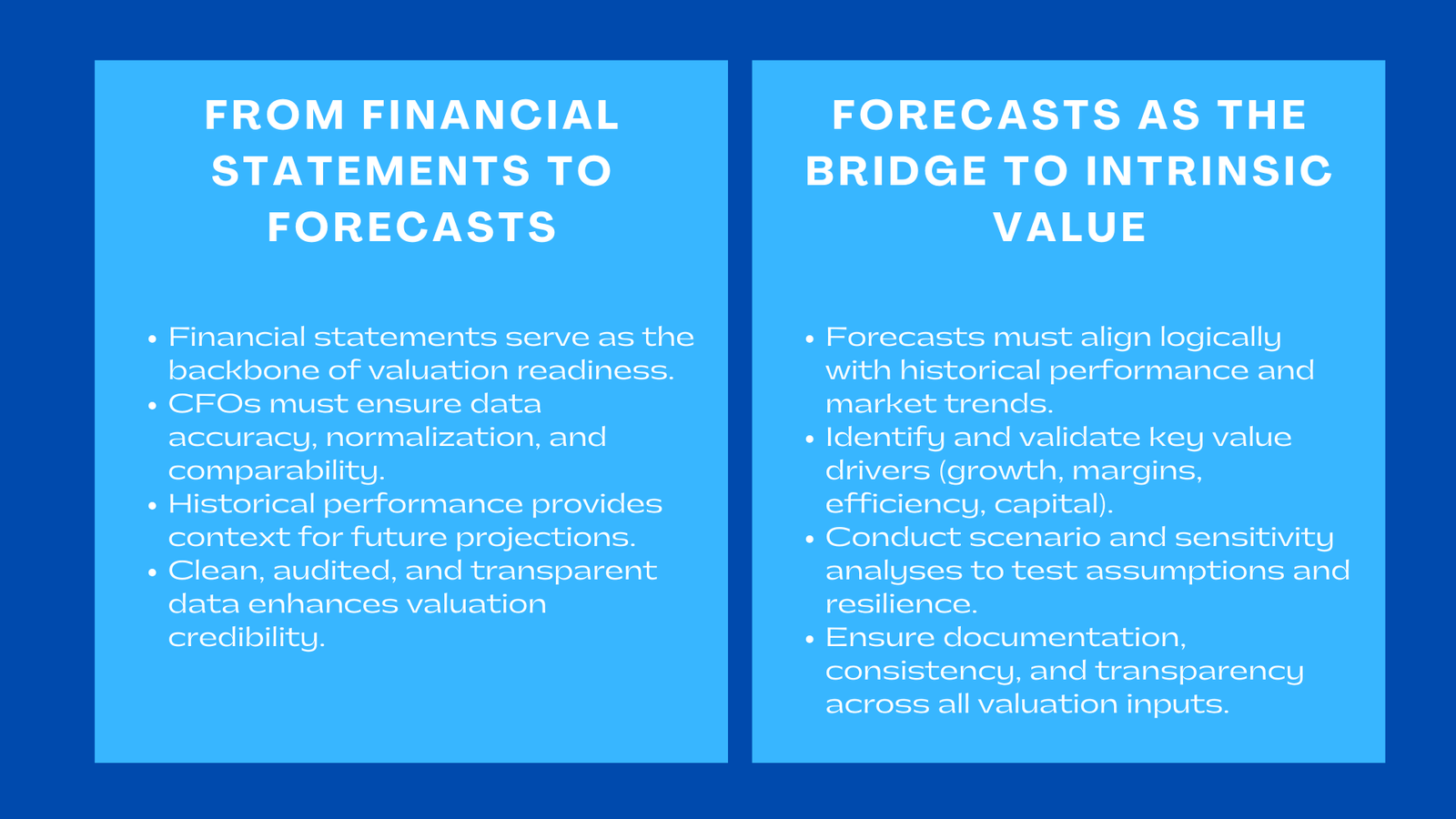
Financial statements form the factual backbone of every valuation. They document how effectively a company has managed its resources, generated profits, and deployed capital over time. For CFOs, the goal is to ensure that the balance sheet, income statement, and cash flow statement accurately portray the company’s financial health, free from inconsistencies or one-off distortions that could mislead evaluators.
Valuation professionals rely on these statements to establish baselines for earnings, margins, and capital efficiency. Historical data provides context for understanding the company’s trajectory — whether it is growing steadily, stagnating, or recovering from past volatility. Therefore, the integrity and completeness of historical financials are non-negotiable prerequisites for any credible valuation process.
Audited, Normalized, and Comparable Data
Before entering the valuation stage, CFOs must ensure that financial statements are audited and normalized. Audited financials provide external assurance of accuracy, while normalization adjusts for extraordinary items, owner-specific expenses, or non-recurring transactions. The purpose is to arrive at a set of financials that reflects sustainable, ongoing performance.
Normalization also enhances comparability — both across time periods and relative to industry peers. For example, if one fiscal year includes an exceptional one-time gain from asset disposal, this must be adjusted to avoid inflating future projections. Similarly, aligning accounting policies (such as depreciation or revenue recognition) ensures consistency in how performance trends are interpreted.
Connecting Past Performance to Future Potential
Translating Historical Trends into Forward Insights
The valuation review process requires bridging the gap between the company’s past and its projected future. Historical performance should inform the assumptions that drive financial forecasts. Revenue growth rates, gross margins, and expense ratios cannot be arbitrarily chosen — they must emerge logically from historical patterns combined with informed expectations about future market conditions.
For instance, if a company’s revenue has historically grown at 10% annually, projecting 25% growth without explaining new market opportunities or product launches would lack credibility. Conversely, an overly conservative forecast that disregards recent strategic initiatives could undervalue the business. The CFO’s role is to ensure that historical and forecast data align through transparent, evidence-based reasoning.
Identifying Core Drivers of Value
Forecasts gain credibility when they are grounded in clear value drivers. These include sales growth, pricing power, production efficiency, capital structure, and customer retention. By analyzing how these drivers have evolved in the past, CFOs can project how they are likely to influence future results.
For example, if historical improvements in gross margins were driven by automation investments, forecasts should incorporate further efficiency gains only if additional investments are planned. The relationship between operational performance and financial results must remain consistent, logical, and transparent throughout the valuation review process.
The Importance of Forecasts in Valuation Analysis
Forecasts as the Bridge to Intrinsic Value
While financial statements tell the story of what has already happened, forecasts reveal what the company is expected to achieve. For income-based valuation approaches such as discounted cash flow (DCF), forecasts serve as the core input for determining intrinsic value. They represent management’s best estimate of future revenues, expenses, capital expenditures, and cash flows. In practice, partnering with a business valuation consultancy in Singapore like ValueTeam ensures that these forecasts are structured, validated, and aligned with industry best practices to support a credible and defensible valuation process.
Accurate forecasting is both an art and a science. It requires balancing optimism about growth opportunities with caution about risks and uncertainties. The challenge for CFOs lies in crafting projections that are sufficiently detailed to be credible, yet flexible enough to accommodate changing business dynamics. The more grounded and transparent the forecasts, the more confidence valuation analysts and investors will have in the resulting valuation.
Key Elements of a Robust Forecast
A robust forecast should include detailed assumptions across all major financial components — revenue growth, cost of goods sold, operating expenses, depreciation, working capital, and capital expenditure. These assumptions should be interconnected, ensuring that changes in one variable logically affect others. For instance, a projected increase in sales should correspond with higher receivables and potentially higher inventory levels.
Moreover, the forecast period must be appropriate to the company’s business cycle. High-growth companies may require five to seven years of projections, while mature firms may only need three to five. The inclusion of a terminal value — representing the company’s steady-state cash flows beyond the explicit forecast period — completes the bridge between short-term projections and long-term value.
Step One: Reviewing and Cleaning Historical Data
Ensuring Data Integrity
Before forecasts can be developed, historical data must be meticulously reviewed and validated. CFOs should conduct reconciliations across financial statements to ensure consistency — for example, confirming that ending cash balances in the cash flow statement match those reported on the balance sheet. Any discrepancies or unexplained variances must be investigated and corrected before the valuation review begins.
Historical data should also be analyzed for trends, seasonality, and anomalies. Identifying recurring patterns helps set realistic expectations for the future, while recognizing one-off events prevents distortion. Clean, verified data enhances both the precision of forecasts and the credibility of the valuation narrative.
Normalization for Comparability and Continuity
Normalization adjustments eliminate distortions caused by exceptional or non-recurring items. This process ensures that the financial base used for forecasting represents the company’s true earning capacity. Adjustments may include removing restructuring costs, extraordinary gains, or owner-related expenses not relevant to future operations.
CFOs must document all normalization adjustments clearly, providing explanations and supporting evidence. This transparency builds trust with external reviewers and auditors, ensuring that valuation conclusions are viewed as fair and objective.
Step Two: Building Realistic and Defensible Forecasts
Linking Forecast Assumptions to Operational Realities
Forecasting is not simply about projecting numbers forward — it requires a deep understanding of the business model and operating environment. Each forecast assumption should be traceable to a tangible driver, such as sales pipeline growth, new product launches, or market expansion.
For example, if the company plans to enter a new market, the forecast should include evidence of market demand, investment requirements, and expected margins. Similarly, if cost reductions are projected, they should align with operational plans, such as process optimization or supplier renegotiations. A forecast disconnected from operational strategy will not withstand scrutiny during valuation review.
Integrating Macroeconomic and Industry Trends
External factors often influence future performance as much as internal initiatives. CFOs should integrate macroeconomic indicators — such as inflation rates, interest rates, and currency movements — as well as industry-specific dynamics like technological disruption, regulation, or competitive intensity.
Referencing credible third-party data strengthens the objectivity of forecasts. For instance, aligning revenue growth assumptions with overall industry growth forecasts demonstrates analytical discipline and prevents accusations of bias or overconfidence.
Step Three: Conducting Scenario and Sensitivity Analysis
Preparing for Valuation Stress Tests
Valuation reviews rarely rely on a single set of forecasts. Instead, analysts test multiple scenarios to understand how value responds under different assumptions. CFOs should prepare base-case, upside, and downside projections that reflect varying degrees of optimism and risk.
Scenario analysis highlights the range of potential outcomes and demonstrates that management has considered uncertainty. It also enables valuation professionals to assess how resilient the business model is to market fluctuations or operational challenges.
Sensitivity Analysis for Key Value Drivers
In addition to scenario analysis, sensitivity testing identifies which variables have the greatest impact on valuation results. Changes in discount rates, terminal growth rates, or gross margins can significantly alter value estimates. CFOs should conduct sensitivity analyses on each major assumption, quantify its impact, and document the rationale for the selected base-case values.
Presenting this analysis during a valuation review conveys preparedness and transparency, strengthening the CFO’s position in discussions with investors or auditors.
Step Four: Aligning Forecasts with Valuation Models
Consistency Across Financial Statements and Valuation Inputs
For forecasts to be credible, they must be internally consistent and compatible with the valuation model being applied. In a DCF model, projected cash flows should reconcile with income and balance sheet forecasts, ensuring that working capital and capital expenditure assumptions flow logically through to free cash flow.
CFOs should also verify that forecasted figures align with the chosen valuation approach. For instance, if an earnings multiple method is used, EBITDA projections must be normalized and comparable to those of peer companies. Alignment between forecasts and valuation inputs avoids confusion and supports a coherent narrative during the valuation review.
Documentation and Transparency of Assumptions
Every assumption embedded in the forecast must be documented, sourced, and justified. This includes explicit notes on how revenue, expense, and capital forecasts were derived. If market data or management judgment was used, the documentation should explain the reasoning.
Clear documentation allows external parties — such as auditors, investors, or M&A advisors — to trace each assumption and validate its plausibility. Transparency at this stage reduces disputes later and enhances trust in the final valuation outcome.
Step Five: Presenting the Financial Narrative for Valuation Review
Crafting the Story Behind the Numbers
A valuation review is not simply an audit of figures — it is an evaluation of the story those figures tell. CFOs must articulate how the company’s financial past supports its strategic future. This narrative should highlight key milestones, strategic initiatives, and market opportunities that justify projected growth.
A strong narrative connects data to decision-making. For instance, explaining how past investments in R&D are now yielding higher margins or new market entry opportunities can justify elevated growth assumptions. The valuation review becomes far more persuasive when backed by a compelling strategic story grounded in evidence.
Anticipating Questions and Addressing Weaknesses
CFOs should anticipate potential challenges from reviewers and prepare responses backed by data. Common questions may relate to discount rate selection, terminal value assumptions, or the realism of growth projections. Addressing these proactively demonstrates professionalism and readiness.
It is equally important to acknowledge weaknesses openly. If certain assumptions involve uncertainty — such as untested markets or pending regulatory approvals — acknowledging these transparently builds credibility and fosters trust.
Step Six: Ensuring Audit-Readiness and Data Accessibility
Organizing Supporting Documentation
Valuation reviews often involve multiple stakeholders, including auditors, consultants, and potential investors. To streamline the process, CFOs should maintain organized digital data rooms containing all relevant documents — financial statements, management forecasts, contracts, and market studies.
Proper organization minimizes delays and confusion during review. Each figure in the forecast should be traceable to its source, whether an accounting record or a management presentation. Having data readily accessible demonstrates operational maturity and strengthens confidence in the valuation process.
Maintaining Version Control and Security
Since valuation models and forecasts often undergo revisions, maintaining version control is essential. CFOs should establish clear protocols for naming, updating, and sharing documents. Secure access should be granted only to authorized individuals to prevent data leaks or inconsistencies.
Audit readiness is not just about having information; it is about ensuring that the information is accurate, consistent, and verifiable at all times.
Conclusion to From Financial Statements to Forecast Preparing for a Valuation Review
Transitioning from financial statements to forecasts is one of the most vital steps in preparing for a valuation review. It transforms static accounting data into a dynamic vision of future potential. For CFOs, mastering this process requires technical rigor, analytical precision, and strategic storytelling.
The key lies in building transparent connections between historical performance and future expectations. Reliable financial statements form the foundation, while defensible forecasts and scenario analyses preparing for a business valuation review create the bridge to intrinsic value. When supported by clear documentation, operational logic, and credible market data, this bridge becomes unshakable.
Ultimately, valuation readiness is not about perfection — it is about credibility. Companies that can demonstrate disciplined financial management, coherent forecasting, and transparent communication will consistently command higher confidence from investors, partners, and regulators. In the evolving landscape of corporate finance, the ability to turn financial data into a compelling forecast of value is not just a technical skill — it is the defining hallmark of financial leadership.