
Professional Investment Analysis and Valuation Workshop
Investment Decision-Making Using Company Valuation Metrics
Professional Investment Analysis and Valuation Workshop
In order to make investment decisions, it is important to have a solid understanding of the true value of a company. Valuation metrics help form a common language for investors to now compare opportunities and to assess risk more effectively, as well as to allocate capital harmoniously. Whether investing in public equities or private companies, or commercial investments such as mergers & acquisitions, being a master of valuing such ratios in precise decision making based on data and discipline.
In today’s markets, when optimism dissemination and speculation are often more involved than one might want to show, valuation metrics drop the floor of decisions to financial reality. They can take complex financial statements and interpret them into performance that helps investors recognize opportunities that have been unappreciated by others or even recognize risk overpriced and should be avoided. Beyond mere numbers, they offer investors insights into strategic decision-making, highlighting whether a company is undervalued, fairly priced, or overvalued relative to peers and market conditions. In today’s dynamic markets, where optimism, speculation, and market sentiment can sometimes overshadow fundamentals, relying on valuation metrics grounds decisions in financial reality.
Understanding Valuation Metrics
Commonly used valuation ratios are Price-to-Earnings (P/E), Enterprise Value-to-EBITDA (EV/EBITDA) and Price-to-Book (P/B). Each provides a different perspective in the way the market views the value of a company in comparison to its fundamentals. Valuation metrics are tools that help investors interpret financial statements and distill them into actionable insights.
For example, a low P/E ratio could be a signal of an undervalued company – or it could be that growth prospects are declining. Similarly, investment decision-making using company valuation metrics EV/EBITDA eliminates the influence of capital structure and taxes, and provides a better picture of operational performance.
“It is impractical for investors to see one ratio to understand the entire situation; they should read the ratios in the context of industry reference, past period, and macroeconomic factors.” It is important to recognize that no single metric tells the full story. Investors should interpret these ratios in context, considering industry benchmarks, historical performance, and macroeconomic factors. Only by integrating multiple metrics can one achieve a comprehensive understanding of a company’s value.
Integrating Valuation Metrics into Investment Decisions
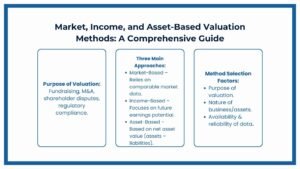
Valuation analysis is linked to more than ratios; it is about relating metrics to future company prospects. While investors compare companies to each other in relation to each other using the relative valuation method, they attempt to determine the intrinsic value of companies using inherent valuation techniques like DCF.
Smart investors reconcile these approaches. For instance, a company might appear expensive based on EV/EBITDA multiples, but if its projected revenue growth, profit margins, and innovation capacity exceed industry norms, the premium on how to use valuation ratios for risk management in investing may be justified. Integrating valuation metrics into investment decision-making ensures that investments are guided by fundamentals rather than market sentiment alone. Additionally, qualitative factors such as leadership quality, innovation capability, and regulatory exposure must be considered to complement the quantitative analysis.
Using Valuation in Risk Management
Valuation concepts are not just opportunity – they are defence against risk as well. Overpaying for assets can have long-term negative effects on returns. Investors who make investment decisions based on reasonable principles of valuation have a lower chance of losses in market corrections.Overpaying for assets can significantly diminish long-term returns, particularly during market corrections or downturns. Investors who base decisions on disciplined valuation principles tend to avoid overpriced securities and reduce exposure to systemic and idiosyncratic risks.
Portfolio managers often incorporate valuation into risk management by rebalancing positions: selling overvalued holdings and acquiring undervalued ones. This practice allows investors to systematically lock in gains, limit downside exposure, and maintain a disciplined, long-term approach. By embedding valuation into risk management strategies, investors can achieve a balanced return-risk profile, preserving capital while pursuing growth opportunities.
Conclusion
Company valuation metrics are the compass that we act on when making intelligent investment decisions. Ask them to upgrade unstructured financial data into profitability information, efficiency and market sentiment information. When applied with discernment and in context, valuation ratios provide investors with a structured framework to compare assets, evaluate risks, and make decisions aligned with long-term investment objectives.
Reliable and applied with discernment and thoughtful context, valuation ratios can help investors achieve favorable decisions, both between assets and over time, linked with a balanced return-risk profile. These are not optional in a volatile global economy – they are imperative to sustainable investment success. Proper use of valuation metrics ensures that investment decisions are grounded in data, disciplined analysis, and long-term strategic foresight, rather than short-term market noise.
Frequently Asked Questions
Q1. What are company valuation metrics?
Company valuation metrics are financial ratios and analytical measures used to estimate a company’s value and compare it with other businesses. Common metrics include the Price-to-Earnings (P/E) ratio, Enterprise Value-to-EBITDA (EV/EBITDA), and Price-to-Book (P/B) ratio. Investors use these metrics to determine whether a company is undervalued, fairly valued, or overvalued before making investment decisions.
Q2. Why are valuation metrics important in investment decision-making?
Valuation metrics provide investors with an objective way to evaluate investment opportunities based on financial performance rather than market sentiment. They help compare companies, assess potential returns, identify investment risks, and support informed capital allocation decisions for both public and private investments.
Q3. Which valuation metric is commonly used by investors?
There is no single best valuation metric because each serves a different purpose. The P/E ratio measures valuation relative to earnings, EV/EBITDA focuses on operating performance while excluding financing effects, and the P/B ratio compares market value with net assets. Investors typically use multiple metrics together to obtain a more comprehensive assessment of company value.
Q4. How does company valuation help manage investment risk?
Company valuation helps reduce investment risk by identifying whether an asset is priced above or below its intrinsic value. Investors who apply valuation analysis are less likely to overpay for investments and can rebalance their portfolios by reducing exposure to overvalued assets while increasing holdings in undervalued companies.
Q5. Can valuation metrics be used without financial statement analysis?
No. Valuation metrics should always be interpreted alongside financial statements, business performance, industry benchmarks, and future growth prospects. Combining quantitative valuation ratios with qualitative analysis provides a more accurate basis for making long-term investment decisions.