
Advance Company Cash Flow Valuation
Company Valuation Based on Cash Flow: A Practical Guide to Free Cash Flow and Discounted Cash Flow Valuation
Introduction to Advance Company Cash Flow Valuation
In modern corporate finance, valuation based on cash flow is widely regarded as the most conceptually sound and defensible approach to determining the economic value of a business. Unlike accounting-based or market-multiple methods, cash flow valuation focuses on the company’s actual ability to generate cash for investors over time. As a result, company valuation based on cash flow has become the preferred method for strategic decision-making, mergers and acquisitions, investment analysis, and long-term financial planning.
This article provides a comprehensive and practical explanation of cash flow–based valuation, with a focused emphasis on the company valuation free cash flow method and the application of company valuation using discounted cash flow techniques. It also clarifies how practitioners apply company valuation with dcf in real-world corporate, investment, and advisory contexts. The discussion is written in formal business English and is suitable for finance professionals, business owners, analysts, and valuation practitioners seeking a clear and structured understanding of cash flow valuation.
1. Understanding Company Valuation Based on Cash Flow
1.1 Why Cash Flow Is Central to Business Value
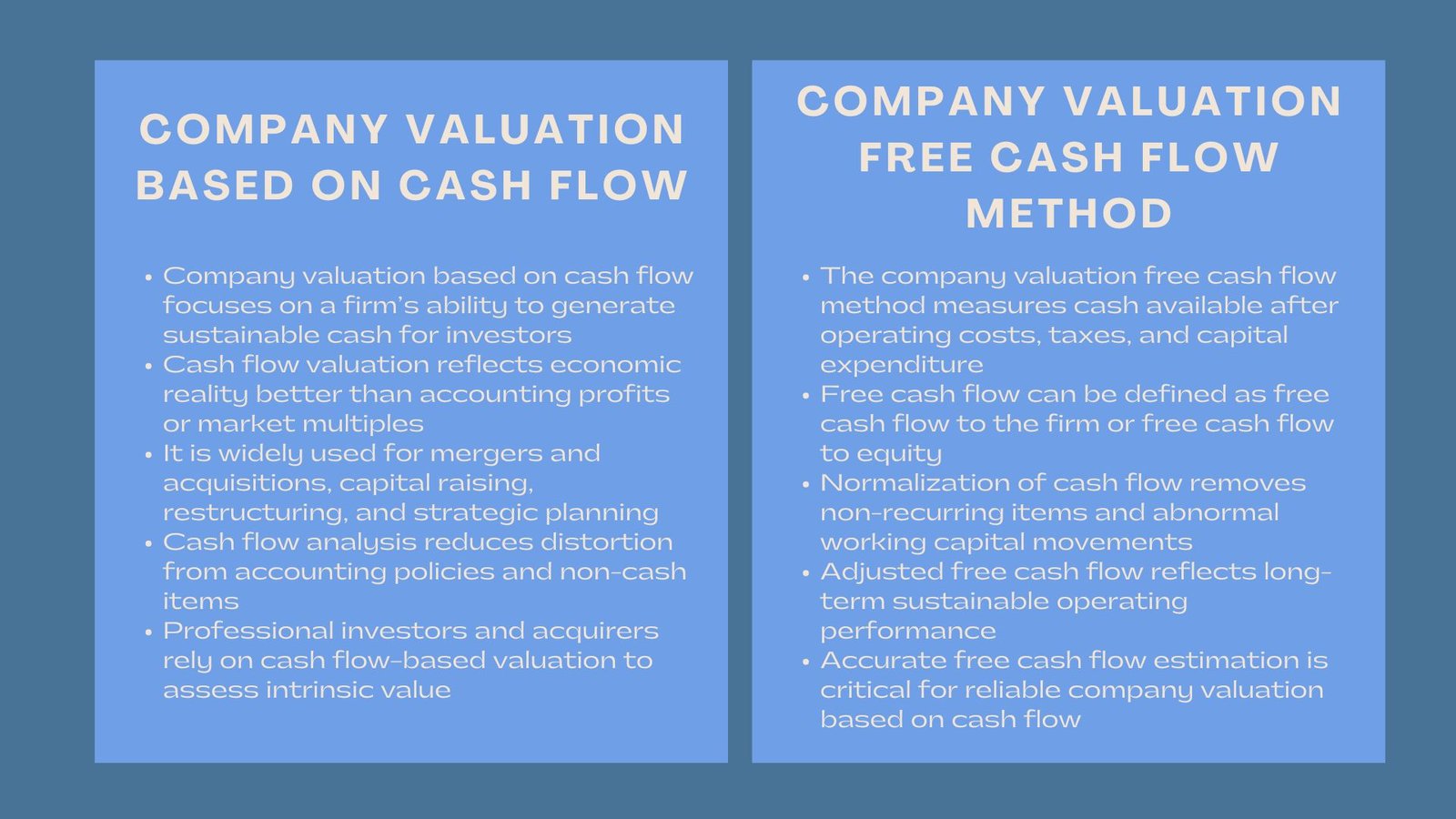
Purely speaking, business value can be generated through the economic benefits that a firm is likely to provide to the sources of its capital in the future. This principle is applied in company valuation based on cash flow that concentrates on cash outflows and inflows as opposed to accounting profits. Cash flow is the amount that it has to provide to service the debt, invest back in the operation and provide value back to the shareholders.
Practically, the accounting policy, non-cash items and short-term management decisions can affect the earnings. Cash flow gives a better idea about financial sustainability though. This is the reason professional investors, acquirer and valuation professionals always use company valuation on cash flow as a basis of judging intrinsic value.
1.2 Strategic Relevance Across Business Scenarios
Cash flow valuation can be used in a vast array of things such as acquisition, raising of capital, restructuring and internal performance. To illustrate, cash flow valuation is applied in a case of merging and acquiring companies where the buyer evaluates the expected synergies against the price of acquiring the company. On the same note, lenders consider cash flows to determine the ability to service debts.
The cash flows valuation of companies allows making a decision that is more informed and becomes defensible compared to the ones that depend only on historical earnings or market comparisons.
2. The Free Cash Flow Concept in Valuation
2.1 Defining Free Cash Flow for Valuation Purposes
Free cash flow is the amount that is produced by a business after taking into consideration operating expenses, taxes, and capital expenditure that is necessary. This is a measure that is considered in the company valuation free cash flow method due to the reason that it shows cash that is actually available to the investors without compromising the operational capacity of the company.
In valuation practice, free cash flow is often computed either as free cash flow to firms or free cash flow to equity, based on whether the valuation is of enterprise value or of equity value. It is necessary to understand this difference to make proper company valuation depending on cash flow.
2.2 Normalization and Adjustments in Free Cash Flow
One thing that is essential in the method of calculating valuation of company with free cash flow is taking measures to normalize cash flows to demonstrate sustainable operating performance. This has to do with the adjustment of non-recurring items, abnormal working capital movements, and discretionary spending. In the absence of such adjustments, the results of valuation can be distorted.
As an illustration, a company that minimized capital spending in the short term might include high values of free cash flow in the temporary period. An efficient company estimation through cash flow is a remedy to such anomalies to allow the projected cash flows to reflect the long-term economic reality.
3. Company Valuation Using Discounted Cash Flow
3.1 Conceptual Foundation of Discounted Cash Flow
The principle behind the company valuation based on a discounted cash flow is that the money of today is more valuable than the same amount of money in the future because of risk and time value. Discounted cash flow or DCF technique transforms free cash flows in the future into the present value after taking an acceptable discount rate.
The method is consistent with the basic theory of finance and is generally agreeable to investors, auditors, and regulators. This makes discounted cash flow valuation of the company be considered as the most rigorous and theoretically sound method of valuation.
3.2 Forecasting Cash Flows in DCF Analysis
One of the most judgmental parts of valuation of companies in terms of the discounted cash flow is forecasting. Analysts need to assume revenue to increase, operating margins, capital expenditure, and working capital requirement within a specific forecast period. These estimations are expected to be realistic making assumptions based on historical performance analysis and industry.
A proper forecast would increase the credibility of the company valuation on the basis of cash flow as it shows the definite correlation of company strategy with its financial results. Unjustified forecasts, on the one hand, reduce the reliability of valuation.
4. Discount Rates and Risk Assessment
4.1 Determining the Appropriate Discount Rate
The discount rate indicates riskiness of the estimated cash flows. This is usually reflected in the weighted average cost of capital in the valuation of a firm as a whole in company valuation with dcf. The market risk, business-specific risk, and capital structure have been considered in the discount rate.
The choice of discount rate is very important and even minor adjustments will affect the outcomes of valuations. This sensitivity confirms the role of professional judgment in calculating a company value on the basis of discounted cash flow.
4.2 Aligning Risk and Cash Flow Assumptions
There is a need to be consistent in the assumptions of cash flows and discount rates. Riskier cash flows demand higher discount rates as compared to stable and predictable cash flows that are worth lower rates. The discrepancy between these factors may give false value of a company on the basis of cash flow and make incorrect judgments.
Proficient practitioners make sure that risk assessment is incorporated in the whole model of valuation which makes the integrity of the company valuation with dcf analytical.
5. Terminal Value and Long-Term Assumptions
5.1 Role of Terminal Value in Cash Flow Valuation
Most DCF analyses would have a large percentage of value vested in the terminal value of cash flows after the explicit forecasting period. Discounted cash flow valuation of a company thus requires large amounts of assumptions on long term growth and sustainability.
A perpetual growth model or exit multiple approach are the common approaches to estimate the terminal value. Both approaches should be taken into consideration to make sure that they correspond with the state of the economy and the situation in the industry.
5.2 Avoiding Overreliance on Terminal Value
One of the pitfalls associated with company valuation using dcf is the overuse of terminal value owing to the use of short periods to forecast or owing to overly optimistic assumptions on growth. The ideal practice in company valuation on the basis of cash flow is striking the balance between the elaborate short-term projections and the conservative long-term assumptions.
This rigorous methodology will increase the accreditation of the valuation and will decrease the sensitivity to changes in small assumptions.
6. Practical Applications of Cash Flow Valuation
6.1 Mergers and Acquisitions
Company valuation according to cash flow in acquisition circumstances enables the purchasers to determine whether the synergies and growth developed are likely to be worth the transaction costs. The company value free cash flow approach is also especially helpful in the assessment of leveraged transactions, in which the debt service capacity is paramount.
The DCF analysis also assists in the negotiation process as there will be a clear platform on which the value drivers and risks can be discussed.
6.2 Investment and Strategic Planning
Discounted cash flow Intrinsic value of companies is evaluated by investors using company valuation to compare intrinsic and market prices. Cash flow valuation, on the other hand, is used by corporate management to calculate the worth of strategic plans, capital investments and long term strategic planning.
Cash generation of the company with dcf is important to align the shareholder creation of value with strategic planning.
7. Limitations and Professional Judgment
7.1 Sensitivity to Assumptions
Although it is a powerful valuation of a company based on cash flow, company valuation is very sensitive to assumptions. Even minor fluctuations in growth rates, margins, or discount rates can have a significant impact on the valuation results. Such delicacy highlights the need to use scenario analysis and professional skepticism.
7.2 Importance of Experience and Context
The method of using the free cash flow of the company valuation method also demands experience and knowledge of the industry as well as good judgment. Valuation is not a technical operation but rather an analytical process that incorporates quantitative modeling as well as qualitative determination.
When professionals know the shortcomings of company valuation through the use of discounted cash flow, they are in a better position to give the results in a responsible manner and convey them to the stakeholders.
Conclusion
Cash flow–based valuation remains the cornerstone of modern business valuation practice. By focusing on economic reality rather than accounting artifacts, company valuation based on cash flow provides a robust framework for assessing intrinsic value. The company valuation free cash flow method, when combined with disciplined forecasting and risk assessment, offers deep insight into a company’s value creation potential.
Through rigorous application of company valuation using discounted cash flow and informed judgment in company valuation with dcf, professionals can produce valuations that are credible, transparent, and strategically meaningful. As businesses and investors continue to navigate uncertainty and complexity, cash flow valuation will remain an indispensable tool for informed financial decision-making.