How to Value a Company Course Singapore
How to Value a Company Course Singapore: Methods and Best Practices
One of the most significant and, at the same time, complicated exercises in finance is the determination of the value of a company. You may be the investor who wants to assess the viability of acquisition, the founder who wants to raise funds, or the financial analyst who needs to justify strategic decisions, you should know how a company gets its value.
Company valuation assists in revealing the real value of a firm other than the financial statements. It gives an idea about profitability, growth prospects, exposure to risk and sustainability in the long term. In an increasingly changing world economy where the intangibles and innovation are the key to success, education on how to determine the worth of a company in the most accurate way has never been more important.
Learning the Purpose of Company Valuation.
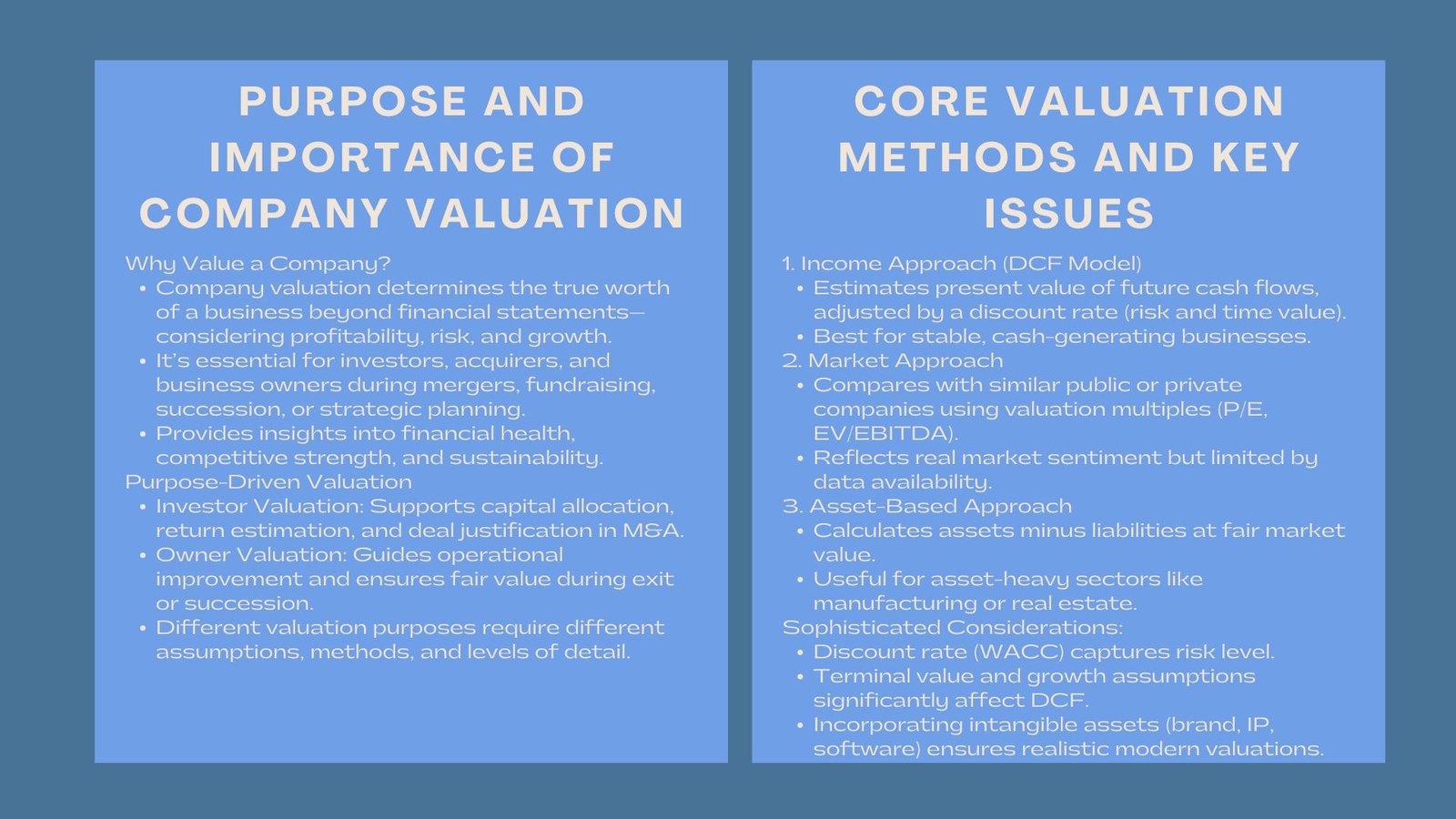
It is good to define the reason why valuation is being carried out before getting into techniques. All purposes can result in dissimilar assumptions, approaches, and detail.
Investor and Acquirer valuation.
Valuation helps investors to make wise decisions concerning the allocation of capital. Valuation is useful in acquisition and mergers (M&A) to assist in establishing a reasonable price of purchase and averting overpaying. Valuation models allow buyers to project returns and evaluate risks and justify their offers to shareholders or boards.
Business Owner Valuation.
Valuation is a strategic plan to the business owners. It shows the way company value can be impacted by operational enhancement, cost, or market growth. In exit planning or succession, fair valuation will make sure that the owners get the right valuation of years of hard work.
Basic Techniques of Company Valuation.
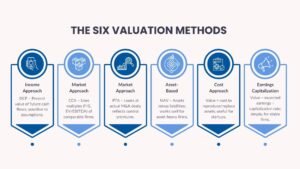
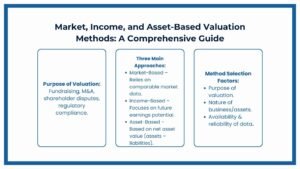
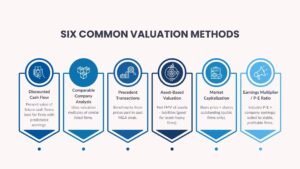
Each firm possesses a distinct financial framework, development path and business environment. Consequently, valuation may yield various results depending on the valuation techniques. Professional valuation practice has three core approaches namely, income, market and asset-based approaches.
The Income Approach
The income approach looks at profitability in future. Analysts can project future cash flows, discount them using the discount rate that would bring the cash flow to present value taking into consideration the risk and the expected return. This is normally referred to as Discounted Cash Flow (DCF) model.
DCF is the most suitable approach to those businesses whose revenues and cash flows are constant and predictable. It captures intrinsic value, which is pegged on the amount of cash that the business is likely to bring in the future. But, this method needs proper forecasting and consideration of assumptions such as the growth rate, discount rate and terminal value.
The Market Approach
The market strategy is based on the comparison of the company with the similar businesses. Valuation multiples utilized by analysts can include valuation of similar transactions or publicly quoted companies- price to earnings (P/E) ratio, enterprise value to EBITDA, or price to revenue ratios.
This method is a wakeup call that brings the valuation of a company to the actual performance in the market. Nevertheless, perfect comparables are not always easy to find particularly when it comes to private or niche businesses.
The Asset-Based Approach
The asset-based method makes its valuation based on the evaluation of the assets and liabilities that the firm possesses. Fair market value is used to adjust assets and the liabilities are deducted to come up with net asset value. This method is especially applicable to those industries that have intensive assets like real estate, manufacturing, or energy.
In the case of service-based or technology companies, the value of intangible assets, such as intellectual property, brand recognition, or proprietary technology, may not be well represented by the practice.
Sophisticated valuation issues.
Discount rate and Risk Assessment.
One of the key aspects of valuation is the discount rate which is a measure of time value of money and of risk. It is usually pegged on the Weighted Average Cost of Capital (WACC) to the company. The larger the risk profile, the larger the discount rate, and the smaller is the present value of future cash flows.
Risk evaluation involves measuring the volatility of the industry, competition in the market, the ability of the management and financial leverage of the company.
Terminal Value and Growth Assumptions.
Valuation results are performed on a long-term basis by growth assumptions. Extrapolating growth will overvalue the company whereas conservative estimates will underestimate potential. The terminal value, which is cash flows in the future and outside the forecast period, comprises a large portion of a DCF valuation and thus the estimation is crucial.
Intangible Assets and the Contemporary Valuation.
The conventional valuation techniques are very keen on the tangible assets and earnings but the modern economy is intangible-driven. The most common enterprise value is that of intellectual property, software, customer data and brand equity.
Accurate measurement of these assets requires specialized expertise and frameworks such as professional intangible asset valuation services for technology and brand-driven companies, which combine financial modeling with legal and market analysis.
Adding intangible assets will make valuations more accurate on actual competitive advantages and value creation potential- particularly in tech, healthcare, and the creative industries.
Best Practices in reliable valuation.
Use Multiple Methods
There is no exclusive solution that will give a full picture. Triangulation of findings on different valuation techniques is the best practice. As an illustration, an analyst can integrate DCF model with market multiples to prove the conclusions and detect outliers.
Maintain Data Accuracy and Cleanliness.
The reliability of valuation models depends on the data used to create them. Accuracy requires updated financial statements, existing market comparables and realistic forecasts. The old or conflicting data may skew the results and misguide the decision-makers.
Use Scenario and Sensitivity Analysis.
The conditions in the market are dynamic, particularly the volatile industries. Scenario analysis is used to evaluate how valuation would be in various circumstances- i.e. optimistic, base, and pessimistic. Sensitivity analysis on the other hand determines what variables (such as growth rate or discount rate) are most important to value.
Engage Independent Experts
When valuation is used for investment, taxation, or financial reporting, independence is critical. Engaging experienced company valuation specialists for M&A and financial reporting compliance ensures transparency, credibility, and compliance with IFRS or local accounting standards.
Common Pitfalls to Avoid
Excess dependence on Industry Multiples.
Although multiples are fast and convenient, they are capable of simplifying complicated financial reality. The risk profile of two businesses in the same industry can be completely different and different in growth prospects, and therefore it cannot be directly compared.
The Neglect to attend to Non-Financial Factors.
The quality of leadership, knowledge of employees, innovation ability, and customer relation among others will be contributors of long term success but it may not reflect in the financial model. The qualitative factors may be missed or undervalued when ignored.
Lack of Regular Updates
Value of the company alters with time because of the transformation of either markets, competition or regulation. Periodic valuations are required of business to ensure that they are aware of financial performance and strategic position.
Real-World Example
Imagine a logistics business that has taken its operation to Southeast Asia. Analysts can use the income approach to estimate future cash flows depending on how the demand of e-commerce delivery is expected to grow. These findings are justified by them with the market method citing similar regional acquisitions.
The ultimate valuation will compromise the intrinsic and market-based perceptions to give a reasonable basis of negotiations with prospective investors.
As revealed in this case, sound judgement about valuation involves effective financial modeling in conjunction with the in-depth knowledge of the market-so that sound decisions are made on the basis of analysis.
Conclusion: How to Value a Company Course Singapore
Pricing a company is not a science, but an art. A combination of the methodology, data integrity, and professional judgment is the key to the fact that the outcome can be considered the true reflection of business reality. The proper valuation, whether it is acquisition-related, fundraising-related or compliance-related, will enable the stakeholders to make the confident and data-driven decisions.
Business valuation is not only a financial tool but also a strategic benefit in the world where intangible assets and innovation are prevailing conditions, determining the future of companies.
Frequently Asked Questions
Q1. What is company valuation?
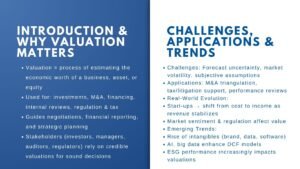
Company valuation is the process of determining the economic value of a business by analysing its financial performance, future cash flow, assets, liabilities, market position, and growth potential. It supports informed financial and strategic decision-making.
Q2. What are the main methods used to value a company?
The three primary company valuation methods are the Income Approach (Discounted Cash Flow or DCF), Market Approach (comparable company multiples), and Asset-Based Approach (net asset value). The appropriate method depends on the company’s industry, financial structure, and valuation purpose.
Q3. Why is learning company valuation important?
Learning company valuation helps finance professionals, investors, entrepreneurs, and business owners assess business performance, support mergers and acquisitions, raise capital, negotiate transactions, and make informed investment decisions.
Q4. What factors influence a company's valuation?
A company’s valuation is influenced by factors such as revenue growth, profitability, cash flow, market conditions, industry trends, business risk, discount rates, competitive position, and intangible assets like intellectual property and brand value.
Q5. What skills can you gain from a company valuation course?
A company valuation course develops practical skills in financial analysis, DCF valuation, market multiple analysis, financial modeling, risk assessment, scenario analysis, and valuation reporting, preparing learners for careers in corporate finance, investment banking, private equity, and business advisory.