Understanding Company Worth Valuation Program
Introduction to Business Valuation: Understanding Company Worth
Guide on Understanding Company Worth Valuation Program
In the contemporary business world characterized by a high level of dynamism, it is important that investors, entrepreneurs and corporate leaders understand the true worth of a particular company. Regardless of whether you are intending to sell a business, raise capital or enter a merger, fair and defendable value is the core of all significant financial decisions.
Business valuation is not merely about the figures in a balance sheet. It gives a clear understanding of financial status of a company, its performance capabilities and position in the market. Since start-ups raising venture capital and large corporations undertaking restructuring are all ventures of this kind, valuation is a middle ground between financial theory and business strategy.
The Basics of the Business Valuation.
The actual meaning of Business Valuation.
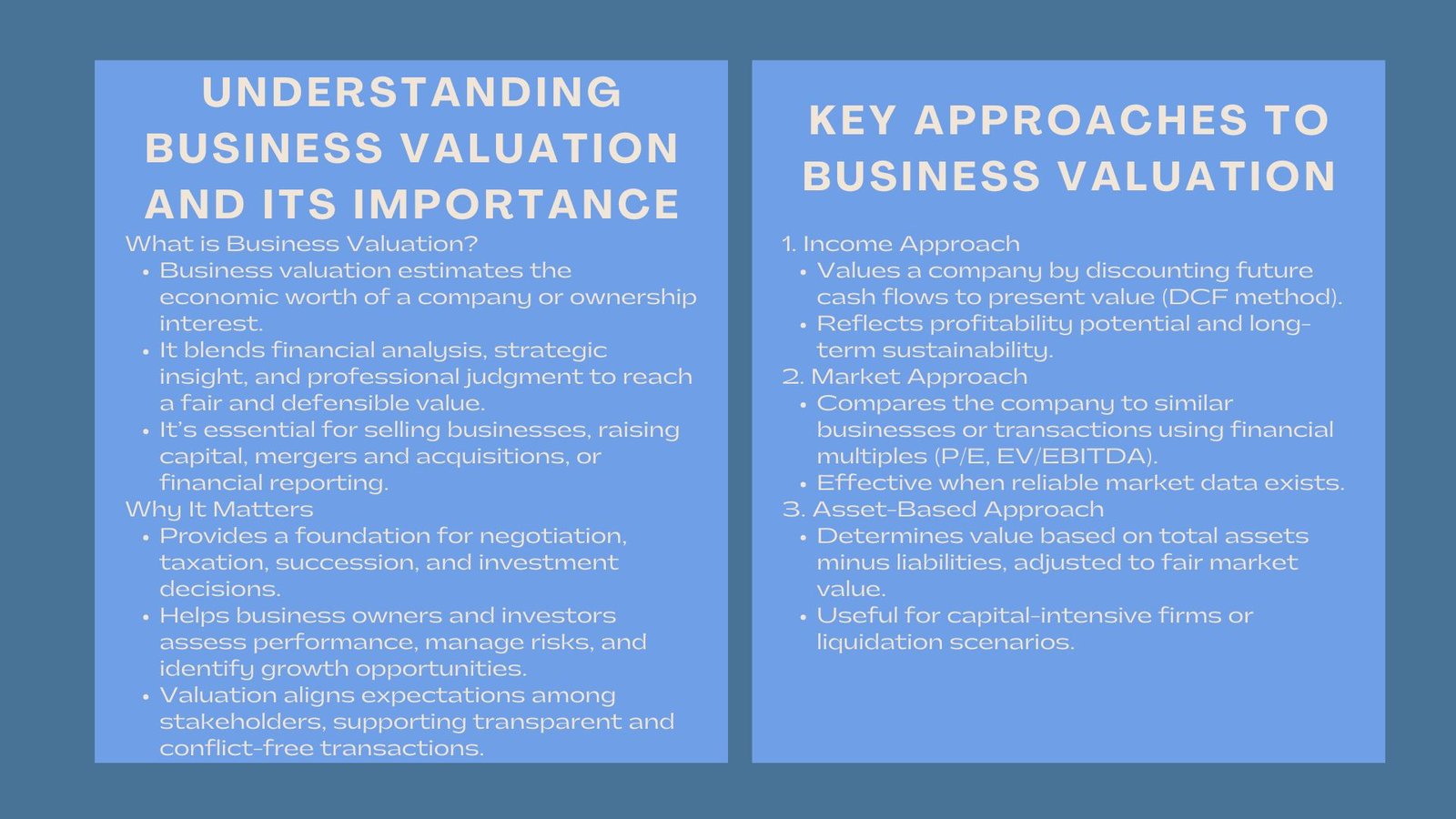
In its simplest form, business valuation refers to the estimation of the economic value of a company as a whole or ownership in the company. It is the financial statement analysis, estimation of the assets and liabilities, projection of cash flow in future and the comparison of the market data.
Valuation is not a science; it is a combination of quantitative analysis and professionalism. This is aimed at getting to a reasonable and sustainable estimate of what the business would fetch in the open and competitive market among willing buyers and sellers.
The importance of Valuation in Business Decision Making.
The outcomes of valuation affect a great deal of strategic decision-making. They provide a basis on which investment negotiations, taxation, succession planning and even litigation support are based. Correct valuation means fair valuation and risk management to the investors. In the case of business owners, it gives an understanding of how performance can be improved and grow.
Business valuation in merging and acquiring companies assists in aligning expectations between buyers and sellers and eliminating the possibility of conflict and enabling clear deal structures, highlighting the Importance of Company Valuation Before Selling.
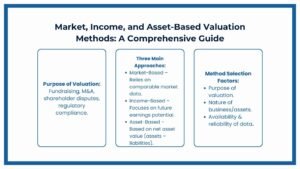
Major much-needed Approaches to Business Valuation.
Income Approach: Cash Flow Potential in future.
One of the most popular methods of valuation is the income approach. It values a company according to the present value of future cash flow of the company. This approach is based on the fact that the real value of the business is the capacity to bring profits in the long run.
Models such as the Discounted Cash Flow (DCF) are more likely to be used by the analysts where the estimated cash flows are assumed to be discounted in the present value with the help of a suitable discount rate. This rate is a combination of time value of money and risk in investments. DFS model is especially applicable in a mature business with constant earnings.
Market Strategy: Industry Comparison.
The market approach identifies the value with comparisons between the company and related businesses which have been sold or publicly traded. Performance is benchmarked using multiples like price to earnings (P/E), EV/EBITDA or revenue multiples.
This technique is effective when there is substantial transaction information or publicly traded comparables in an industry. It portrays the externality in as far as the market understands businesses of similar nature and gives an external picture regarding value.
Asset-Based Approach: Evaluation of Net Worth on the Balance Sheet.
In the asset-based method, the valuation of a company is based on net worth of assets it owns minus net worth on the side of liabilities. It is best suited to capital-intensive sectors or when the value of the cases of liquidation is important.
Physical properties such as machinery, property and inventory are adjusted to fair market value and intangible properties (such as patents, brands or goodwill) are also considered in case they can be measured. This strategy can be a good asset base, but it can underestimate highly innovated, or intellectual capital-based companies.
It is important to note that factors that affect company valuation exist.
Financial Performance and Stability.
Revenue patterns, profit margins, and financial stability of the cash flow are determinants of valuation of a company. Constant performance is an indicator of reduced risk and increased investor confidence. To determine financial health, analysts also analyze debt levels, working capital efficiency as well as the return on investment metrics.
Economic Trends and Market Conditions.
The wider economic variables like interest rates, inflation and industry development influence the perspective of the investors regarding the potential of the company. When there is an economic boom, the valuations are expected to increase as a result of optimism of the earnings but when there is a downturn the valuation is expected to be more conservative.
Brand Value and Intangible Assets.
In most contemporary companies, intangibles are generating high valuation. The company worth can be more than its physical assets through brand recognition, customer loyalty, intellectual property and proprietary technology. Accurately quantifying these elements often requires the expertise of professional business valuation services for intangible asset assessment and financial reporting, ensuring compliance with international valuation standards.
Common Scenarios Requiring Business Valuation
Mergers and Acquisitions (M&A)
In the process of acquisition, valuation dictates the amount that a buyer is supposed to pay or a seller supposed to receive. It also impacts on deal structuring, financing and post merger integration. Valuation is necessary to both parties so that they do not get overpaid or underpaid.
Fundraising and Investment Round.
Valuation is used to determine share prices and attract venture capital by startups and companies in the process of growth. Investors estimate the valuation in order to know the percentage of ownership and potential of exit. Defensible valuation instills confidence and proves that the company is aware of its position in the market.
Financial Reporting and Tax Compliance.
Valuation is frequently required by businesses to account or tax purposes- purchase price allocation, goodwill impairment testing or estate planning. Financial reporting standards under IFRS and other fair value measurement principles provide that the figures reported under fair value measurement represent the fair economic reality.
Professional practices and Ethics.
The Position of Valuation Experts.
Although a numerical result can be obtained using financial models, it has to be interpreted using professional judgment. The valuation experts believe in the context that cannot be captured by the models (management capability, competition environment, and future risk). Having experienced professionals would make the valuation to be conducted in compliance with the best practice and pass the audit test.
Insuring Objectivity and Transparency.
Valuation requires objectivity. The exaggeration or reduction of company value will mislead and falsify decision-making among the investors. Independent valuation is credible and also eliminates conflicts of interests, particularly in controlled industries or international transactions.
Real-Life Case Study: Valuation during an M and A deal.
Consider a case of a smaller software developer purchase by a technology company to increase the line of products. The target company possesses few physical resources yet it has a valuable proprietary code and a devoted user base.
Income approach, the acquirer approximates the amount of future subscription revenues. At the same time, market approach will make comparisons with recent acquisitions of other similar software companies to prove assumptions. Findings: intangible assets such as branding and intellectual property take almost 80 percent of the purchase price.
This example shows that the idea of business valuation can be used to assess not only financial power, but strategic significance and market potential.
Difficulties in Founding Real Business Value.
The valuation is never perfect although there are well-established techniques. Error in forecasting, changing market sentiment, and external shock, e.g. regulatory change or technological shock can severely impact the outcomes.
Also, it is hard to value a startup or a company whose profitability is uncertain, and the forecasts are based on assumptions of growth and market acceptance.In such cases, comprehensive business valuation analysis for startups and high-growth companies provides a more balanced assessment, incorporating scenario modeling and risk-adjusted discounting.
Conclusion
It is much more than a mathematical calculation, business valuation is a strategic, financial and market-informed instrument of decision. Accurate valuation will enhance transparency and confidence of all transactions regardless of whether the company is being sold, attracting investors or accounting standards.
Quantitative approaches used in tandem with expert judgment would enable businesses to know their real value and make a decision regarding future progress. In this age of intangible assets, valuation is no longer a matter of choice, but a tactical requirement to be successful in the long term.
Frequently Asked Questions
Q1. What is business valuation?
Business valuation is the process of determining the economic value of a company by analysing its financial performance, assets, liabilities, cash flow potential, and market conditions. It helps support informed business and investment decisions.
Q2. Why is business valuation important?
Business valuation provides an objective estimate of a company’s worth, helping business owners, investors, and stakeholders make informed decisions during fundraising, mergers and acquisitions, business sales, financial reporting, and succession planning.
Q3. What are the main business valuation methods?
The three primary valuation methods are the Income Approach, Market Approach, and Asset-Based Approach. Each method evaluates company value from a different perspective depending on the business and the purpose of the valuation.
Q4. What factors affect a company's valuation?
Company valuation is influenced by financial performance, profitability, cash flow, growth potential, market conditions, industry trends, debt levels, and intangible assets such as brand value, intellectual property, and customer relationships.
Q5. Who can benefit from learning business valuation?
Business valuation knowledge benefits entrepreneurs, investors, finance professionals, accountants, business owners, and corporate executives who need to evaluate company performance, support investment decisions, or manage business transactions.