Business Valuation Requirements under Singapore and Global Standards
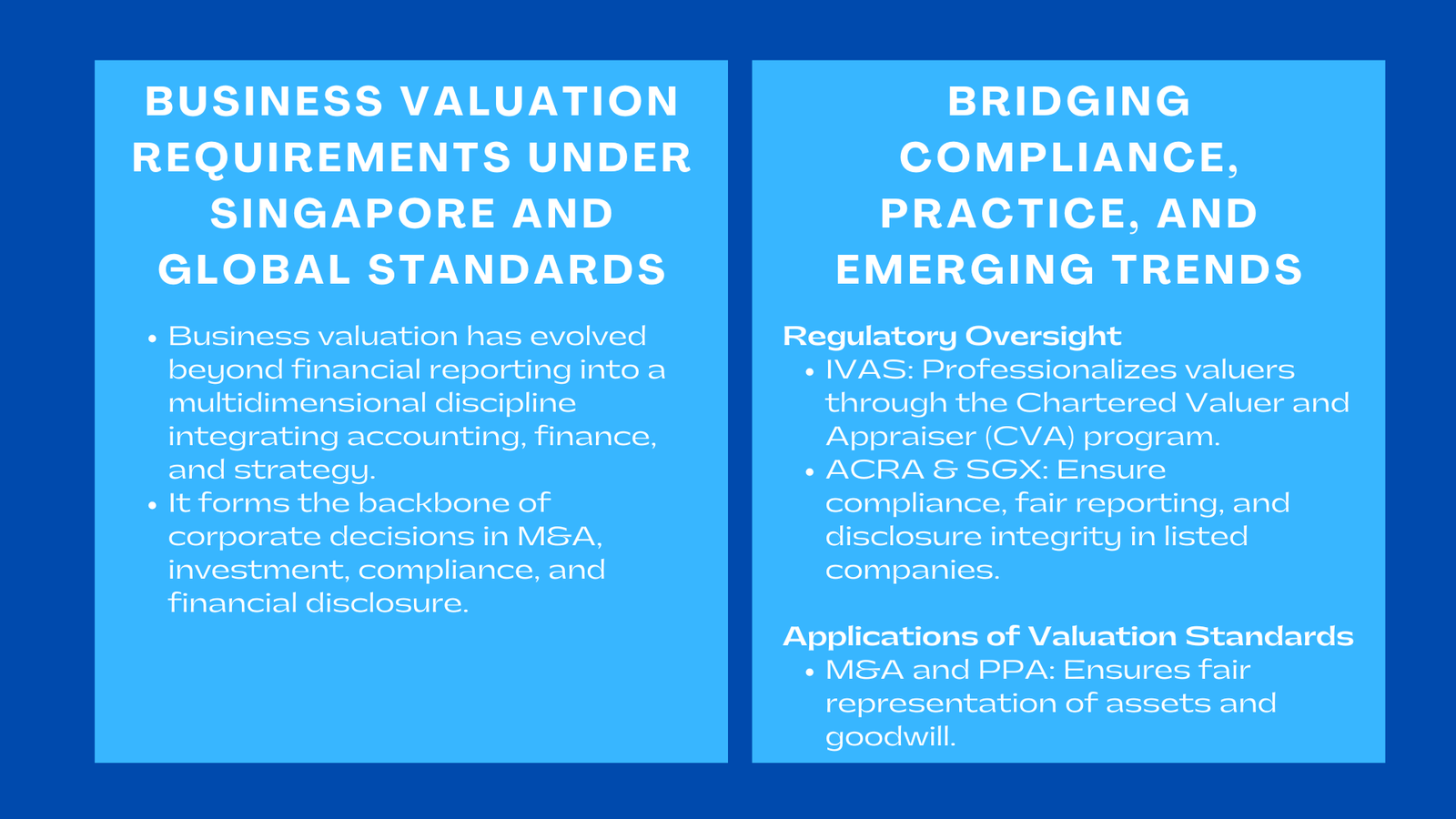
In the globalized economy, the role of business valuation has evolved far beyond its traditional use in financial reporting. Today, valuation represents a multidimensional discipline that integrates accounting, finance, strategy, and economics into a single analytical framework. It forms the backbone of corporate decision-making, shaping mergers and acquisitions, investment strategies, regulatory compliance, and financial disclosures. Accurate valuation ensures that assets are properly represented, liabilities are fairly measured, and corporate value is communicated transparently to investors, regulators, and the public.
In Singapore, the importance of valuation is amplified by the country’s position as a leading financial and investment hub in Asia. The nation’s capital markets attract multinational corporations, institutional investors, and private equity funds, all of whom rely on robust valuation practices to support complex transactions. Singapore’s regulatory ecosystem—anchored by the Singapore Financial Reporting Standards (SFRS)—is closely aligned with International Financial Reporting Standards (IFRS) and the International Valuation Standards (IVS). Together, these frameworks ensure that valuations conducted in Singapore adhere to global best practices, ensuring comparability, transparency, and fairness.
This paper aims to explore business valuation requirements under both Singapore business valuation standards and international standards in depth. It examines the historical and conceptual foundation of these frameworks, their technical implementation in practice, and the regulatory ecosystem that enforces them. Furthermore, it considers how the convergence of local and international standards strengthens investor confidence, facilitates cross-border investments, and ensures that Singapore remains a trusted hub for global business valuation.
The Relevance of Business Valuation Standards
From Technical Analysis to Strategic Insight
Business valuation has evolved from a purely numerical exercise into a powerful instrument of strategic management. It connects quantitative analysis with qualitative interpretation, allowing professionals to assess how financial, operational, and market variables influence corporate value. Through business valuation services Singapore, decision-makers can quantify the impact of leverage, market trends, and risk factors, transforming abstract financial data into actionable insights.
In corporate finance, valuation serves as the cornerstone for structuring mergers, acquisitions, and capital raises. It helps determine appropriate purchase prices, identifies value creation opportunities, and measures the potential returns under different scenarios. In private equity and venture capital, valuation is the lens through which investors assess a company’s growth potential, exit strategy, and long-term viability. Meanwhile, in accounting and reporting, valuation ensures that financial statements truly reflect economic reality—capturing not only the book value of assets but also their fair value in the marketplace.
Ultimately, valuation bridges the gap between numerical analysis and strategic thinking. Professionals who understand how to interpret valuation outcomes in light of broader business goals are able to create more sustainable value and communicate it effectively to shareholders, clients, and regulators.
Bridging Local Compliance and Global Consistency
In a world of cross-border capital flows, valuation standards must achieve both local relevance and international consistency. The alignment between Singapore’s SFRS and the globally recognized IFRS framework ensures that financial statements prepared in Singapore can be compared directly with those from other major economies. This harmonization supports the flow of investments, enhances due diligence in international transactions, and reinforces investor confidence in the integrity of Singapore’s markets.
For multinational corporations and financial institutions operating across jurisdictions, the ability to produce valuation reports that comply simultaneously with SFRS, IFRS, and IVS provides a significant advantage. It reduces the cost of compliance, ensures recognition by global regulators, and facilitates the consolidation of financial results across subsidiaries. In this respect, Singapore’s approach to valuation regulation not only ensures technical rigor but also enhances the country’s competitiveness as a global business destination.
The Core Frameworks Governing Business Valuation in Singapore
Singapore Financial Reporting Standards (SFRS)
The Singapore Financial Reporting Standards (SFRS) form the foundation for all financial reporting and valuation practices within the country. Administered by the Accounting Standards Council (ASC), these standards incorporate the principles of the International Financial Reporting Standards (IFRS) but are tailored to Singapore’s unique business environment. The purpose of SFRS is to ensure that companies present financial information that is relevant, reliable, comparable, and understandable to stakeholders.
SFRS(I) 13, which governs fair value measurement, establishes the framework for determining the fair value of assets and liabilities. It defines fair value as the price that would be received to sell an asset or paid to transfer a liability in an orderly transaction between market participants. This standard requires valuation professionals to use market-based data whenever available and to provide clear disclosures of their assumptions, models, and valuation inputs.
SFRS(I) 3, which addresses business combinations, sets out the requirements for measuring identifiable assets and liabilities at fair value during acquisitions. This process, known as Purchase Price Allocation (PPA), ensures that the cost of an acquisition is transparently distributed between tangible assets, identifiable intangible assets, and goodwill. The outcome directly influences subsequent accounting treatments such as depreciation, amortization, and impairment testing.
SFRS(I) 36 focuses on the impairment of assets, requiring companies to assess at each reporting date whether the carrying amounts of their assets are recoverable. If not, impairment losses must be recognized. This process involves estimating recoverable amounts using discounted cash flow models and market-based evidence. Similarly, SFRS(I) 38 provides comprehensive guidance on intangible assets—covering their recognition, measurement, and amortization. It ensures that assets such as trademarks, software, and customer relationships are accounted for in a consistent and defensible manner.
Together, these standards create a coherent framework that ensures every valuation conducted in Singapore adheres to the principles of objectivity, transparency, and consistency.
International Valuation Standards (IVS)
Complementing SFRS are the International Valuation Standards (IVS), published by the International Valuation Standards Council (IVSC). The IVS serves as the global benchmark for valuation methodology, ethics, and reporting. It provides detailed guidance for valuers across industries—whether they are appraising businesses, intangible assets, real estate, or financial instruments.
The IVS framework establishes clear expectations on the scope of work, data collection, analysis, and disclosure. IVS 101 outlines the structure of valuation engagements, defining the basis of value, the purpose of the valuation, and the intended audience. IVS 102 focuses on investigations and compliance, emphasizing the need for sufficient evidence and adherence to ethical standards. IVS 103 details reporting requirements, ensuring that valuation reports are transparent, comprehensive, and capable of withstanding professional scrutiny.
The IVS also includes specialized sections—such as IVS 200 through IVS 500—that address the valuation of specific asset classes. These guidelines ensure methodological consistency across different industries and asset types. Singapore’s Institute of Valuers and Appraisers (IVAS) actively promotes the adoption of IVS, ensuring that local professionals operate within a globally recognized framework.
IFRS 13: The Cornerstone of Fair Value Measurement
Unified Framework for Measuring Fair Value
IFRS 13, mirrored by SFRS(I) 13 in Singapore, provides a unified framework for measuring fair value across all asset and liability types. Its central concept is that fair value should reflect market participants’ perspectives rather than the reporting entity’s internal view. In other words, fair value represents an exit price in an orderly transaction between knowledgeable and willing parties.
Three-Level Hierarchy of Valuation Inputs
To ensure transparency and reliability, IFRS 13 introduces a three-level hierarchy of valuation inputs. Level 1 inputs refer to quoted prices in active markets for identical assets or liabilities, such as stock prices or exchange-traded bonds. Level 2 inputs include observable data other than quoted prices, such as comparable transactions, yield curves, or industry-specific ratios. Level 3 inputs involve unobservable data—typically based on management assumptions and valuation models like discounted cash flow (DCF), Monte Carlo simulations, or option pricing models.
Disclosure and Transparency Requirements
This hierarchy not only enhances comparability but also requires entities to disclose the nature of the inputs used, the valuation methods applied, and the sensitivity of the valuation to changes in key assumptions. As a result, stakeholders gain a deeper understanding of both the reliability and limitations of reported fair values.
Professional and Regulatory Oversight in Singapore
Role of IVAS
Singapore’s valuation ecosystem operates under the supervision of multiple regulatory bodies that uphold professional integrity and public trust. The Institute of Valuers and Appraisers, Singapore (IVAS), established under the Singapore Accountancy Commission, plays a central role in professionalizing the valuation industry. Through its Chartered Valuer and Appraiser (CVA) program, IVAS ensures that practitioners possess the technical expertise and ethical grounding necessary to perform high-quality valuations.
Oversight by ACRA and SGX
The Accounting and Corporate Regulatory Authority (ACRA) enforces compliance with SFRS and monitors the integrity of corporate financial reporting. Companies listed on the Singapore Exchange (SGX) are also required to comply with disclosure requirements related to valuation, particularly in cases involving acquisitions, disposals, or related-party transactions. These mechanisms ensure that all valuation work in Singapore is independent, evidence-based, and aligned with international best practices.
Regulatory Triad for Credibility
Together, IVAS, ACRA, and SGX form a robust regulatory triad that safeguards the credibility of Singapore’s valuation industry and promotes transparency in the financial markets.
Applications of Valuation Standards in Practice
Mergers and Acquisitions (M&A)
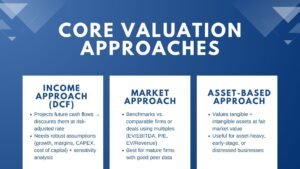
The practical application of valuation standards spans a wide range of business contexts. In mergers and acquisitions (M&A), valuation serves as the foundation for negotiation, structuring, and post-deal accounting. Under SFRS(I) 3, acquirers must perform a comprehensive Purchase Price Allocation (PPA) exercise that assigns fair values to acquired assets and liabilities. The methodologies used—whether income-based, market-based, or cost-based—must align with both IVS and IFRS principles to ensure defensibility.
Financial Reporting and Impairment Testing
In financial reporting, valuation plays a critical role in impairment testing under SFRS(I) 36. Companies are required to estimate recoverable amounts of goodwill, intangible assets, and long-term investments. This involves projecting future cash flows, determining appropriate discount rates, and assessing market conditions. Transparency in assumptions is crucial, especially when using Level 3 inputs that rely on management judgment.
Taxation and Transfer Pricing
In taxation and transfer pricing, valuations provide the foundation for determining arm’s-length prices for intercompany transactions. The Inland Revenue Authority of Singapore (IRAS) often reviews these valuations to ensure that profits are allocated fairly and that companies comply with international tax principles. Adhering to IVS and IFRS methodologies ensures that valuations can withstand scrutiny from tax authorities both in Singapore and abroad.
Investment Management
In the investment management industry, valuation determines the Net Asset Value (NAV) of funds and portfolios. For private equity and venture capital funds, where investments are often illiquid, valuation must rely on Level 3 inputs and sophisticated models. The use of consistent methodologies under IFRS 13 and IVS provides assurance to investors and auditors that reported values reflect the true economic position of the fund.
Integration of Global and Local Practices
Harmonization with International Standards
Singapore’s integration of local and international valuation frameworks exemplifies its commitment to maintaining relevance in a globalized economy. By harmonizing SFRS with IFRS and IVS, Singapore ensures that valuations conducted locally are accepted globally. This alignment facilitates cross-border investments, enhances comparability of financial statements, and supports Singapore’s position as a regional hub for professional services.
CVA Program and Global Recognition
The Chartered Valuer and Appraiser (CVA) program by IVAS mirrors global credentials such as the Royal Institution of Chartered Surveyors (RICS) in the United Kingdom and the American Society of Appraisers (ASA) in the United States. Such alignment enables Singaporean valuers to operate seamlessly in international markets and enhances the credibility of valuations conducted under Singapore’s regulatory framework.
Emerging Challenges and Evolving Trends
Intangible Asset Valuation
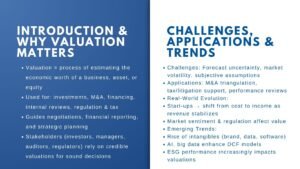
The field of valuation is constantly evolving in response to new asset classes, regulatory developments, and technological innovations. One of the most significant challenges is the valuation of intangible assets, which now constitute a majority of corporate value in knowledge-driven industries. Intellectual property, brand equity, software, and proprietary data are increasingly central to business performance, yet their valuation remains complex due to the lack of observable market transactions.
ESG Integration in Valuation
Environmental, Social, and Governance (ESG) considerations have also emerged as critical determinants of corporate value. Investors are demanding greater disclosure of ESG metrics, and valuation professionals are beginning to incorporate sustainability risks and opportunities into their models. For example, a company’s exposure to climate risk or its performance in corporate governance can significantly influence its cost of capital and long-term valuation. Singapore’s regulators are actively encouraging such integration, aligning with international initiatives like the Task Force on Climate-related Financial Disclosures (TCFD).
Technological Innovation and Automation
Technological innovation is another transformative force in valuation practice. Artificial intelligence, data analytics, and automation tools are reshaping how valuers collect data, build models, and communicate results. Real-time data feeds and predictive analytics enable dynamic scenario modeling that improves both accuracy and speed. As financial modeling tools evolve, valuation professionals must adapt by mastering programming languages and data visualization platforms to remain competitive.
Advantages of a Standardized Valuation Framework
Benefits for Practitioners
A standardized valuation framework offers numerous benefits at both professional and institutional levels. For individual practitioners, adherence to recognized standards enhances credibility, improves analytical precision, and strengthens ethical accountability. Valuers trained under IVS and SFRS frameworks are equipped to interpret complex data, apply consistent methodologies, and communicate insights with confidence.
Organizational and Macroeconomic Benefits
For organizations, standardized valuation practices improve internal governance and reduce the risk of errors or bias. They also facilitate clearer communication with investors, auditors, and regulators. At the macroeconomic level, uniform valuation practices promote transparency, enhance market efficiency, and foster investor trust—key ingredients for the continued growth of Singapore’s financial sector.
Conclusion to Business Valuation Requirements under Singapore and Global Standards
Business valuation under International valuation requirements for companies Singapore and global standards represents far more than an accounting function; it is a strategic discipline that shapes financial reporting, corporate governance, and investment decisions. The integration of SFRS, IFRS, and IVS provides Singapore with a robust, internationally consistent framework that ensures fairness, transparency, and reliability in every valuation exercise.
As global markets evolve, the valuation profession must continue adapting to emerging challenges—whether in intangible asset valuation, ESG integration, or technology adoption. Through the strong oversight of institutions such as IVAS, ACRA, and SGX, Singapore continues to set a global benchmark for excellence in valuation practice.
Ultimately, the strength of Singapore’s valuation ecosystem lies in its combination of technical rigor, ethical professionalism, and global alignment. By maintaining these principles, Singapore not only secures its position as a leader in valuation standards but also reinforces its role as a cornerstone of trust and transparency in international finance.