Understanding IFRS and Accounting Standards in Business Valuation
Business valuation has become an indispensable aspect of corporate finance, investment strategy, and overall strategic management in today’s dynamic and globalized business environment. Beyond its traditional role as a purely accounting exercise, business valuation now serves as a critical tool for decision-making, enabling organizations to understand their true economic worth, identify potential growth opportunities, and communicate value to stakeholders with clarity and transparency. Accurate valuation is not only about assigning numerical values to assets and liabilities; it is also about interpreting financial data within the broader context of business operations, market trends, and strategic objectives.
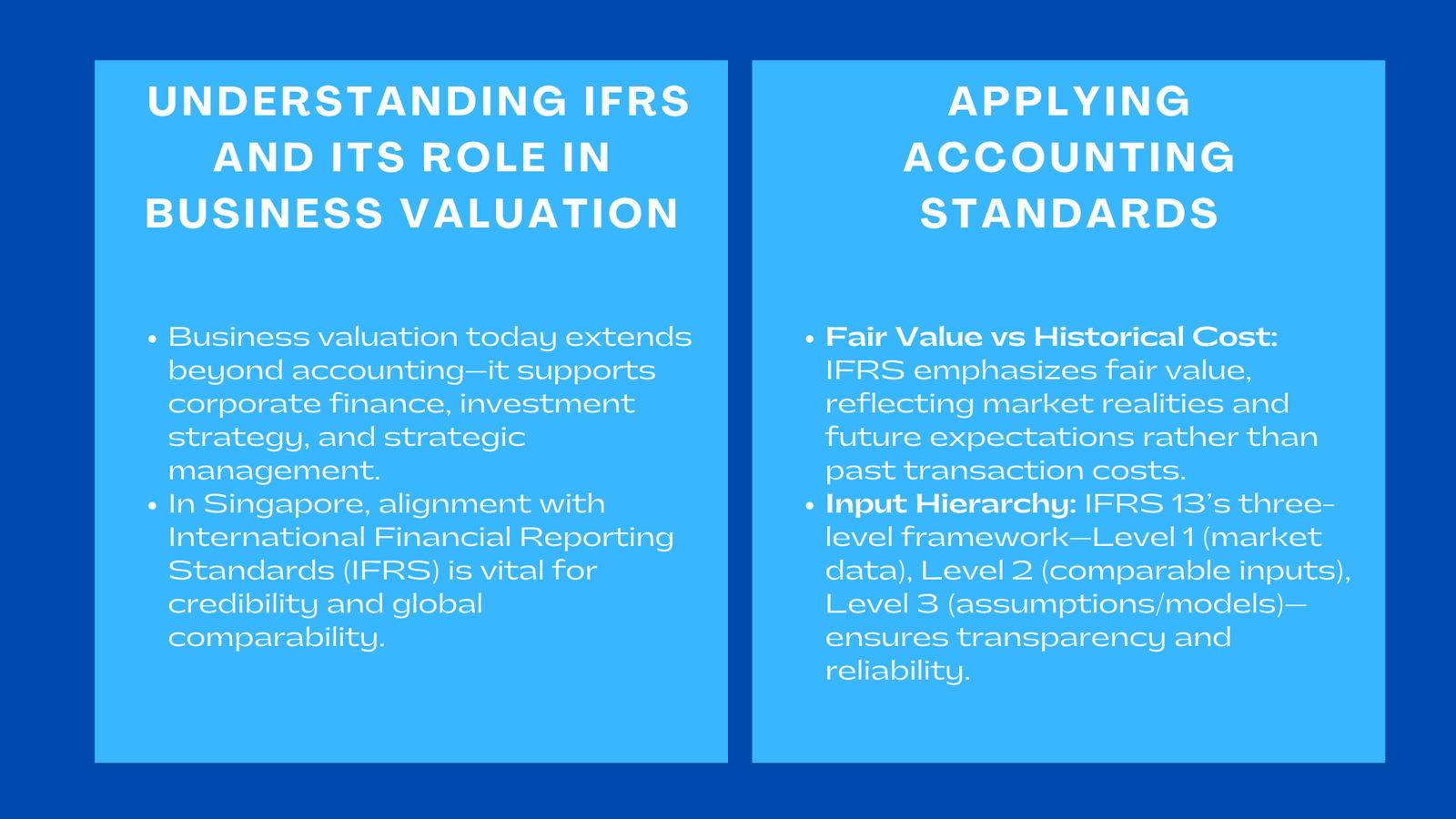
In the context of Singapore, a key financial hub in Asia, understanding and applying international accounting standards is particularly important. Businesses operating in Singapore often engage in cross-border transactions, attract global investors, and are subject to rigorous regulatory oversight. Aligning local practices with International Financial Reporting Standards (IFRS) ensures that valuations are credible, defensible, and comparable across jurisdictions. This alignment facilitates investment decisions, strengthens corporate governance, and enhances trust among investors, regulators, and the wider business community.
Accounting standards therefore serve a dual purpose: they provide a structured framework for technical valuation processes while also acting as a strategic instrument that guides corporate decision-making, risk assessment, and stakeholder communication. By integrating IFRS business valuation Singapore principles into valuation practices, organizations can achieve more accurate, transparent, and actionable insights, which in turn contribute to sustainable business growth.
The Role of IFRS in Business Valuation
IFRS as a Global Benchmark
IFRS provides a globally recognized framework for financial reporting and business valuation, offering clear guidance on how organizations should measure, present, and disclose financial information. The standards are designed to prioritize economic substance over form, ensuring that reported values reflect the actual financial and operational realities of the business. This is particularly critical in the context of valuation and understanding various business valuation method types Singapore, where the goal is not simply to comply with accounting rules but to provide stakeholders with meaningful insights into a company’s economic value.
Adhering to IFRS allows organizations to produce valuation reports that are internationally credible, reducing discrepancies in cross-border financial reporting and enabling investors and auditors to make informed comparisons between companies operating in different countries. For multinational corporations, private equity investors, and institutional investors, the ability to rely on IFRS-compliant valuations provides assurance that the reported figures are transparent, methodologically sound, and consistent with global best practices. In essence, IFRS serves not only as a technical guide but also as a tool to foster confidence and integrity in the valuation process.
Key IFRS Standards Impacting Valuation
Several IFRS standards have a direct and significant impact on business valuation. IFRS 13, Fair Value Measurement, provides a comprehensive framework for determining the fair value of assets and liabilities. It emphasizes the perspective of market participants rather than the internal assumptions of the reporting entity and introduces a three-level hierarchy of inputs, ensuring that valuations reflect observable market data whenever possible. IFRS 3, Business Combinations, requires the measurement of identifiable assets and liabilities at fair value during acquisitions, including the calculation of goodwill, which is the excess of the purchase price over the fair value of net assets. This standard ensures that all components of a business combination are transparently valued, enabling more accurate post-acquisition financial reporting.
IAS 36, Impairment of Assets, mandates regular testing of assets to determine whether their carrying amounts exceed their recoverable amounts, requiring organizations to recognize impairment losses if necessary. This ensures that financial statements reflect potential declines in asset value due to market or operational changes. IAS 38, Intangible Assets, provides guidance on the recognition, measurement, and amortization of intangible assets such as patents, trademarks, brand value, and proprietary technology. Proper valuation of these assets is essential in today’s knowledge-driven economy, where intangible assets often constitute a significant portion of corporate value. Together, these standards provide a structured, globally recognized framework that supports reliable and comparable business valuations across industries and jurisdictions.
How Accounting Standards Affect Valuation Methodologies
Fair Value Versus Historical Cost
IFRS emphasizes fair value measurement as opposed to traditional historical cost accounting. Fair value reflects the price at which an asset could be sold or a liability settled in an orderly transaction between knowledgeable and willing market participants. This approach captures both current market conditions and future expectations, making it more relevant for decision-making than historical cost, which only records past transaction values and may not reflect the current economic reality.
In practical terms, fair value measurement allows organizations to more accurately assess the impact of market fluctuations, operational changes, and strategic decisions on asset values. For financial reporting, mergers and acquisitions, and investment management, this approach ensures that valuations provide actionable insights rather than merely accounting compliance.
Input Hierarchy and Valuation Models
IFRS 13 introduces a three-level hierarchy of inputs for determining fair value. Level 1 inputs consist of quoted prices in active markets for identical assets or liabilities, such as publicly traded securities. These inputs are considered the most reliable because they reflect actual transaction prices. Level 2 inputs include observable market data other than quoted prices, such as prices from similar assets, industry benchmarks, or yield curves. Level 3 inputs consist of unobservable data, typically based on management assumptions, complex valuation models, and projections such as discounted cash flow (DCF) or Monte Carlo simulations.
Valuers must carefully select the appropriate inputs and methods based on the characteristics of the asset or liability, availability of market data, and the level of uncertainty involved. Furthermore, transparency in disclosing methodologies, assumptions, and sensitivity analyses ensures that stakeholders understand the reliability and limitations of the valuation, enabling more informed decision-making.
Consistency and Comparability
Accounting standards promote consistency and comparability in financial reporting and valuation. Organizations applying IFRS can ensure that their valuations are methodologically consistent over time, across subsidiaries, and relative to industry peers. This comparability is critical for investors, auditors, and regulators who need to assess financial performance, evaluate risk exposure, and make strategic decisions. Without standardized approaches, valuations may vary widely, undermining stakeholder confidence and potentially affecting market stability.
Regulatory Oversight and Professional Guidance
Role of Regulatory Bodies
Business valuation operates within a structured regulatory framework to safeguard transparency, reliability, and ethical standards. Accounting standards boards, such as the International Accounting Standards Board (IASB) globally and the Accounting Standards Council (ASC) in Singapore, provide guidance and oversight for consistent application of IFRS and its local adaptations. Financial regulators, including the Monetary Authority of Singapore (MAS) and the Singapore Exchange (SGX), enforce compliance, particularly for publicly listed companies and those involved in cross-border transactions. Professional bodies, such as the Institute of Valuers and Appraisers Singapore (IVAS), establish ethical guidelines, offer certifications, and provide ongoing professional development for valuation practitioners.
Together, these institutions ensure that valuation practices meet technical, ethical, and regulatory requirements, thereby promoting investor confidence and market stability.
Professional Standards and Ethical Considerations
Valuers must exercise professional judgment, maintain independence, and rigorously document their assumptions and methodologies. Adherence to IFRS ensures that valuations are defensible and objective. Ethical compliance is particularly important when valuation assumptions could be influenced by management incentives or internal pressures. By adhering to recognized standards, valuers enhance credibility and provide stakeholders with reliable, unbiased information essential for strategic decision-making.
Practical Implications for Business Valuation
Mergers and Acquisitions (M&A)
In M&A transactions, IFRS standards provide the framework for assessing the fair value of assets, liabilities, and goodwill. The Purchase Price Allocation (PPA) process requires that all acquired assets, including tangible and intangible items, be measured accurately, and that any excess purchase price is properly allocated as goodwill. Properly applying IFRS ensures that valuations are transparent, defensible, and can withstand scrutiny during negotiations, regulatory reviews, and post-acquisition reporting.
Financial Reporting and Investor Communication
Accurate valuations under IFRS significantly impact financial reporting. Proper measurement of assets and liabilities, impairment testing, and fair value recognition provide investors and auditors with reliable information, supporting transparency, credibility, and regulatory compliance. This transparent reporting also strengthens communication with stakeholders, allowing companies to explain their financial position clearly and with authority.
Taxation and Transfer Pricing
Business valuations form the foundation for determining arm’s-length pricing in intercompany transactions. Applying IFRS-compliant methodologies ensures that valuations are consistent with international tax principles and can withstand scrutiny from tax authorities such as the Inland Revenue Authority of Singapore (IRAS). Accurate, defensible valuations reduce disputes, support compliance, and facilitate strategic tax planning.
Investment Management and Portfolio Valuation
Valuation is central to investment management, determining the Net Asset Value (NAV) of funds and portfolios. For private equity, venture capital, and other illiquid investments, Level 3 inputs are often necessary, relying on advanced models and projections. IFRS provides a framework for using these methodologies consistently, ensuring that reported NAV values reflect true economic positions, thereby enhancing investor confidence and auditability.
Emerging Trends and Challenges in Valuation
Intangible Assets and Knowledge-Based Industries
The increasing importance of intangible assets, including intellectual property, software, brands, and proprietary data, presents challenges for traditional valuation approaches. IFRS provides guidance on recognition, measurement, and reporting of intangible assets, enabling valuers to quantify these often critical drivers of corporate value in knowledge-based industries.
Integration of ESG Factors
Environmental, Social, and Governance (ESG) considerations are becoming increasingly significant in valuations. A company’s ESG performance can influence its risk profile, cost of capital, and long-term sustainability. IFRS-aligned valuations provide a structured approach to incorporate ESG metrics consistently, ensuring transparency and comparability.
Technological Innovation in Valuation
Technology is transforming valuation practices through artificial intelligence, predictive analytics, and automation tools. Real-time market data, advanced modeling, and scenario planning enable dynamic valuations, enhancing both speed and accuracy. IFRS frameworks provide a foundation to apply these technological advancements while maintaining methodological rigor and consistency.
Advantages of Understanding IFRS in Valuation
Professional Benefits for Practitioners
For valuation professionals, mastery of IFRS enhances credibility, analytical rigor, and ethical accountability. Practitioners can interpret complex data, select appropriate valuation methodologies, and communicate insights confidently to stakeholders, which is essential for high-stakes financial decision-making.
Organizational Benefits
Organizations benefit from standardized, IFRS-aligned valuation practices, which improve internal governance, reduce the risk of errors or bias, and strengthen communication with investors, auditors, and regulators. Consistent valuation practices also facilitate cross-border investments and make organizations more attractive to global investors.
Macroeconomic and Market-Level Benefits
At the macro level, consistent application of IFRS promotes market transparency, comparability, and investor trust. Uniform valuation practices enhance market efficiency, support international capital flows, and strengthen overall credibility in financial markets.
Conclusion to Understanding IFRS and Accounting Standards in Business Valuation
Understanding IFRS and accounting standards for corporate valuation Singapore is fundamental to achieving accurate, reliable, and defensible business valuations. IFRS provides a globally recognized framework that ensures assets, liabilities, and equity are measured transparently and consistently.
Through proper application of IFRS, organizations can enhance financial reporting, facilitate mergers and acquisitions, support investment decisions, and maintain credibility with investors, regulators, and stakeholders. Emerging trends, such as the increasing role of intangible assets, ESG integration, and technological innovation, present new challenges that require continuous adaptation. Nevertheless, adherence to IFRS principles ensures that valuations remain rigorous, transparent, and internationally accepted.
By mastering IFRS and its application to business valuation, professionals and organizations alike can achieve strategic insights, strengthen governance, and create sustainable value in a complex and competitive global business landscape.