Accredited Business Valuation Trends Workshop
Emerging Trends in Business Valuation and Deal-Making
Introduction: Accredited Business Valuation Trends Workshop
The international business environment of valuation and business dealings is fast changing with the technological changes, changing demands of the investors and the ever complicated world of business. Innovative valuation techniques are being embraced to help companies, private equity and investors to capture intangible assets, risk management and strategic opportunities. With mergers, acquisitions, and capital raises still defining the global markets, the knowledge of the most recent trends in valuation and deal structuring is more important than ever.
Changing the Emphasis to Intangible Asset Valuation.
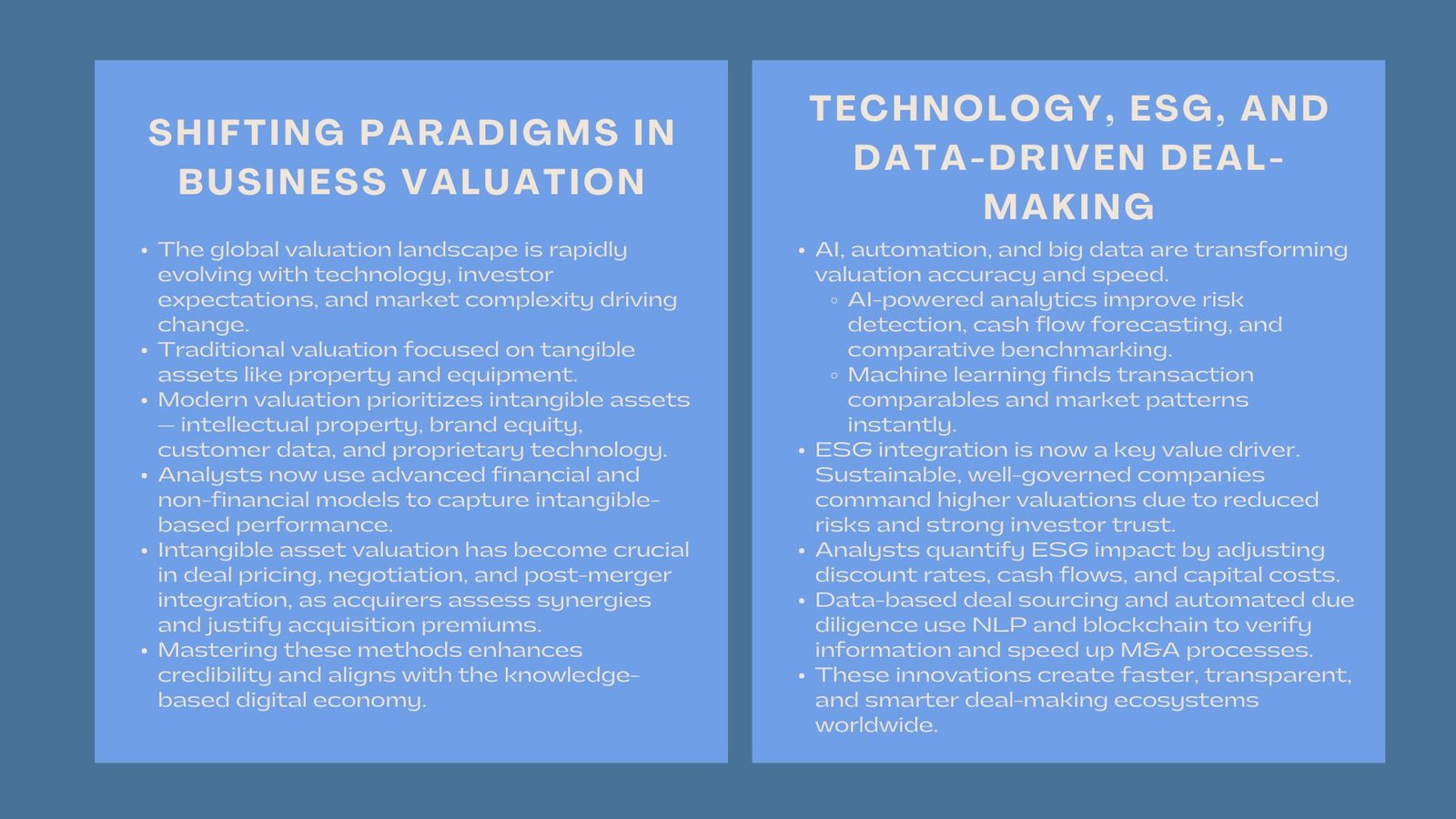
Traditionally, the valuation of business paid much attention to tangible assets, i.e. property, equipment and inventory. But, in the modern economy, the real worth of a business lies often in the intangible assets of a company intellectual property, brand recognition, customer base, data. This has been enhanced by the increased dominance of technology based and service based industries. The field of valuing intellectual capital, digital platforms, and proprietary technologies is getting more and more adopted by the analysts with the help of specialized techniques.
Investors are now becoming aware that traditional methods of valuation, such as book value, or basic multiples of earnings, do not entirely reflect intangible-based performance. This change has caused an increased usage of both financial and non-financial valuation models that are more advanced. Consequently, intangible asset valuation has taken center stage in the deal negotiations and post-merger integration where the acquirers can evaluate the synergies as well as rationalize the acquisition premiums.
The role of technology in the current valuation.
The use of technology has changed all the valuation and deal-making. Analyzing the data, which previously took longer and was less accurate, can now be done much quicker and more precise with the help of automated financial modeling tools, AI-driven analytics, and big data platforms. These developments are used to model scenarios in real-time and perform predictive forecasting to assist the professionals undertaking valuation to anticipate the possible result under various market conditions.
In the case of machine learning, to find similar transactions or compare company performance across industries, it is possible to analyze large amounts of data. It is also artificial intelligence that is assisting valuation experts identify deviations in financial statements, gauge the stability of cash flow, and future growth paths using past and macroeconomic information. The integration of AI-powered business valuation analytics has elevated the precision and transparency of valuation processes, especially in sectors like technology, healthcare, and financial services where data plays a dominant role.
Value Drivers: ESG and Sustainability.
The environmental, social, and governance (ESG) considerations have never had as much impact on business valuation and deal strategies as it does today. Sustainability practices, climate risk exposure and ethical governance are the new areas of transparency demanded by investors and regulators. Those companies that take ESG risks seriously and operate within the reality of global sustainability policies tend to have greater valuation because of the strong brand recognition gained and fewer risks in the long run.
The concept of ESG into valuation models is not limited to the qualitative analysis. The analysts are moving toward quantifying ESG performance through discount rates, cash flow projections and cost of capital assumptions adjustments. As an example, companies that have good sustainability records could enjoy reduced perceived risk and green financing which eventually enhances the valuation results. This development is indicative of a wider understanding of ESG performance as being directly correlated with financial performance in the long term and stakeholder confidence.
Emergence of Data-Based Deal Sourcing and Due Diligence.
The digital transformation is also being extended to deal-making processes. Offline connection-based sourcing is being integrated with data-driven deal identification systems as well as automated due diligence systems. Sophisticated analytics systems have the ability to search through thousands of possible targets to find those companies that fit particular acquisition criteria, depending on such metrics as revenue growth, market share, or customer sentiment.
In due diligence, the automation of data reviews, financial analysis, and compliance checks is now being conducted. Natural language processing (NLP) systems have the ability to process significant information within contracts, patents, and regulatory filings in minutes less than human analysts would spend. This has increased the speed in deal processes and enhanced precision in the evaluation of financial and operating risks. Moreover, cross-border transactions are getting more transparent and secure due to digital data rooms, blockchain verification, and AI-based document analysis.
Greater significance of Scenario Analysis in Deal Structuring.
The uncertainty surrounding the economy and market has necessitated the need to incorporate scenario-based analysis into the decision-making models of valuation professionals and dealmakers. Instead of the base-case projections that only use the base case scenario to estimate a deal outcome, analysts are building various scenarios of valuation to determine the impact of different market conditions on the outcomes of a deal. This involves simulation of the effect of inflation, fluctuation of interest rates, disruption of the supply chain and the effect of geopolitical risks.
This type of scenario modeling enables investors to discover possible weaknesses in the deal at an early stage and make more favorable bargains. An example is that contingent earn-out and performance-based compensation are gaining increasing popularity as a means to narrow the valuation differences between buyers and sellers. Such leeway mechanisms guarantee that final consideration is in tandem with the actual performance of the company after acquisition and minimize risk between the parties.
The relevance of Alternative Financing and Private Capital.
The growing role of private capital – particularly that of private equity, venture capital and sovereign wealth funds is another important trend that is influencing deal-making. These investors are also playing a vital role in investing in innovation and making cross-border transactions. As the conventional financing facilities are constrained in most locations, the private capital is giving the liquidity and flexibility in strategic investments.
In particularly, the private equity firms are adopting more innovative deal structures like minority ownership, joint ventures, and structured equity participation. The strategies allow investors to benefit both in the upside and downside risk. In the eyes of the valuation professionals, this development requires them to have a better insight into hybrid financing instruments, and how they affect the fair value assessment.
International Sales and Integration.
The aspect of globalization still continues to impact the valuation and structure of deals. With the internationalization of companies, valuation specialists have to deal with varying accounting regulations, taxation, and regulatory setups. There is also a necessity to have a more profound knowledge of cultural peculiarities, risks in local market, and exchange rates in cases of cross-border transactions.
The Asian, African and Latin American emerging markets are also becoming hot spots in terms of deal activity. High-growth opportunities are attractive to investors with higher volatility and uncertainty in the political sphere. In this situation, valuation accuracy and risk analysis will be even more important.The integration of cross-border business valuation methodologies allows professionals to harmonize financial assumptions and risk factors across jurisdictions, ensuring comparability and transparency in multinational transactions.
The Increasing Power of Online Property and Tokenization.
The emergence of digital assets and tokenized investments is one of the most radical changes in the field of valuation. The blockchain technology has facilitated fractional ownership of assets, both real estate and intellectual property. These tokenized models have opportunities and challenges to valuation experts. The establishment of fair value of digital assets needs newly developed strategies that take into consideration the liquidity, market adoption, and the underlying technological risks.
When it comes to M&As, organizations with substantial digital resources, including cryptocurrencies or NFTs, have to be accredited through two different approaches: a mixture of financial and market-oriented value. When the regulatory clarity is enhanced, the tokenization can become a common aspect of the deal structuring process that enables the more efficient capital allocation and trading in the secondary markets.
Looking Ahead
With the changing scenario of global markets, data intelligence, sustainability and adaptability will mark the future of business valuation and deal making. The valuation professionals should be dynamic and should have the combination of financial skills and technological skills as well as strategic insight. Valuation accuracy and speed of deal execution will also be enhanced as the integration of AI, ESG metrics, and real-time data analytics will go on.
Meanwhile, the principles of valuation, including the knowledge of business drivers, risk management and harmonisation of interests, do not change. The issue with valuation professionals of the modern world is to strike the right balance between classical standards of analytical rigor and new methodologies that capture current realities of the fast-changing business world. The players that embrace these new trends will not only improve the precision of valuation but also increase their presence as key players in determining the future of deal-making.
Frequently Asked Questions
Why are intangible assets becoming more important in business valuation?
Intangible assets such as intellectual property, software, customer relationships, proprietary data, and brand reputation often represent a significant portion of a company’s value, especially in technology and service-based industries. Modern valuation methods increasingly incorporate these assets because they are key drivers of competitive advantage, future earnings, and long-term business growth.
How is artificial intelligence (AI) transforming business valuation and deal-making?
AI enhances valuation by automating financial analysis, identifying trends, forecasting cash flows, detecting anomalies, and analyzing large datasets much faster than traditional methods. In mergers and acquisitions (M&A), AI also supports due diligence, risk assessment, and comparable company analysis, enabling faster and more informed decision-making.
What role do ESG factors play in company valuation today?
Environmental, Social, and Governance (ESG) factors have become important valuation considerations because they influence a company’s long-term sustainability and risk profile. Strong ESG performance can improve investor confidence, reduce financing costs, enhance brand reputation, and potentially increase business valuation, while poor ESG practices may lead to higher risks and lower valuations.
Why is scenario analysis becoming more important in modern deal-making?
Scenario analysis allows investors and business leaders to evaluate how different economic conditions, market changes, interest rates, or operational risks may affect company value. By testing multiple outcomes instead of relying on a single forecast, organizations can make more resilient investment, acquisition, and strategic decisions while better managing uncertainty.
How are cross-border transactions changing business valuation practices?
Cross-border transactions require valuation professionals to consider differences in accounting standards, taxation, regulations, exchange rates, and local market conditions. As international deals continue to grow, businesses increasingly use standardized valuation methodologies and comprehensive risk assessments to ensure fair valuations and support successful global mergers, acquisitions, and investments.