Certified Share Price and Company Valuation
Impact of Market Conditions on Share Price and Company Value
Introduction: Certified Share Price and Company Valuation
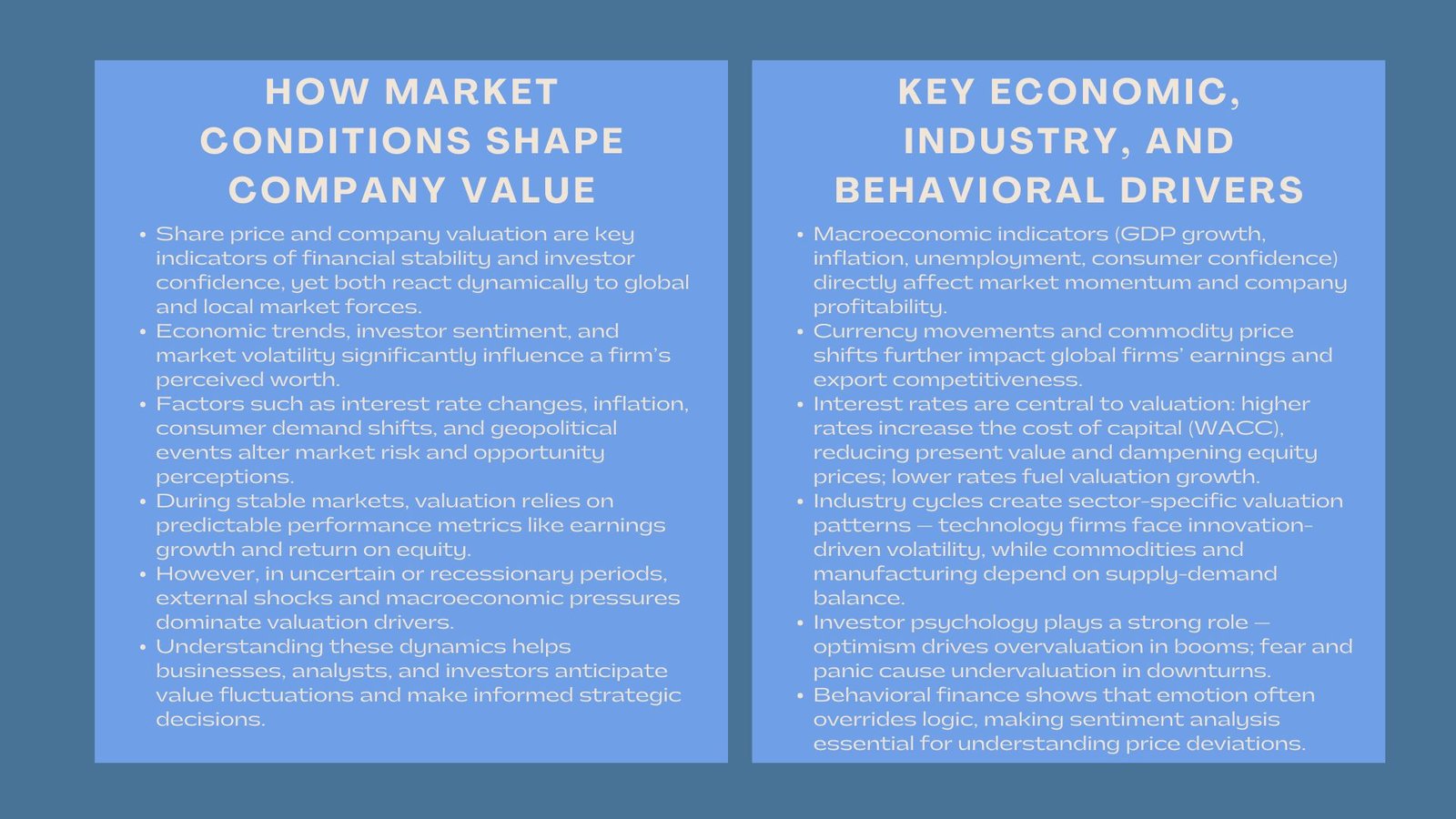
The most noticeable financial stability and investor trust indicators include share prices and company valuation. However, they do not act in isolation, as they act dynamically in response to larger market environment, both local and international. The knowledge of the impact of economic trends, investor sentiment, and market volatility on value is critical to businesses, investors as well as analysts. It is either a variation in the interest rates, or alteration in consumer demand, or political events in the geopolitical arena, all these factors can have a major effect on the perceived worth of a firm within the market.
Relationship between Market Forces and Valuation.
In its most simple form, the share price of a company is a collective reflection of the market on what the company will be able to achieve in the future in terms of future profitability and risk profile. At a point when the market environment is stable, the investors are able to make valuation decisions based on the predictable performance measures which include earnings growth, cash flow and return on equity. The same fundamentals however, during uncertain periods or during economic downfalls will be shadowed by external factors that would redefine views of risk and opportunity.
As an illustration, with increased interest rates, the cost of borrowing will go up and this will make corporate earnings less and it will lower the present value of future cash flows. This normally results in reduced valuation particularly to expansion-oriented firms that are highly dependent on estimated income. On the contrary, share prices and enterprise values are increased during low interest rates or robust economic growth as investors are more prone to higher premiums.
The Macroeconomic Indicators Role.
The macroeconomic conditions act as a guide of investor feelings and company worth. The main indicators like GDP growth, inflation, unemployment rates and consumer confidence have a direct impact on the momentum of the market and also the performance of the company. In the boom times, stock prices increase due to an increase in consumer demand and larger profit margins. On the other hand, in case of inflation spurt or reduced growth in economic performance, market players re-evaluate risk levels, which usually leads to compression of valuation.
There is also the factor of currency fluctuations especially to firms that are high internationally exposed. The currency will make overseas incomes less valuable when it is strong whereas export competitiveness and incomes will be increased when the currency is weak. Equally, the commodity prices including the oil, metals or the agricultural products are subject to ripple effects on sectors that are related to the production cost or the global trade.
Investor Psychology and Sentiment.
Other than basic economic factors, the psychology of the market plays a significant role in share price movements. Temporal flotation between intrinsic value and market price can arise due to investor sentiment which may be stoked by media coverage or analyst reports, or it may be due to macroeconomic uncertainty. In booming markets, the positive market feeling can result in overvaluation when investors pursue the momentum stocks. Conversely, bearish markets may cause mass selling which causes price to fall below the fundamental prices.
According to the study of behavioral finance, there are emotional factors like fear and greed that tend to affect short-term fluctuations in the market rather than a rational analysis. This is the reason why the valuation professionals give extra attention to the volatility indexes, trading figures and investor surveys. These factors give a clue on whether the present price trends represent the underlying underlying fundamentals or speculation.
Interest Rates and Cost of Capital.
One of the most market influencing factors on the valuation of companies is interest rates. Interest rates prevailing in the market are included in the discount rate applied in the valuation models, especially the weighted average cost of capital (WACC). Increases in the cost of capital as the monetary policy and rates go up lower the present value of future cash flows. This normally results in underpricing particularly in high growth or capital-intensive industries.
In case of income-generating enterprises, including utilities or real estate investment trusts (REITs), capital outflows might be experienced as a result of equities as fixed-income securities become more attractive to investors in case of higher interest rates. Conversely, the opposite was also true since lowering the rates led to an increase in the equity valuations since investors wanted more returns on their stock market. Interest rates and share prices are therefore direct and cyclical in the sense that they not only influence valuation but also decision to allocate capital.
The Effect of Industry Cycles.
Market conditions are also different in industries, which presents a distinctive valuation dynamics. As an example, technology companies are prone to high-rate valuation fluctuation as an outcome of innovation cycles and investor demands regarding expansion opportunities. Companies involved in energy and commodity, on the other hand, are more susceptible to the global supply-demand discrepancies and geopolitics. Cyclical industries like the automotive, construction, and manufacturing are especially sensitive to the swings in the consumer confidence and the trend of business investments.
The analysis of industry specific drivers aids analysts to differentiate between short term volatility and long term value creation. This is where market-driven company valuation analysis becomes critical — it combines financial performance with macroeconomic trends, industry data, and comparative metrics to produce a more comprehensive valuation outlook.
Effects of World Events and Geopolitical Shocks.
The effects of geopolitical events, trade policies and world crises can be very severe on confidence of the markets and flow of capital. Battles, epidemics or disruption in the supply chain can create a massive uncertainty, which leads investors to reconsider risk exposure. In such periods, risk-averse assets such as gold or government bonds normally appreciate whereas equity markets can fall.
Geopolitical risks in the case of the multinational corporations may derail operations, change cost structure, and decrease access to the market. These uncertainties are usually priced by investors in valuation of companies by imposing high risk premiums or using low growth assumptions. This underscores the need to have elastic valuation models which are able to factor in geopolitical stress testing and dynamic forecasting.
Technology and perception of the market.
The other new trend that has been affecting the price behavior of the shares is the influence of adoption of technology and digital transformation. The markets are also rewarding businesses that are innovative and flexible, especially in such areas as fintech, healthcare technology, and renewable energy. Companies that do not innovate or cannot adjust to the new ways of consumer behavior tend to see their valuation fall even when their financial results are in check.
The integration of real-time financial data analytics for equity valuation has made it easier for investors and analysts to track performance indicators, benchmark peer comparisons, and identify value gaps. These tools are based on artificial intelligence and machine learning to determine the relationships between market movements and company fundamentals, and result in more accurate pricing decisions and market transparency.
Strategy of Market Volatility and Long-term Valuation.
Although short term market volatility can be an upsetting situation, experienced investors can understand that volatility usually opens up long term opportunities. One such type of investor is value investor, who will look to buy undervalued companies when the market is down with the anticipation that the market will one day pick up and the share value will align with intrinsic value. Similarly, the executives of corporations take market crashes as a chance to buy back stocks or make acquisitions at reasonable prices.
Volatility management entails a strict strategy of valuation and financial review. When the market mood turns to the negative direction in the short term, companies need to convey their long-term strategy well to ensure that the investors do not lose confidence. Clear disclosure, steady dividend policy and good governance structures will reduce the valuation volatility by enhancing credibility and stability.
Conclusion
The dynamics of market and investor behaviour of investors and economic variables are fundamental to the dynamics of the market and how the prices of shares of companies and their valuation change. Even though underlying determinants prevail in the long-term value, external forces which include interest rates, global events, and others can have a profound impact on the short-term pricing movements. Investors and businesses will be in a better position to manage the volatility in the market and make sound strategic decisions by interpreting economic indicators, behavioral insights, as well as industry-specific data in their analysis.
In a rapidly globalizing economy, companies that modify their valuation systems to accommodate the emerging market realities will be in the best position to create value, handle risk as well as grow sustainably over the long-run.
Frequently Asked Questions
How do market conditions affect a company's share price?
Market conditions such as interest rate changes, inflation, economic growth, investor sentiment, and geopolitical events directly influence share prices. Positive economic conditions typically increase investor confidence and company valuations, while uncertainty or economic downturns often lead to lower share prices.
Why do interest rates impact company valuation?
Interest rates affect the cost of borrowing and the discount rate used in valuation models like Discounted Cash Flow (DCF). Higher interest rates generally reduce the present value of future cash flows, leading to lower company valuations, while lower rates tend to support higher valuations.
Can investor sentiment influence share prices even if company fundamentals remain strong?
Yes. Investor sentiment, driven by market psychology, news, analyst reports, and global events, can cause short-term price movements that differ from a company’s intrinsic value. Fear and optimism often create temporary overvaluation or undervaluation.
Which industries are most sensitive to changing market conditions?
Different industries respond differently to market conditions. Technology companies are highly sensitive to interest rates and growth expectations, while energy, commodities, manufacturing, and real estate are more affected by commodity prices, economic cycles, and geopolitical developments.
How can investors manage valuation risks during volatile markets?
Investors can reduce valuation risk by combining fundamental analysis with market analysis, diversifying their portfolios, monitoring macroeconomic indicators, and focusing on long-term intrinsic value rather than reacting to short-term market fluctuations.