Company Valuation for Financial Reporting & Investor Due Diligence Singapore
Introduction to Company Valuation Due Diligence
The Importance of Company Valuation Beyond Compliance
Within the highly developed financial landscape in Singapore, company valuation Singapore has developed far beyond a formal compliance procedure. Although the regulatory requirements, especially the provisions of the IFRS and the Singaporean SFRS(I) framework might compel a company to undertake a valuation event on an ongoing basis, especially on each acquisition, on each impairment testing, and each fair value determination date, the most progressive companies in Singapore have realized that valuation is much more than a reporting activity.
Valuation is fundamentally a language – the language that a company uses to express to investors, lenders, regulators, and strategic partners its economic value or economic value. An executed, independently supported valuation will inform the market not just what a company is worth at any one point in time but what reasons underlie that valuation: what are the assets that bring the value, how do the assets that bring the value are secured, and what direction is the business headed? It is both a governance indicator and a strategic implementer and a compliance deliverable.
Quality company valuation Singapore
by Singapore companies operating in mergers and acquisitions, IPO preparation, fundraising, or restructuring, the credibility of financial disclosure is directly related to the quality of company valuation Singapore practice, the success of the investor negotiation, and the defensibility of management decision making by the company under regulatory examination. The reasons why the quality of valuations matters are that there is consistently better performance of the companies that invest in quality of valuations i.e. commissioning independent experts and using rigorous methodologies and reporting assumptions transparently are found to be better in efficiency of fundraising, deal pricing and audit results compared to their counterparts.
Procedure in Financial Reporting and Investment Decision.
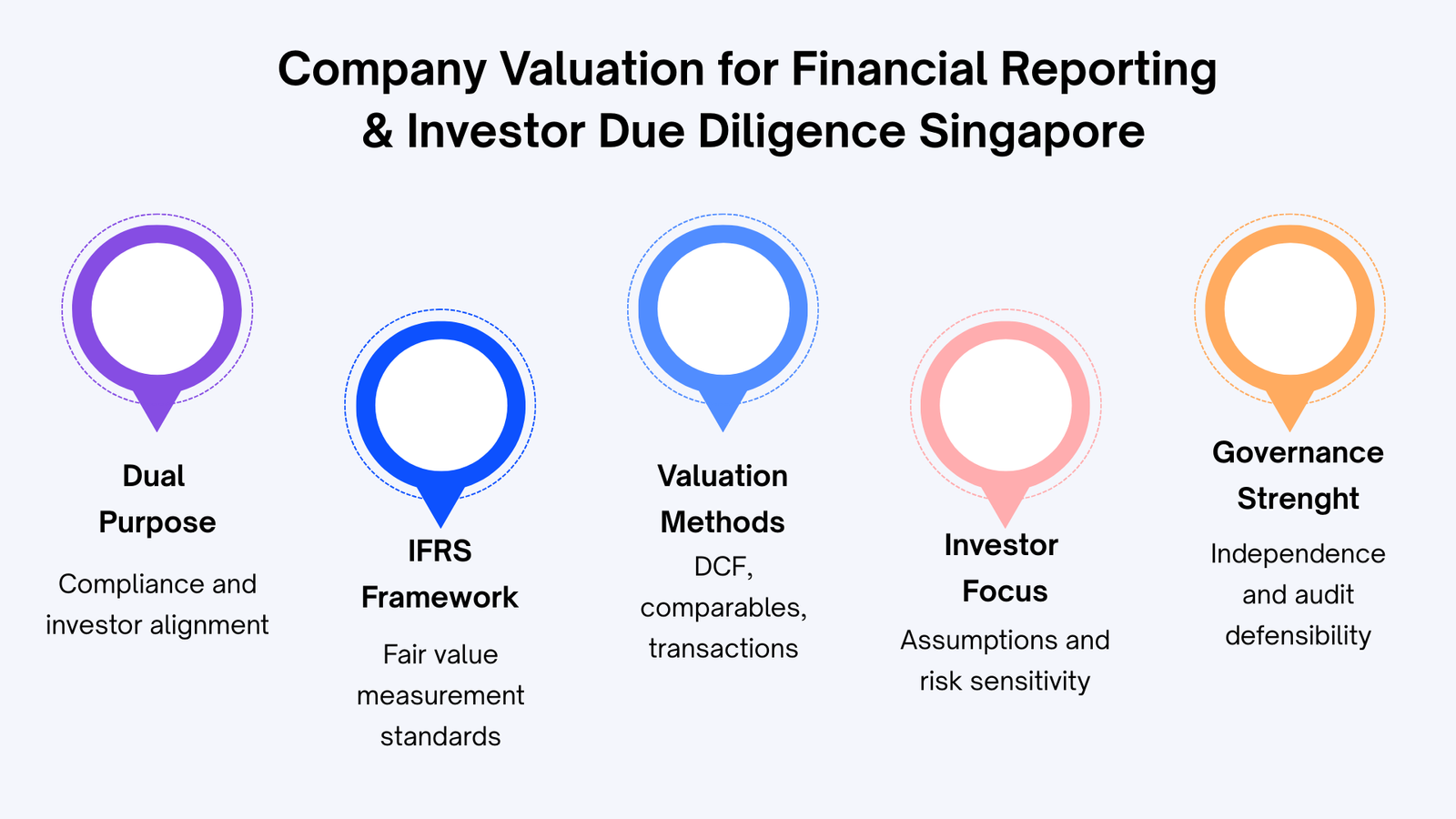
The two-fold role of company valuation in the Singapore business environment, which fulfills both financial reporting and valuation of decision making to investors, poses a unique set of demands. Valuation should be completed as per the IFRS standards: that is, IFRS 3 (business combinations), IFRS 13 (fair value measurement), IAS 36 (impairment testing), and IFRS 16 (lease valuation). These standards have certain methodological requirements, disclosure and audit scrutiny which influence the way valuations are carried out and reported.
In investment decisions, such as those that venture capital funds may need to make when evaluating a Series B investment, or to the private equity firms when evaluating an acquisition, or to strategic buyers, the requirements are different but complementary. Defensibility, comparability, and analytical rigour are of concern to investors. They desire to know the assumptions behind value, sensitivity of these assumptions and what are the worst scenarios that might reduce it. Trying to meet the IFRS disclosure requirements, but not trying to respond to the economic questions that investors are really asking, will not create the investment conviction that is required to close a deal at the right terms.
Managing this two-way imperative, financial accounting reporting compliance on the one hand and investment grade analytical rigour on the other, is the main difficulty of the practice of company valuation Singapore. This guide handles the two dimensions in a systematic way and offers the practitioners the frameworks, methodologies, and best practices to generate valuations that are valuable to the two masters.
Financial Reporting Valuation
10 IFRS Requirements on Fair Value Reporting
Companies and other entities that prepare financial statements in Singapore are obliged to use SFRS(I) the Singapore version of IFRS which obligates them to prepare financial statements that give rise to mandatory financial reporting valuation events spanning a variety of standards and reporting period cycles. The basics of compliance planning and investor communication are based on understanding what valuation requirements are initiated by which IFRS standards and what they are.
The basic financial reporting valuation standards in the SFRS(I) are IFRS 13 (Fair Value Measurement), which gives the general definition of fair value, and the measurement framework under all IFRS standards that require or allow fair value measurement, IFRS 3 (Business Combinations), which regulates the recognition and measurement of acquired and internally generated intangibles, and IFRS 16 (Leases), which mandates leases, and right-of-use assets, to be measured at current value.
According to IFRS 13, fair value is the amount that would be obtained in order to sell an asset or remunerate to transfer a liability in a transaction that is regular between market parties on the measurement date. This market-participant, exit-price, concept is the foundation of financial reporting valuation under IFRS – and this implementation needs professional judgment and market data and thorough documentation that transcends the mere book value adjustments.
The Role of Valuation in Transparency and Comparability
In addition to meeting regulatory requirements high-quality financial reporting valuation is important to capital markets in a more basic way: it allows investors and analysts to compare companies in a consistent way that is economically meaningful. Once a Singapore company has rightly determined and determined the fair value of the acquired intangible assets, the goodwill balance is simply a reflection of the real unidentifiable premium paid to the target company and not a storage facility of unanalysed value. Goodwill write-downs are taken when they are required, and not dictated by auditors, when the impairment tests are rigorously carried out.
Both the Singapore Exchange (SGX) and the Accounting and Corporate Regulatory Authority (ACRA) have indicated in regulatory communications and audit quality reviews that financial reporting valuation quality is an area of focus that should be the subject of continued examination. Companies that report poor performance on fair value measurement of their financial statements especially on the aspect of acquiring accounting and goodwill are subject to regulatory scrutiny, restatement risk, and the reputational cost involved in developing corrected accounts that had been reported before.
To investors, quality of fair value disclosures in the financial statements of a company is an indirect measure of quality of the management. Companies that make extensive, clear, and well-described disclosures of fair value, including with clear descriptions of the methods used, clear descriptions of assumptions, and material sensitivity analysis, are becoming evidence of the discipline and analytical rigour of governance to which sophisticated investors are accustomed. This relationship is not accidental: good financial reporting valuation normally results in good capital allocation and business management.
Due Diligence Investor Valuation
Investor Valuations: What Investors want to know in Valuation Reports
In case institutional investors are performing due diligence valuation in Singapore (be it a private equity takeover, a venture capital follow-on or a strategic M&A acquisition) the answers to a set of specific questions extend far beyond the top-line valuation figure. Knowledge of what these questions are and getting the valuation report to answer them specifically is the basis of investor ready valuation preparation.
The main questions that investor valuation requirements attempt to answer are: Is the value promoted by a believable, autonomously executed procedure? Do the major assumptions, such as revenue growth, margin trajectory, discount rate, terminal value, have any basis on observable market data as opposed to management aspiration? What are the values that are reasonable, in various conditions, and what happens to the values at the edges of the range of reasonable values? Is the IP and competitive advantage durable such that a competitor can recreate it without the premium? And is it an actual arm-length market view valuation, or is it toxified by enthusiasm of deals or relationship?
Singapore M&A and private markets Sophisticated investors have become quite analytical in terms of valuation evaluation of due diligence report. The professionals working in family offices that have their own dedicated investment teams, in the international PE funds with offices in Singapore, or SGX- listed strategic acquirers all know how to stress-test DCF assumptions, make the wrong methodology choices and what valuations have been influenced by the result of a negotiation process and not by independent analysis.
Vital Measures and Valuation Suasion
The validity of a company valuation Singapore report as a due diligence tool by investors is based on a number of observable indicators that are the quality proxies of experienced investors:
Independence of the valuer: Report prepared by a credentialed specialist, who has no financial interest in the outcome of the transaction, is of much greater weight than that prepared by management or by the advisers of the company.
Valuation methodology suitability: The most widely used valuation methodology in the similar assets and similar situations should be used and not the valuation methodology that results in favourable result. The selection of methodology that seems to have been determined by the conclusion instead of the analysis is something that investors are sensitive to.
Support of assumptions: All the key assumptions must be traced back to a particular identifiable source, such as, industry research, management accounts, regulatory information or market databases. Self-referential or circular assumptions will be found and defied.
Sensitivity and scenario analysis: A valuation which shows one number of the base-case is not complete. Investors would want to understand how the value varies as they vary the key assumptions within their plausible ranges, and what would the bottom of the book would be under conservative assumptions.
Reconciliation to similar evidence: The determination of valuation ought to be reconciled to indicators of market observation – similar company trading multiples, recent M and A transactions comparables or sector benchmarks – with reasons given as to why such references are materially different.
The Techniques of Valuation of the investors
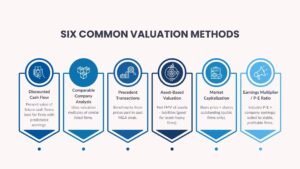
Discounted Cash Flow (DCF)
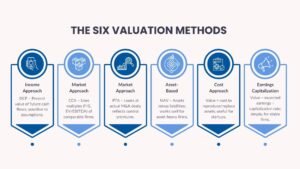
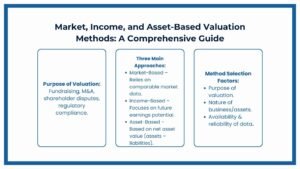
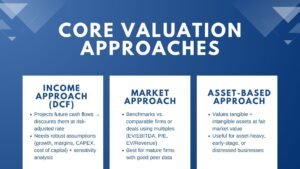
Discounted Cash Flow method is the most theoretically-based and widely applied method of M&A valuation standards and investor due diligence in Singapore. DCF calculates the intrinsic value of a business by estimating the net cash flows of the business (free cash flows) at the explicit forecast period, which is normally five to ten years, and discounting them to present value at a Weighted Average Cost of Capital (WACC) based on the business risk profile and the capital structure of other similar businesses.
The terminal value, the present value of cash flows outside the explicit forecast period, usually contributes 60 80 percent of the total DCF value, so the assumptions underlying it have the most important consequences in the whole analysis. The most frequently used models of computing terminal value according to the practice of Singapore investor valuation requirements include the Gordon Growth Model (capitalising a normalised terminal-year free cash flow at the WACC less a long-term sustainable growth rate) or an exit multiple model (applying a sector EV/EBITDA multiple to the terminal-year EBITDA).
The derivation of WACC used in Singapore companies is based on the standard CAPM framework, with the Singapore Government Securities yield used as risk-free rate, Singapore-specific equity risk premium (typically in the range of 5.5 to 7.5% of most sectors, in accordance with country risk datasets offered by Damodaran) and industry beta of similar listed companies and a size premium to smaller or privately-held companies. The resultant WACC must be brought to market evidence in observable form – e.g. implied WACCs on similar valuations of public companies – one checking sanity.
Market Comparables
The market comparables method – or trading multiples or comparable company analysis (CCA) – valuation of a business is based on the trading multiples of publicly-traded corporations in similar sectors. The most common multiples that are applied when valuing companies in Singapore are EV/EBITDA, EV/Revenue, EV/EBIT and Price/Earnings, which are chosen due to the nature of the industry and the level in which the company is in.
In the case of Singapore firms, the appropriate comparables normally comprise of the SGX-listed comparables (where there are enough domestic representatives), ASEAN-listed comparatives (where the businesses are consumer, real estate, and financial services-based), and global sector comparables where there is not enough data on Singapore. The international comparables have to be adjusted to differences in country risk, global liquidity premiums and profile of growth – adjustments which should be clearly applied and justified.
The market comparables method is the most dependable when: there are, actually, comparable listed firms; the financial performance of the subject company (margins, growth rate, leverage) is generally similar to the comparables; and current market conditions are not being misleading by short-term sentiment, sector dislocation, liquidity crises making trading multiples unreliable predictors of underlying value.
Precedent Transactions
The value of business using precedent transaction analysis is the amount paid in similar past M&A transactions as indicated by multiples. This is especially applicable to valuation standards of M&A in Singapore, since the transaction multiples usually incorporate a control premium, meaning the premium that an acquirer will pay to acquire a controlling interest and as such, they are the most relevant benchmarks when negotiating the acquisition prices.
The precedent transaction database of Singapore is based on the acquisitions announced by SGX, cross-border transactions in the ASEAN region and transactions across the global industry. Major databases such as the Capital IQ, Bloomberg, and Mergermarket offer transaction multiple data, but in Singapore and ASEAN private transactions are not as well covered as more developed markets, and in that case it is common that practitioners have to expand their comparable universe of transactions to cover relevant Asia-Pacific transactions.
The main factor to be taken into account in the application of precedent transaction multiples is context comparability: transactions made in other market cycles, based on other strategic justification or with significantly different target characteristics can be non-representative. Practitioners need to evaluate the similarity of every precedent in such areas as deal size, strategic justification, target margin structure, growth pattern, and market environment at the moment of the transaction.
Adjusted Net Asset Approach
The adjusted net asset approach also known as net asset value (NAV) values a business by adjusting the carrying amount of all the assets and liabilities with the current fair values and adding them up to obtain the net asset value. The method is best used to hold companies, businesses with significant value of assets (e.g. property companies, mining firms, and investment funds) and companies being valued on a liquidation or break-up basis but not as a going concern.
Adjusted net asset method is widely used in valuing Singapore due diligence situations in relation to property holding companies, infrastructure related businesses, and conglomerates with large bases of tangible assets. In most running companies, especially the technology, financial services, and professional services companies, the adjusted net asset approach will greatly undervalue the business by disregarding intangible value created by the company through the operations of the business, brand, customer relationships, and intellectual property.
The IFRS 3 Purchase Price Allocation has its conceptual basis in the adjusted net asset approach through which each identifiable asset and liability is valued to fair value at the time of purchase, and the surplus between consideration and the resulting net asset value is recorded as goodwill in a business combination environment.
Singapore Background: Data, Market, and Issues
Issue of Data Availability
Another characteristic aspect of company valuation Singapore practice, relative to other larger markets, including the US or the UK, is that the majority of comparable transaction information is not available in the valuation of the company and SMEs. The private M&A market is smaller than that in other global markets, and the deal terms of the private practices are not publicly disclosed, and Singapore is still developing its private M&A market. This information weakness has an impact on the market comparables method (comparable transaction multiples might not be available) and income-based methods (industry growth standards and industry sector margin information on Singapore-specific businesses might need to be supplemented by regional or global sources).
Common strategies used by the practitioners in dealing with data shortfall in Singapore M&A valuation standards engagements include: expanding the comparable universe to ASEAN-listed or ASEAN-transactions peers, with country risk differentials recorded; use of global sector databases ( Royalty Range, sector statistics at Damodaran, IPS market data ) with calibration to Singapore; use of Singapore Institute of Valuers and Appraisers, IPS IP Value Lab or other local databases of sector data; and reporting the limitations on data transparently in the valuation report, with an explicit sensitivity analysis acknowled
The current investment in data infrastructure by the Singapore government such as the ACRA BizFile+ corporate database, the MAS financial sector statistics and the SGX market data services is slowly enhancing the data environment with respect to valuing data specific to Singapore. Particularly, the IP Value Lab of IPOS offers more comprehensive information on intangible assets transactions that are relevant to financial reporting values of businesses that are intensive in IP in Singapore.
Effects of Local Market Conditions
The market conditions of Singapore generate some unique considerations of investor valuation needs and financial reporting valuation exercises. The reason why global macroeconomic cycles- interest rate fluctuations, China growth path, and US-China trade relations have a disproportional impact on Singapore corporate cash flows and risk premium is because its open, trade-dependent economy. The valuations conducted under high levels of global uncertainty have to contain higher levels of risk premiums and have to assume lower levels of growth as compared to valuations drawn in stable settings.
The high real estate prices of Singapore, which are one of the highest in Asia, influence the values of the businesses that have high physical premise needs, in particular, retail, F&B, and hospitality businesses with occupancy costs being a substantial part of cost base. The lease liabilities under IFRS 16 of Singapore businesses may significantly exceed the lease liabilities of similar businesses in the lower cost jurisdictions, which has a direct effect on net debt, bridge of enterprise to equity value, and covenant headroom.
Tight, highly educated, and costly labour market, by regional standards, has an impact on Singapore on its margin projections and the valuation of workforce in the valuation of companies Singapore practices. Assemblies of workforce value that are considered a contributory asset (although not individually as an intangible) under IFRS 3 PPA practices can be more in the case of Singapore enterprises than similar enterprises in less-costly ASEAN markets.
| Local Factor | Valuation Impact | Practical Adjustment |
| High real estate costs | Elevated IFRS 16 lease liabilities; higher operating cost base | Ensure IFRS 16 lease liabilities fully reflected in net debt bridge; adjust margin benchmarks for local occupancy costs |
| Tight labour market | Higher workforce costs; elevated assembled workforce contributory asset value | Reference Singapore-specific salary benchmarks; reflect foreign worker quota constraints in labour cost projections |
| Open, trade-dependent economy | Greater sensitivity to global macro conditions; higher risk premiums in uncertainty | Calibrate discount rates and growth assumptions to current MTI forecasts; apply scenario analysis for global downside |
| Limited private transaction data | Reduced comparables for market approach; wider uncertainty ranges | Broaden comparable universe to ASEAN / global; document limitations; stress-test with wider sensitivity ranges |
| MAS-regulated sectors | Regulatory licences carry independent value; compliance costs affect margins | Separately value transferable regulatory licences; reflect compliance capex in normalised earnings |
Reporting vs Investment The adjustment of valuation
Entity based Assumptions vs Market participant Assumptions
The distinction between entity-specific assumptions and market participant assumptions is one of the most basic and the most commonly misconceived differentiations in financial reporting valuation practice. Under IFRS 13, fair value should be calculated based on market participant assumptions (the assumptions that what a hypothetical and informed buyer would apply in an arm-length buying and selling transaction) and not what the particular acquirer or current owner actually has.
This difference has tangible implications of valuation. The acquirer anticipating S$5 million in the expense synergies per year of an acquisition might think the business is worth significantly greater than a market participant who does not enjoy those synergies. In the purchase price allocation provisions of IFRS 3 and under IFRS 13 financial reporting standards, the financial reporting valuation of the identified intangible assets should not include acquirer-specific synergies in the identified intangible assets values — the synergies are charged to goodwill instead. The valuation that faced the investors that facilitated the acquisition cost, however, can be valid to include the present value of the anticipated synergies as a part of the acquisition reasoning.
Likewise, on impairment testing with IAS 36, the model of value-in-use can include entity-specific projections of cash flows that would not be shared by a market participant, such as the ability of the company to perform above-market returns due to certain operational capabilities of the company. These entity-specific projections have been allowed under IAS 36 value-in-use (but not under IAS 36 fair value less costs of disposal) but are not suitable under the IFRS 13 fair value measurements.
The reverse is also true as far as investors carrying out valuation in due diligence is concerned in that the difference between reporting-standard fair value and investment-specific value is crucial in the opposite direction. The fair value of an asset under the IFRS 13 fair value of an asset that is determined using assumptions of market participants may also under-value the asset to a particular well-positioned acquirer, which has certain synergies or strategic positions. The knowledge of this gap and the measurement of this gap in the form of the strategic premium over market fair value is part of the analytic knowledge required in the sophisticated standards of M&A valuation.
IFRS vs Investor Expectations
Financial reporting valuation and investor valuation requirements have a complementary relationship other than an equivalent relationship. The IFRS valuations are market-participants and backward-looking (quantifying what was previously acquired at an acquisition date). The investor valuations are not past-directed (what the business has already done or completed in accordance with the strategy of the particular owner) but strategic in their nature (that is, involving the effects of synergies, integrations, and portfolios).
The best way in addressing these two sets of requirements at the same time is to develop a valuation architecture that distinctly presents the two purposes. These are the IFRS-compliant PPA or impairment test which utilises market participants and methodology to produce a defensible, auditable fair value conclusion. The investor-facing analysis carries the same underlying methodology but superimposes on this market-participant base model the strategic scenarios and synergy cases. This methodology will make certain that there is no contamination of the financial reporting valuation with optimistic assumptions of the deal, and also prevents artificial limitation of investor analysis by reporting-standard conservatism.
Case Study: Singapore Company Valuation Case Study
The situation: Singapore Wealth Management Firm acquisition
As an example of the interplay between M&A valuation standards and financial reporting valuation in a Singapore deal scenario, one can consider the following hypothetical acquisition:
PPA Exercise and Intangible Identification.
The acquirer has an independent valuation specialist who undertakes the IFRS 3 Purchase Price Allocation, to identify and value each material intangible asset:
| Intangible Asset | Method | Key Assumptions | Fair Value (S$M) | Useful Life |
| Client relationships | MEEM | 8% annual attrition; 10-yr horizon; 38% EBITDA margin; WACC+3% | S$38.5M | 10 years |
| Brand & trade name | Relief-from-Royalty | 1.8% royalty rate; 15-yr life; WACC+1% | S$8.2M | 15 years |
| CMS licences (2, transferable) | With-and-Without | 24-month re-licensing timeline; probability-weighted AUM attrition | S$6.8M | Indefinite (impairment-tested) |
| Proprietary portfolio model | Relief-from-Royalty | 3.5% royalty rate; 7-yr tech life; WACC+2% | S$4.1M | 7 years |
| Non-compete (founding partners) | With-and-Without | 4-yr restriction; 12% AUM-at-risk assumption | S$2.4M | 4 years |
| Total identified intangibles | S$60.0M | Wtd. avg. 9.8 yrs | ||
| Residual goodwill | Synergies, cross-sell platform, assembled team | S$5.5M | Indefinite |
Perspective of Investor Due Diligence
Through the valuation of the acquiring bank, whose valuation is based on the due diligence perspective, same WealthBridge acquisition was considered on a DCF model, which projects the cash flows to be enhanced by synergy over a 10-year period. Valuation to the investors included: revenue synergies: cross-selling the bank own products to WealthBridge customers (projected to S$4.2 million per annum in years 3); cost synergies: integration of the back-office (S 1.8 million per annum in year 2); and the strategic value of the CMS licences to allow the bank to tap into the high-net-worth market in Singapore without a three-year MAS licensing process.
The DCF of the investor including these strategic factors came with equity value of S$68 to S$78 milliouns – in line with the negotiated price of S$72milliouns. This S10M difference between the IFRS 3 fair value of identified net assets S66.5 million including S6.5M tangibles) and the investor DCF midpoint reflects the acquirer-specific synergy premium – which is not recognized in the financial reporting valuation, but is fully reported in the investment rationale.
The case demonstrates the complementary character of M&A valuation standards of reporting and investment purposes. The changes in the S60 million identifiable intangibles in the PPA is correct with a reduction in S60 million goodwill to S5.5 million which is defensible. The reason why the investor DCF is correct in its ability to incorporate the deal rationale is that it provides the bank with a price it is willing to pay. And the two analyses can be entirely reconciled – both audit-ready financial statements and transparent investment governance.
Best Practices of Valuation Report
Clarity, Transparency and Traceability
A report on company valuation Singapore that fulfills both financial reporting valuation requirements and investor valuation requirements is based on three main attributes: it needs to be understandable by the reader (the reader does not need to be a specialist to understand the methodology and its findings), it has to be transparent (all the main assumptions are disclosed and the sources of the latter are identified), it should be traceable (the reader can be sure that the model is governed by the inputs and that the evidence to the findings produced by the model can be traced all the way to the inputs).
Clarity demands that the executive summary section of the valuation report has conclusions written in a manner understandable to any audience without the use of jargon but reflecting the methodology. The detailed parts are allowed and ought to use technical terminology that is suitable to the standard being utilized, but the readers of a valuation report are directors of boards, audit committee members and representatives of investors who are not necessarily specialists and the report needs to be understandable to all.
Transparency means that it has to be clearly disclosed that all material assumptions are made, i.e. revenue growth rates, attrition rates, discount rates, royalty rates, useful lives, and it must be disclosed with references to the very sources on which it has been based. Assumptions that have been presented as management estimate without any further explanation will be questioned by both the auditors and investors. A hypothesis that has a management estimate and which is benchmarked on similar company data under Capital IQ with Singapore-specific modification according to Damodaran 2024 is verifiable, verifiable, and justifiable.
Sensitivity Analysis and Scenario Planning
Systematic sensitivity and scenario analysis is part and parcel of no valuation report prepared to meet financial reporting or investor valuation requirements purposes. Sensitivity analysis The sensitivity analysis is a test which shows how the valuation conclusion would vary with varying individual assumptions over their plausible range, usually by ±1 percentage point on the discount rate, by ±2 percentage points on the growth rate, and by a percentage of the revenue or margin projections.
Scenario analysis forms coherent alternative scenarios – a base case, an optimistic case which encompasses optimistic estimates by management, and a stressed case case which encompasses more pessimistic estimates by the environment and shows the valuation conclusion under each scenario. In the context of M&A valuation standards, scenario analysis comes in especially handy in terms of assisting an investor to determine the scope of outcomes and which of the assumptions prove most important to the investment thesis.
To impairment test under IAS 36 Sensitivity analysis in the standard has some regulatory implications: the standard stipulates that a disclosure of the extent to which the recoverable amount of the CGU would have to fall (or the key assumption would have to vary) before the carrying amount would be equal to the recoverable amount. This disclosure of headroom is a direct, quantitative report to investors of the closeness of possible impairment, and quality of sensitivity analysis is appositely pertinent to the market view of goodwill risk.
Role of Independent Valuers
Audit Defensibility
In the material financial reporting valuation exercises in Singapore, the work of an independent qualified valuation expert is technically a requirement to a clean outcome of an audit. The audit of a PPA, impairment test, or other complex Level 3 fair value measurement will not only look at whether the figures are accurate, but also whether the process that created those figures was independent, rigorous and adequately documented.
Even a technically sound valuation report prepared by the management alone always has the risk of management bias. The very people who championed the acquisition, quoted a price, and made the sale of a PPA case to the board have a personal interest in an asset that makes their case of investment come true. The objectivity that is needed by auditors and demanded by investors is provided by independent valuers who will not have any financial interest in the outcome of the transaction.
Practice In practice, however, Big Four and major mid-tier firms in Singapore commonly have their own internal valuation specialists go through client-submitted PPAs and impairment tests. In cases where the client has prepared its valuation by an independent specialist with credentials, the auditor is not likely to need to devote as much time to the review, and discussion with the client is more likely to entail methodology validation and assumption calibration, as opposed to fundamental methodology issues. The auditor will have a more comprehensive review, a greater number of questions, and a higher risk of the timeline when the valuation of the client has been prepared internally.
Qualified independent valuers in the company valuation Singapore engagements have Chartered Valuers and Appraisers (CVA) qualified by SIVA, certified charterholders of the CFA with relevant experience of valuation and membership of the Royal Institution of Chartered Surveyors and also specialists with the ASA (American Society of Appraisers) designation. Credentialing offers a bare minimum of technical proficiency; experience in a field and specialized experience in a particular sector and Singapore market is equally significant in choosing the appropriate specialist to a particular engagement.
Strategic Decision Support
In addition to audit defensibility, independent valuers can offer a strategic decision support that goes far beyond the actual valuation exercise at any given time to Singapore companies. A seasoned valuation expert provides an external market point of view, expertise in methodology and sector that internal finance functions do not have in fact, internal finance functions can use information directly to make strategic decisions concerning acquisition pricing, deal structure, licensing economics and capital allocation.
The independent valuer can act as a good communication medium between the management and the investors, in the context of investor valuation requirements. When the investor questions the assumptions of the valuation of the company, it is important to have a second party expert present, who can elaborate on the methodology, justify the assumptions as referred to the market data, and get technical with the analysis that the investor has made independently, which will help speed up the deal negotiations and create the investment confidence that will result in the deal being closed.
The independent valuer also plays a governance role to board directors and audit committee members who bear responsibility to the M&A valuation standards compliance and financial reporting valuation quality assurance: that the company valuation process is of professional quality, and that underlying assumptions are not management-aspirational, but rather based on market-participants.
Conclusion
A Governance Growth Fusion with Valuation
The largest lesson that has been learnt in this guide is that company valuation Singapore practice is not a compliance exercise that companies engage in every now and then when a transaction or audit cycle requires such a practice. It is an ongoing discipline that when applied in governance and strategy properly, it makes it one of the greatest tools to the management, boards, and investors to understand, communicate, and create business value.
Firms that incorporate the quality of financial reporting valuations into their governance systems: through the establishment of an effective process in relation to major valuation events, continued engagement of independent valuation specialists, and frequent briefing of audit committees concerning valuation sensitive areas of the balance sheet, will be in a position to face each of the consequential events in the corporate lifecycle: the fundraising round, the acquisition, the IPO, the impairment test, and the ultimate exit.
The investor valuation standards that inform the Singapore capital markets are not fixed – they keep on changing as the investors grow smarter, as the IFRS standards grow and as regulators concentrate on the quality of disclosure. The M&A valuation principles that regulate acquisition accounting are being constantly developed by the IASB, and the proposals of goodwill amortisation, better disclosure of impairment, and better business combination reporting are all under discussion. The Singapore firms that are establishing strong valuation of due diligence venerations today, are investing in an infrastructure that will be invaluable and pertinent irrespective of the way the regulatory and market conditions change.
The quality of company valuation Singapore practice is a derivative of the quality of management in the competitive internationally integrated Singapore capital market. It is the companies that measure, report and report the values of their assets with rigour and disclosure excellence that are forwarded with independent expertise, informed with market observable data, and articulated to the highest professional standards, which attract the best investors, conclude the best deals and develop the most sustainable business. In this regard, valuation is not merely a figure. It is an assertion that is to be — and in the Singaporean market, assertion is listened to, judged upon and compensated.