Advanced Company Restructuring and Valuation
Corporate Restructuring and Its Effect on Company Valuation
Introduction: Advanced Company Restructuring and Valuation
In the modern competitive and dynamic business environment, corporate restructuring has taken the strategic need. Restructuring initiatives can have a profound financial impact and valuation to a company no matter the purpose, be it financial distress, market growth, or strategic resetting. These changes are highly watched by investors, analysts, and corporate leaders as restructuring tends to transform not only how the company works but also what its future development path is and what the risk is viewed as. The implications of restructuring on valuation of the company would be important in making effective decisions regarding investment, mergers or strategic turnaround.
The meaning of Corporate Restructuring.
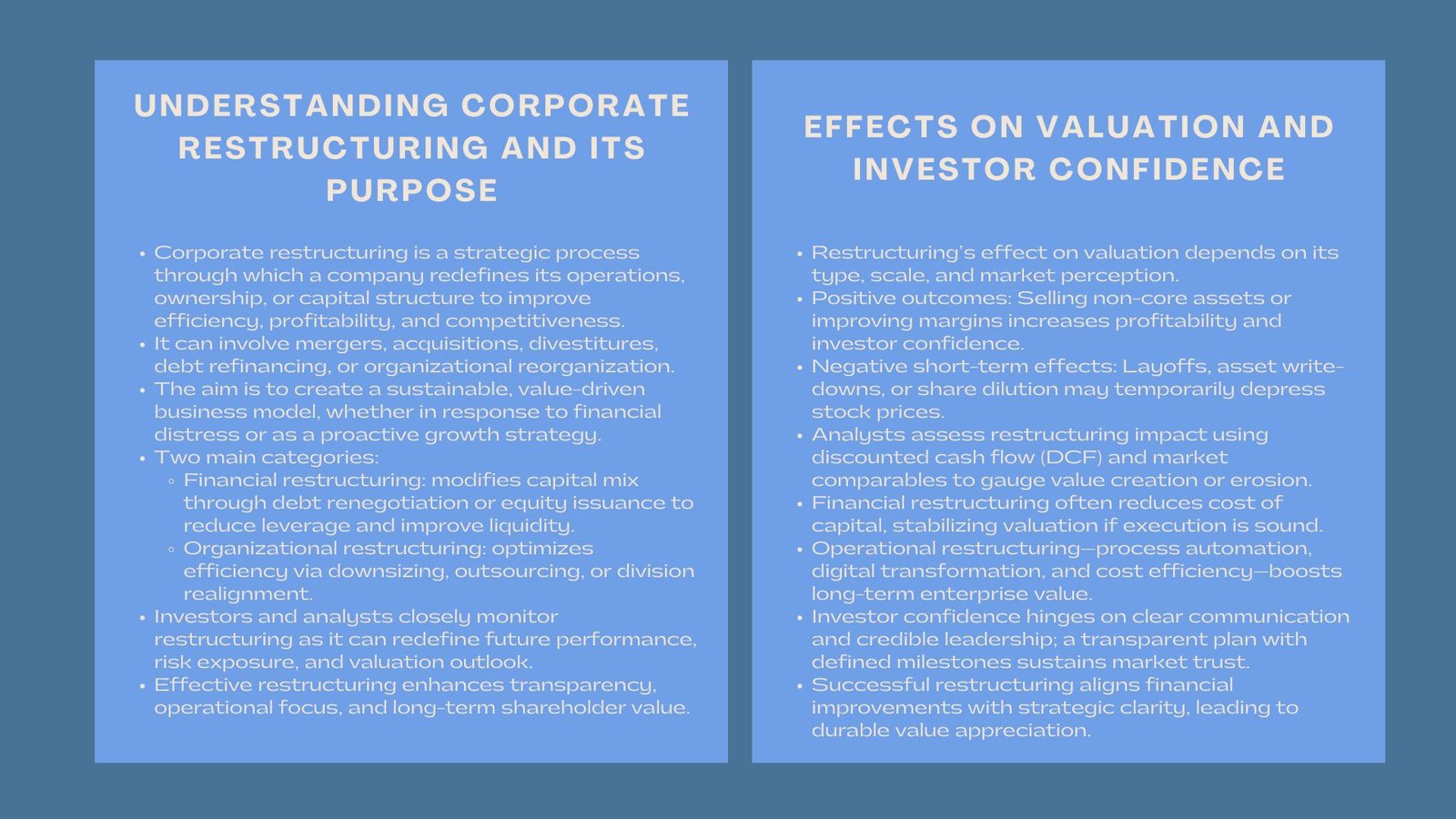
Corporate restructuring is the process through which a firm redefines its operations, capital structure or ownerships in the effort to increase the profitability, efficiency or competitiveness of the corporation. It can be related to divestiture, merger, acquisition, debt refinance or reorganization of management. Although the goal may be different, such as the need to lower debt burdens to unlock shareholder value, the overall goal is always the same, to establish a more sustainable and value-driven business model.
Restructuring is usually divided into two categories namely financial restructuring and organizational restructuring. Financial restructuring aims at modifications in the capital mix of the company which may be a renegotiation of debt terms, a new issue of equity or conversion of liabilities into equity. On the other hand, organizational restructuring refers to changes in operations such as the merging of divisions, downsizing, or outsourcing non-core operations. The implications of the two approaches on valuation are far-reaching, as the two approaches affect the potential of earnings, cost efficiency, and risk exposure.
The Reasons of Company Restructuring.
There are a number of strategic and financial reasons why companies engage in restructuring. In other instances, economic recessions, increase in interest rates or lack of liquidity can compel companies to reorganize their financial position in order to stay afloat. In other cases, restructuring can be proactive, i.e., to take advantage of new growth opportunities or to cut down operation after mergers or acquisitions.
As an example, a diversified conglomerate can dispose those units that do not perform in order to concentrate in more profitable core business. On the same note, a tech company can reorganize following a high growth to adopt a more stringent governance and operation regulation. In both scenarios, the restructuring is meant to increase efficiency and shareholder value.
In addition to this, globalization and technological disruption have increased the speed of change forcing firms to revise their strategies. Energy, telecommunications, and financial industries are a few among others that are vulnerable to restructuring as a result of changes in regulation, innovation and changing customer preferences.
Effects of Corporate Restructuring on Valuation.
Restructuring also can have a complicated and multifaceted effect on valuation. Restructuring can also augment, diminish or skew momentarily a company market worth depending on its character. A case in point is the selling of non-profitable divisions with the result of increasing margins and confidence among investors, which creates a valuation boost. On the other hand, any form of restructuring, which involves massive layoffs or impairment of assets, can diminish earnings and perception in the market, although in the long-term, it improves sustainability.
The effects of restructuring are normally determined by valuation experts after reviewing the alterations that occur in the estimated cash flows, capital cost, and risk profile. Such analysis is often based on discounted cash flow (DCF) method. The projections are made after restructuring and are compared to the projections made before the restructuring to ascertain value creation or erosion. In the same way, market-based approaches, like trading comparables can help put the emphasis on the value that peer companies received following similar endeavors.
In other instances, restructuring may open up a value that was hidden due to lack of transparency and focus. In the event that a firm gets rid of the complicated subsidiary set-up or spin-offs, the investors can have a better insight into the business performance. This increased transparency tends to result in a lower perceived risk and high valuation multiple.
Financial Restructuring: Effects on Debt, Equity and Liquidity.
Restructuring of finances is very significant in the valuation of companies. A more sustainable capital structure may be realized by maximizing the debt to equity ratio. Cutting down on the high leverage will reduce financial risk and may reduce the cost of capital, which directly increases the enterprise value.
Nevertheless, the response of the market to the financial restructuring is determined by the situation. To illustrate, when a company uses new shares to settle debt, the remaining shareholders risk being diluted hence, leading to a low share price in the short term. On the other hand, profitable debt refinancing on reduced interest rates has the capacity to increase the profitability and investor confidence. The use of financial restructuring valuation modeling techniques allows analysts to quantify how adjustments to capital structure impact overall firm value under different market conditions.
Other considerations are liquidity improvements. When companies are experiencing short-term cash flow problems they tend to restructure their debt to lengthen its maturity or negotiate covenant waivers. These moves will create space to heal and can send financial messages of caution to the market- both of which can make valuation measures stable or better.
Strategic Realignment: Operational Restructuring.
Operational restructuring aims at enhancing efficiency and matching the business model of the company with the changing market realities. It usually entails cost reduction, process automation, and redirection of the resources to the high-performing segments. To keep with a few examples, the mergers of production facilities or the digital transformation programs can lead to significant cost reductions and increased productivity.
Valuation wise, operational improvement would lead to an increase in margin and an increase in cash flow projection. This normally results in an increase in the enterprise value provided that the execution risks are well controlled. But short-term disruptions, like the restructuring costs, severances, or transition delays, can also be viewed by investors, and they can temporarily hurt profitability.
Strategic realignment is another appropriate element of operational restructuring. Firms can drop out of the unprofitable markets, or stop producing the old-fashioned products or concentrate on the segments that are innovative-based. When implemented properly, these strategic changes add value to the long-term perspective by ensuring that the company is placed in a sustainable growth.
Investor Confidence and Market perceptions.
The success of any restructuring initiative is not only based on the implementation but also on its perception by the investors and stakeholders. Clear communication and believable leadership play a crucial role in its maintenance of expectations in the market. Uncertainty can be addressed by having a well-defined restructuring plan that has clear objectives, schedule, and projected financial results to ensure that the results will not be sold off in panic.
Investors are likely to reward those companies that have an active restructuring effort to fortify fundamentals as opposed to responding to financial distress. Confidence in the market is more needed at times of uncertainty as it directly affects the share price stability and multiples of trading. This is where corporate restructuring impact assessment in business valuation becomes invaluable — it integrates both quantitative and qualitative elements to capture the full spectrum of restructuring effects on company value.
Long-Term Value Creation Restructuring.
Although this fluctuation of short-term valuation is usually normal in the process of restructuring, the final outcome of success is ultimately determined by long-term value creation. When companies are formed out of a reorganization involving lean processes, better governance and efficient capital structure, they tend to perform better compared to others. Conversely, ill-implemented restructuring processes may result in value destruction, investor confidence as well as inefficiencies in operations.
In order to achieve sustainable results, organizations should consider restructuring a process that has no solution but one of adjustments. Combining performance monitoring, scenario planning and continuous improvement practices will be sure to keep post-restructuring plans in line with the market conditions and organizational objectives.
Conclusion
Corporate restructuring is of an opportunity and challenge to the companies aiming at improving their competitiveness and shareholder value. Its influence on valuation is based on its quality of execution, strategy intent, and reaction in the market. When used well, restructuring can open up a dormant potential, minimize risk, and set a company on a path of future expansion. Nevertheless, there are also the risks that should be taken into consideration and planned and communicated clearly.
To the valuation specialists and investors, the insight into the complexities of restructuring is critical in proper measurement of the future performance. With the changing economy of the world, businesses that adopt the concept of restructuring as a strategic change tool instead of being a final solution will be in a better position to cope with the current uncertainty, attract investments and create sustainable value.