How Customer Contracts Affect Business Valuation
How Customer Contracts Affect Business Valuation
Two companies can have the same revenue over the past 12 months and have very different valuations, and it’s often the contracts that lie behind the revenue. Business valuation professionals need to know that a customer contract has implications for the business, because what the buyer or investor is actually buying is not the results of the contract he or she has just signed, he or she is buying confidence that the same results are going to be generated in the future. This trust is not to be taken for granted and is only earned when the legal and commercial terms of engagement are known and understood with a valuer’s eye – distinguishing a superficial revenue review from true diligence. This article covers customer contract value from a valuation perspective, the effect of contract stability on discount rates and risk premiums, and a breakdown of the recurring revenue valuation methods, customer retention value and how an in-depth contracted revenue valuation can be undertaken by any finance professional on a set of customer contracts. It’s aimed at providing a framework to repeat, rather than simply a laundry list of concepts to identify on the fly.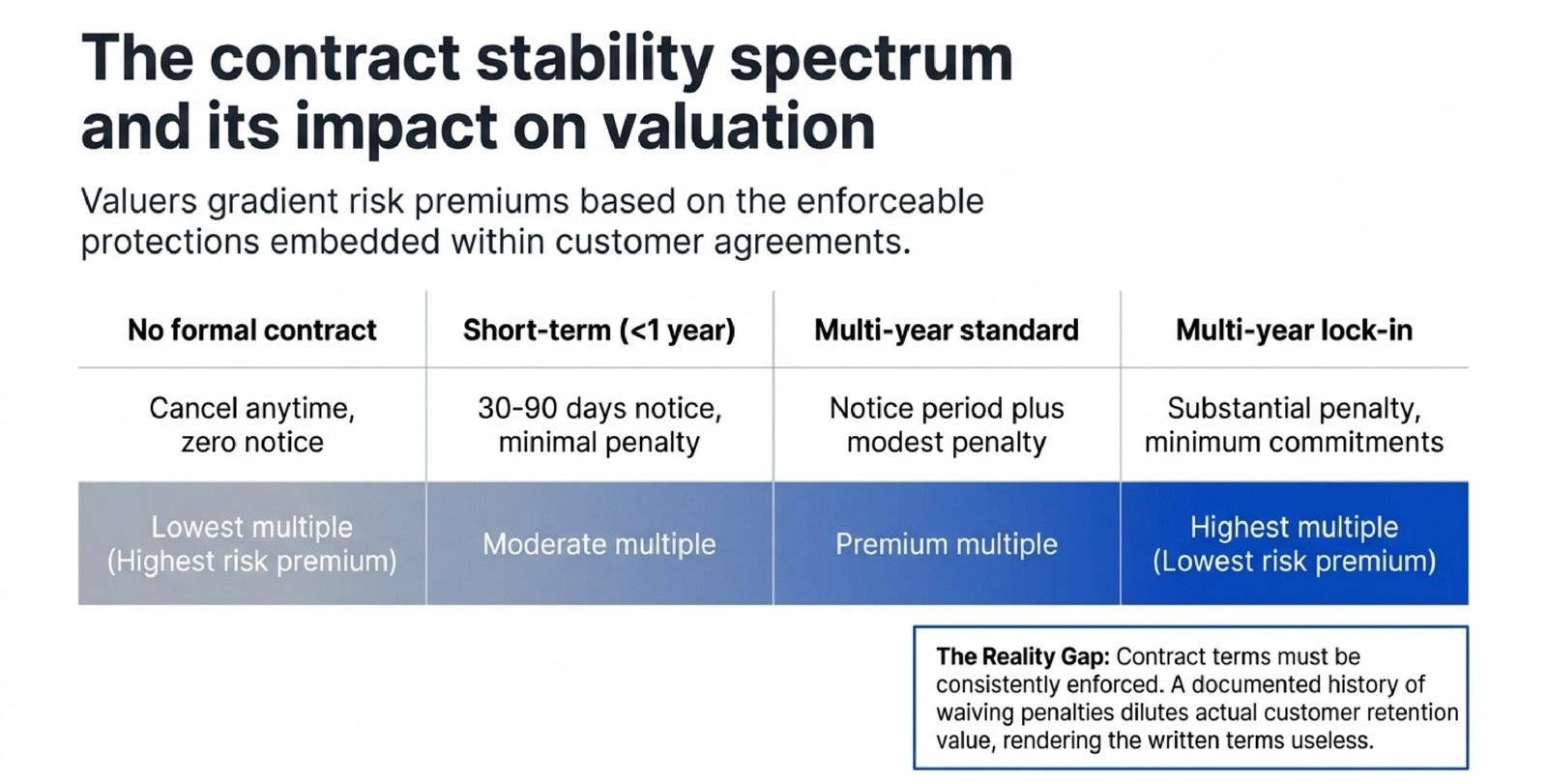
What Is Customer Contract Value and How Customer Contracts Affect Business Valuation?
Customer contract value is the value of a company that is derived from the legal assurance of future revenues, not from a best guessing of what the customers might purchase in the future without having entered a contract. If the company has no revenue at present, but has a significant amount of revenue from future cash flows under a contract that the company earning revenue today has no such right to, then that company has more revenue uncertainty than the one that sold only on a transactional, order-by-order basis. What is meant by this claim precisely – what conditions would allow a customer to leave the contract early despite the contract term shown – is the basis of any valid calculation of customer contract value, and isn’t highlighted on its own by a purely financial analysis of the revenue figures. This is at the heart of the issue of how much the customers have secured through contractual agreements and how much is purely dependent on customer return with no contractual obligations. The reason why two data rooms that appear to be identical for revenue schedule could give a diligence team two entirely different answers when they do the actual diligence, reading through the underlying revenue schedules. That is, two companies could have identical revenue and profit margin and have vastly different valuation multiples because of contract structure. A software firm with long-term contracts with revenue that includes automatic renewals and termination penalties will generally sell for a higher multiple than another similar firm that has only monthly contracts that customers can cancel anytime. Early in their careers, junior valuation professionals tend to overvalue the distinction by giving a lot of weight to the revenue number and comparatively little to the underlying contract terms that affect the reliability of that revenue number going forward. This is one of the best instincts a professional can acquire early in his valuation career: knowing for each revenue line, what legal document it is based on and what that document actually says concerning cancellation.How Does Contract Stability Impact Discount Rates and Risk Assessments?
The effect the contract has on the stability of a contract valuation is most directly seen in the discount rate used for future cash flows. A model constructed from revenue received under long-term, non-cancellable contracts is entitled to a lower discount rate than one based on revenue collected solely on the basis of customer goodwill and continued satisfaction because the contracted revenue has a discernible amount of forecasting risk. Valuers look at a number of specifics and are assessing whether this stability is worth as much as the contract length, the terms of renewal, whether it’s automatic or requires active customer opt-in, termination terms, and whether there are minimum purchase commitments that ensure a revenue floor even though customers’ usage may change month to month. Some valuers also take into account the existence of price escalation clauses because a contract that provides a firm price for several years without any price increases may end up causing a real loss over time if costs are increasing at a higher rate than the contract price; this is something that wouldn’t be picked up by a revenue-based valuation. It is not always easy to draw a distinction between contracted and non-contracted revenue, as contracts differ greatly in the extent of real protection they afford. The thirty day termination period in a contract is not very much more certain than having no contract at all, and a three year term contract with a meaningful termination penalty in the event of an early termination and a clearly absent right of unilateral termination for the customer is far more secure and thus justifies a much lower risk premium in the valuation model. Knowing this gradient instead of just knowing that contracts are binding legal agreements is the difference between a proper contract stability impact assessment and a superficial checklist of the existence of contracts, without actually checking what they say. A simple scoring system, which ranks contracts on a limited number of these factors, and not a tie breaker, can give a valuation team a repeatable, consistent method to compare the quality of contracts, across a large customer base, without having to read each individual contract line-by-line.Table 1: Contract Stability Impact on Valuation Multiples by Contract Type
| Contract Type | Typical Cancellation Terms | Relative Valuation Impact |
|---|---|---|
| No formal contract | Cancel anytime, no notice required | Highest risk premium, lowest multiple |
| Short-term contract (under 1 year) | 30 to 90 days notice, minimal penalty | Moderate risk premium |
| Multi-year contract, standard terms | Notice period plus modest penalty | Reduced risk premium, higher multiple |
| Multi-year contract with lock-in | Substantial penalty, minimum commitments | Lowest risk premium, highest multiple |
What Does Recurring Revenue Valuation Look Like in Practice?
The first step in recurring revenue valuation is to divide revenue into segments according to the reliability of each of these revenue streams: contracted recurring revenue with binding commitments, and non-contracted but historically consistent recurring revenue from repeat customers without any agreements, and finally, one-off or project-based revenue that is not likely to continue in a similar fashion. Each category is usually valued using a different growth rate and discount rate – otherwise, it’s just a top-line multiple applied across the board, masking the differences that make valuation of recurring revenue more accurate than a blanket top-line multiple. A number of metrics have become popular in the software and subscription industries, such as annual recurring revenue (ARR) and net revenue retention (NRR), which provide an analyst with a common language for explaining precisely which portion of the company’s revenue is derived from a subscriber’s continued decision to sign up – and which isn’t. These metrics have been embraced as a common investment language in software and subscription investing in particular, because they allow investors to compare companies whose pricing models vary widely, the same way, on an “apples to apples” basis as opposed to on each company’s own preferred terms of the revenue quality. Recurring revenue valuation is also a matter of looking at the broader picture of the contract book, including its evolution over time, as a reduction in average contract length or increased concentration of contracts among a fewer number of larger customers is a sign of increasing risk even if the contracts seem stable on the surface. Analysts are growing increasingly accustomed to analyzing a combination of contract renewal, average contract value, and customer concentration trends, along with the basic revenue forecast, as leading indicators that can warn of a decline in contract quality before it becomes a real drop in revenue in historical financial statements that would be used as inputs exclusively by a backward-looking valuation. Integrating this forward-looking perspective into the diligence process, versus a standard and optional enhancement, tends to uncover just the kind of erosion that a purely historical revenue trend line wouldn’t see until it had been well underway. A well-structured, contracted revenue assessment is, therefore, a combination of both views: The honest assessment of the state of current contracts, and the proactive assessment of how the state of the contracts is changing over time.What Five Steps Help With a Thorough Contracted Revenue Assessment?
- Identify and divide revenue into different contracts. The idea is to first separate the revenue from the contracted revenue, non-contracted revenue and repeat revenue, one-off revenue because these have different risk profiles before applying any valuation methods.
- Check the terms of the actual contract. Check renewal conditions, termination costs and minimums and conditions before assuming that there is a contract.
- Review customers’ concentration in contracts. Evaluate the dependence of contracts on a few large customers; concentration reduces the diversification advantage that is usually achieved through contracting.
- Monitor the trends in renewal and retention. Check on the historical renewal rates and on the net revenue retention to determine if the contract quality is improving or declining over time.
- Use the correct discount rate for real risk. Do not discount the revenue earned from any contract which sufficiently restricts the ability to earn that revenue, but only the revenue in that contract.
What Real-World Examples Show How Customer Contracts Affect Business Valuation?
Take, for example, Ferrow Data Systems, a business intelligence software vendor that was a large part of its business on three-year contracts with automatic renewals and big breakup fees for existing customers. When the company valued itself ahead of a growth equity raise, they focused on the value of the customer contracts that had 18 months or more of terms left until the next renewal decision point, which provided investors with near-term visibility into cash flow for the next two years. The premium was explicitly justified in the investment memo as the strength and duration of the contract book, which is directly referenced as a major motivator to purchase the company at such a premium over the peer average for similarly sized companies when it comes to software. Later in a report by Ferrow’s finance team, the executives said they had found it much easier to present a clear breakdown of contract length and the time of renewal as this made the investor diligence process much smoother; much of the analysis that investors might otherwise have needed to build themselves would have been ready and available. Later, the team said that the prep had shortened the overall fundraising process by weeks because investors were able to skip the step of having to request and organize up the underlying contract data. The following is a contrasting example: Ashcombe Facilities Management is a commercial cleaning and maintenance firm whose typical arrangement with most of its clients was to have a service agreement that was renewable at will. In spite of its good history of revenue and long term customer relationships over several years, the company’s valuation during the acquisition process accounted for a meaningful risk premium due to the lack of binding multi-year contracts to secure revenue, even though its relationships with customers were in practice quite durable. The team of advisors to the acquirer made it clear that if they were to make the transition to contracts that may run for longer in the future, they would likely see an impact on the value of the company at the next sale process, which is why Ashcombe’s leadership has started a deliberate contract conversion process well before the next transaction. After a year, Ashcombe had already secured about half of its biggest clients on multi-year contracts and the firm’s management viewed it as more than just a way to value the company: it also gave them a more realistic impression of future income, ahead of any would-be buyer. These two examples illustrate well for those learning how to evaluate the value of customer contracts: don’t just take a passive look at contract structure; instead, it’s something that management teams can actively shape well before they get involved in a transaction and with more time and negotiating power than once they’ve entered a transaction process.What Challenges Come With Customer Retention Value and Contracted Revenue Assessment?
The biggest challenge in measuring customer retention value is that a high retention rate does not imply that the trend will persist, especially if retention is based on factors that might shift, such as when the competitor’s retention was due to the absence of viable competitor offerings that may become available as competitors enter the market. Analysts need to separate out customer satisfaction, which is presumably permanent, from switching costs, which can be more fragile if they’re simply a matter of lack of competition or contractual commitment. Another potential problem for the contracted revenue approach is that the agreed terms of contracts are not always enforced in practice; for example, a company could have a clause for high termination penalties in its standard contracts, but have a long history of omitting those penalties from deals with important customers that threaten to walk away, meaning that its contractual protection is far less effective in practice than it appears in the paper. That’s why having a good diligence team perform customer and management interviews is a critical extension of the contract review and not something that can be done on its own – because a document review alone does not tell you whether a company is actually consistently enforcing the protections it puts in its contracts. Those analysts who choose to skip this post-interview step and only look at the terms of the written contract may overestimate the actual protection offered by the contract, especially in situations where the companies have a good culture of customer service where a valuable relationship is involved and where they would rather do what is right than strictly adhere to the contract. The single most important thing that experienced valuation professionals can impart is that analysis of a contract must be conducted both from the document and from the actual experience of customers who wish to terminate the contract; the former is not always consistent with the latter. Looking at some of the actual examples of contract terminations and renewal negotiations in recent years, instead of reading the template, provides a much better idea of what customers are actually willing to pay for their value than just reading the template. Practitioners also discover that the quality of a contract is not something that is determined once, at the completion of a transaction, but merits continuous monitoring, as a company’s contracting processes may also be subject to a steady deterioration over time, without any conscious choice by the parties themselves to reduce the protection. This is one of the reasons why it is important to incorporate the tracking of building quality into a company’s periodic management reporting, as well as other standard measures like revenue growth and margin.Table 2: Common Challenges in Customer Retention Value and Practical Mitigations
| Challenge | Practical Mitigation |
|---|---|
| Retention driven by circumstance, not loyalty | Distinguish genuine switching costs from temporary competitive gaps |
| Contract terms inconsistently enforced | Review actual termination and renewal history, not just templates |
| High customer concentration within contracts | Weight concentration explicitly into the risk assessment |
| Contract quality drifting unnoticed over time | Monitor contract terms and enforcement on an ongoing basis |
| Overreliance on revenue figures alone | Segment revenue by contract type before applying any valuation method |