How Working Capital Adjustments Affect Business Valuation?
How Working Capital Adjustments Affect Business Valuation?
One of the most underutilized—and most significant—factors in a business sale is working capital, and knowing the impact working capital adjustments can have on business valuation can mean the difference between a successful closing and a deal going sour at the finish line due to a working capital dispute that no one could have predicted. Basically, a working capital adjustment is a process of balancing the short-term operating capital that a buyer anticipates receiving at closing with what a seller actually provides, and then adjusting the purchase price up or down as necessary to ensure that the buyer isn’t unfairly treated. This process helps junior analysts, associates, and dealmakers understand how to account and negotiate for deals early in their career and to avoid losing millions of dollars quietly without ever making it into a big headline number. This article explains how this process works, how it’s applied to work up the figures, some examples of how this process works in actual transactions, and some insight into what separates the professionals from the amateurs when it comes to navigating closing without a hitch. Financial modellers on a deal team, advisers to a founder in the early stages of a sale or interviewees during transaction advisory – any of these scenarios will have financial models that you want to build that depend on working capital business valuation.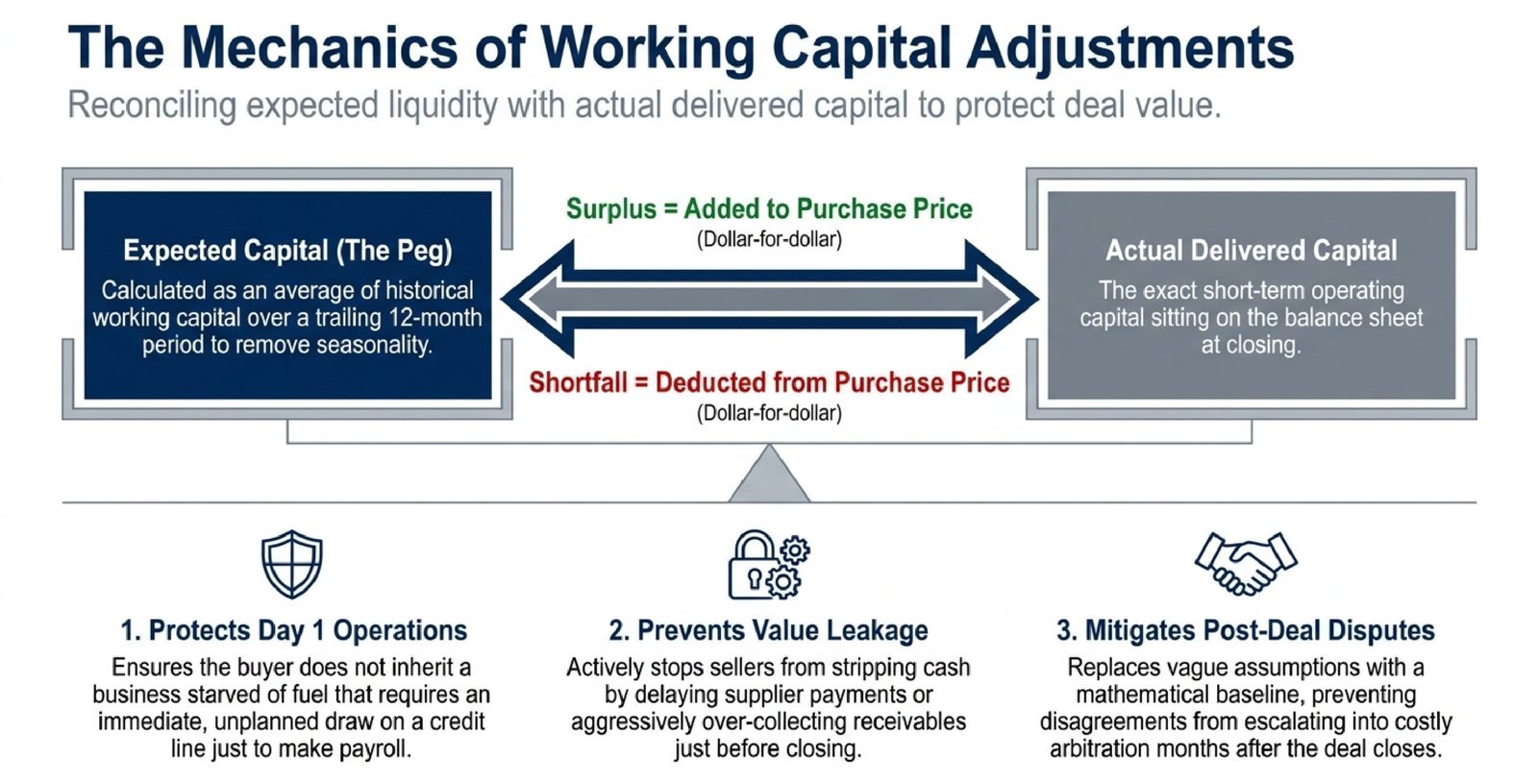
How Working Capital Adjustments Affect Business Valuation for Buyers and Sellers?
In any acquisition, the enterprise value that the buyer and seller agree to will be based on the assumption that the target company will be acquired with an “average” amount of liquidity (receivables, inventory and payables) necessary to operate the business without immediate cash infusion from the purchasing company. Working capital business valuation is crucial because it serves as the benchmark on which the closing day’s balance sheet will be compared and it helps to avoid any unwanted surprises once the closing day has passed. Without being resolved, disagreements about the valuation of working capital can come up again months after closing, sometimes leading to arbitration – and advisory fees can easily exceed the amount in dispute. When a seller delays paying suppliers and/or is too aggressive collecting receivables prior to closing, the buyer ends up with a paper positive business with no cash on hand, resulting in an unplanned credit line draw to pay the bills on day one. On the other hand, if a seller has a large stock of excess inventory or uncollected receivables on the books, the buyer is effectively paying for assets that will have little value to the company going forward, and may not be easily convertible to cash for the buyer. This is precisely why how working capital adjustments impact business valuation has come into play in virtually every mid-market transaction, whether they are a manufacturing roll-up or a software acquisition, and why deal teams budget diligence hours just for the working capital review – and don’t just do it for form’s sake. Many seasoned buy-side advisors say that working capital business valuation needs to be examined as much as revenue quality analysis because both are essential in determining whether the business will be able to operate financially the day after the transaction closes. The working out comes in two parts: a negotiated working capital target, or “peg”, is set, typically as an average of the company’s historical working capital for a trailing twelve month period, excluding seasonality and one-off distortions that would otherwise skew the number. When the time of closing comes, this is the working capital a seller is expecting and a seller will, therefore, pay a dollar less for every dollar that is shorted and pay a dollar more for every dollar that is over. The post-closing adjustment period is normally 60 to 90 days in which both parties’ finance teams reconcile by line item on the closing balance sheet and share supporting schedules, and this is considered the “true up” process. The working capital valuation adjustments are not a footnote in the final agreement; they’re an actual item, included and excluded, with defined dispute resolution and other provisions, and much of the time are given as much attention as the representations and warranties, and, of course, the headline price. One of the things that is common is that lawyers on both sides haggle about an exhibit that is devoted entirely to working capital valuation adjustments, with a sample of the calculation, because the ambiguity at this point is too costly to resolve later.How Working Capital Adjustments Affect Business Valuation in Real Deal Examples?
Let’s go back to the mid-sized industrial parts manufacturer in the American Midwest that signed up an acquisition deal with a private equity guy hoping to add a niche manufacturer to his growing portfolio. Both parties had carefully considered and agreed upon a working capital peg in the letter of intent, which amounted to $4.2 million based on the trailing 12 months’ average. The seller’s finance staff tried to force customers to settle early, and they were also late with payments to important suppliers for almost three weeks in the weeks leading up to closing – a common and typical tactic for creating a more favorable cash position before the sale. The closing working capital figure on paper was robust but as analysts reduced payables and restated accounts payable to normal terms, the closing working capital figure was $650,000 short of the peg. The discrepancy was identified by the buyer’s diligence team by simply comparing the accounts payable age report to the previous periods, and the working capital purchase price was lowered in finalization based on that. The seller ultimately agreed to the lower purchase price without going into a dispute. This example shows how working capital adjustments play out in practice when it comes to business valuation—let’s say the headline enterprise value on the letter of intent is not necessarily the actual number on the wire transfer. The take away message for the junior analyst is simple: never sign off on a working capital business valuation summary without comparing the closing period cash flow patterns to the previous 12-months, as it is easier to see the ‘short term’ manipulation than it will be in hindsight. The same scenario unfolded with a specialty food retailer based in Europe, which was bought by a bigger consumer goods firm looking to expand its geographic reach. In this case, the seller had nearly 6 months of “slow” inventory that had accumulated prior to the sale and which when added to his current cash reserves did not create any corresponding increase in the capacity to generate revenue. In part, this may be due to a sales forecast that proved to be too optimistic the previous year and which resulted in the accumulation of inventory. The buyer’s accountants during due diligence have used a standardized approach to normalised working capital valuation, which removes non-operating and non-recurring balances from the working capital before comparing it to the agreed peg. The net effect was a $310,000 reduction in the final purchase price, which represented the actual cash cost of the inventory carried by the business that it was unable to sell within a reasonable period of time. In both situations, working capital business valuation is not a benign accounting exercise; it will punish operational discipline and the manipulation of balance sheet accounts, whether deliberate or a result of poor projections and/or inadequate internal controls, both of which sides were blithely unaware of prior to the start of their diligence. The final working cap purchase price in both cases proved to fall within a meaningful range from the figures each party had initialed in the beginning of negotiations, creating the need to focus on this line item early and on an ongoing basis instead of at the last minute.How Working Capital Adjustments Affect Business Valuation: What Are the Five Key Steps in Working Capital Business Valuation?
The key steps in the process of valuation adjustments for working capital are generally similar across deals, irrespective of size or industry, and it is important for junior analysts to understand each step so that they can meaningfully engage in the diligence discussion instead of just taking the numbers provided by more senior colleagues. The concept of working capital business valuation is the same regardless of whether the business is a founder-owned manufacturing firm or a venture-backed software-oriented company, with the only difference being the line items and the normalization judgments that differ from industry to industry.- Define the scope. Identify which balance sheet line items should be considered working capital, which typically include accounts receivable, inventory and accounts payable, but exclude cash, debt, and other non-operating assets that would be subject to a different purchase price mechanism than this one.
- Find the peg’s normalized value. Create a baseline of normal working capital for valuation by taking an average of the monthly or quarterly balances over a 12-24 month period, removing seasonal fluctuations that could mislead either party and/or give a “snapshot” view of Working Capital that would not accurately reflect the reality.
- Adjust for anomalies. Educate the audience on removing singular elements of the business being valued such as obsolete inventory, disputed receivables, or terms that were unusual with the vendors, etc., that could throw off the true operating requirement of the business and provide them with supporting evidence that is clear.
- Construct closing system. Put clear terms into the purchase agreement terms and conditions for how the closing balance sheet is to be calculated, who is responsible for preparing it, the process for resolving post-closing disputes, and how long it will take for post-closing true-ups and working capital deal adjustments to be made.
- Reconcile and settle. Companies actually close working capital as compared to the peg and then adjust the working capital purchase price based on the working capital closing differences, the closing difference generally being resolved by an independent accounting firm of the company’s pre-appointment. Those analysts who excel at this last step gravitate to higher-level diligence positions, as it reveals a grasp of the mechanics of accounting and negotiations of working capital deal adjustments.
| Category | Typically Included | Typically Excluded |
|---|---|---|
| Current Assets | Accounts receivable, inventory, prepaid expenses | Cash, marketable securities, intercompany balances |
| Current Liabilities | Accounts payable, accrued expenses | Short-term debt, current portion of long-term debt |
| Adjustments | Seasonal normalization, bad debt reserves | One-time litigation reserves, restructuring accruals |
How Working Capital Adjustments Affect Business Valuation Through Normalized Working Capital Valuation?
The advantage for professionals pursuing a transaction advisory or corporate development career is that they can create a defensible, evidence-based approach to protect transaction value from both the buyers and the sellers’ sides of the negotiating table, instead of relying on their “gut”. Buyers have the confidence that the business they acquire is going to run without an unplanned cash injection during the first few months after acquisition and sellers have the certainty that there will be no disputes that become costly and lead to post closing litigation or broken relationships. The method is forward-looking and takes into account the history of the company’s average working capital, and thus also its average receivables and inventory levels, so that both parties are provided with a fair basis for agreeing on a working capital purchase price that is not a one-time snapshot date, but rather an average of average values. In businesses where there are distinct seasonal variations, like agriculture, construction or seasonal retail, a normalization step is often the most crucial step in finishing a transaction without months of back-and-forth between advisors representing competing baselines. Businesses that conduct a working capital valuation during a process before the closing, instead of after, or on a buyer’s request, typically negotiate from a stronger position and experience less of a surprise during the diligence process. The challenges are genuine, though many are underestimated by deal team junior participants who are not being mentored by a senior deal team member. Choosing the appropriate lookback period can be a matter of debate, especially when the company has grown rapidly or recently made significant changes in operation, as a longer average can lead to an understatement of needs while a shorter one can overestimate them and be a disadvantage for the seller. Another constant challenge is data quality: many private firms have complicated bookkeeping systems and it’s hard to distinguish between the true operating working capital and one-off complications that are masked in the general ledger and need to be painstakingly manually reclassified. More experienced sellers can also anticipate and create a “peg” that looks high when working capital deals are made, which may be a leverage point in negotiations; experienced buyers know to watch for this by engaging in trend analysis. One of the most obvious lessons hard-learned by valuation professionals is to identify these patterns early, before the contract is signed, not after. The best protection against these on (and off) the table is to maintain a well-run normalized working capital valuation process, with clean historical data.How Working Capital Adjustments Affect Business Valuation at the Closing Table?
When the transaction comes to closing, the theoretical theory of working capital business valuation turns into a much more practical issue – what is the amount of cash that will actually pass through the hands of the buyer and seller on the day of closing? The final working capital purchase price is the agreed upon headline enterprise value of the transaction plus the true-up for working capital, net debt and other agreed purchase price mechanisms that may be applicable to the transaction, such as earnout or escrow holdbacks. This is usually detailed in a closing statement that is jointly prepared by both sides’ finance departments, with a breakdown of each amount of money that moves from the peg to the actual closing amount, thus avoiding any surprises at the closing wire. This last reconciliation is a real cost to the buyer and seller and most purchase agreements provide for a neutral and independent accounting firm to resolve any differences that cannot be resolved between the buyer and seller within the time frame allowed for such reconciliation in the purchase agreement. Deal teams that view the valuation of working capital as an afterthought during negotiations often end up having to defend the process and the final result under pressure, a process that is not likely to yield a positive result for either party. The table below is a short-cut format of the working capital deal adjustments and arithmetic that occur to determine the final working capital purchase price in a hypothetical deal. Table 2: Working Capital Purchase Price — Sample Adjustment Calculation| Line Item | Amount (USD) |
|---|---|
| Agreed Enterprise Value | $25,000,000 |
| Working Capital Peg | $3,500,000 |
| Actual Closing Working Capital | $3,050,000 |
| Working Capital Shortfall | ($450,000) |
| Final Purchase Price After Adjustment | $24,550,000 |