Due Diligence in MA Valuation
Due Diligence in Mergers and Acquisitions: Valuation Perspective
Introduction to Due Diligence in MA Valuation
Merger and acquisitions (M&A) are an opportunity and a threat in the realm of corporate transactions. In the case of company acquisition, strategic fit is not the only important factor that can ensure success but also finding the real value of the target business and potential pitfalls. At the heart of this process is due diligence, which forms a basis of the analytical process on which valuation, negotiation, and decision-making rest. Ranging to brand equity reviews to financial audits, due diligence makes sure the acquirers are paying a reasonable price, and they know what they are getting. When considered in the context of valuation, it would be a necessary process to reduce the risk and maximize acquisition prices.
Understanding the Role of Due Diligence in Valuation
In the case of an acquisition under consideration, valuation cannot be done in a vacuum. Any calculation of value is based on the sincerity of information upon which it relies. It is here that due diligence comes in to fill the gulf between value on theory and reality.
The Strategic Purpose of Due Diligence
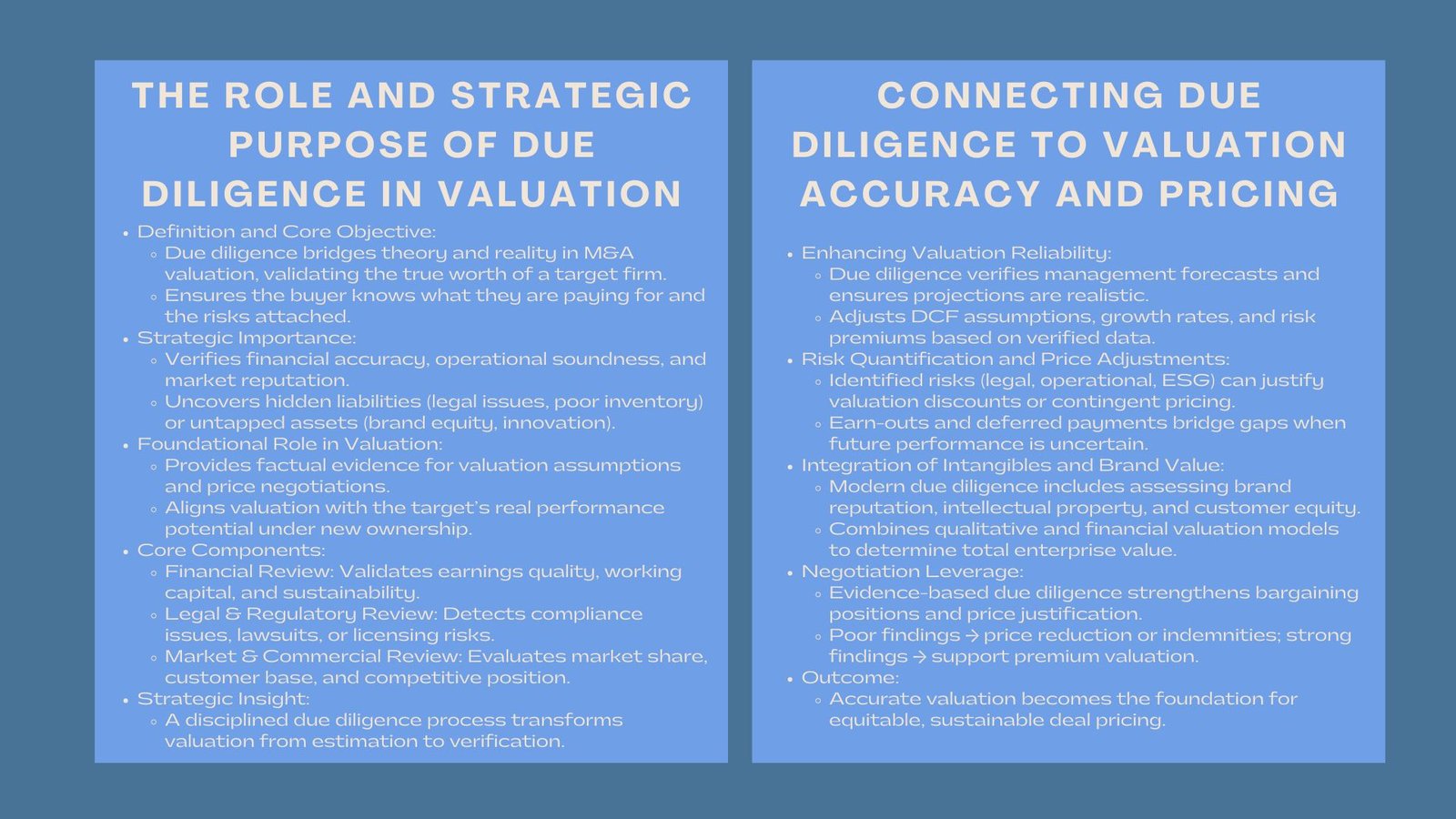
Due diligence is a mechanism of verification, which ascertains that the assumptions that have been made on valuation of a target are verifiable and valid. In addition to the numbers it gives an idea of the operational well-being of the target, brand image, market share and the future. It helps the acquirers to pin down where value could be overstated- or where it could be slumbering untapped.
As an example, a target firm might have good financial reports, yet further due diligence might show the customer concentration risk, unresolved judicial issues, or old stocks, which do not translate into real value. On the other hand, it can reveal brainpower or brand assets or computer potential which is not necessarily reflected in the books. The results in both scenarios have a direct impact on valuation results.
Integrating Due Diligence with Valuation Objectives
Valuation wise, due diligence gives the factual grounds to manipulate pricing models. The accuracy of the underlying data is needed to generate financial forecasts and discount rates, as well as anticipated synergies. The acquirer has the burden of finding out not only what the target is valuing on paper, but what it will be valuing with new ownership and conditions in the market.
Once done well, due diligence undertaking can be used to align valuation with strategy, so that pricing will convey intrinsic value as well as potential into the future. This is especially critical in the competitive markets like Singapore where regulatory, cultural, and brand factors introduce the additional complexity to cross-border transactions.
Due Diligence as a Strategic Investment
Due diligence is time-consuming, knowledge-consuming, and resource-consuming, yet it is an investment that draws much larger amounts of money. The consequences of poor diligence can be disastrous: over-priced assets, post-deal conflict or inability to realize the expected synergies. In these ways, contemporary purchasers do not view due diligence as a check box, but as a strategic asset enabling or boosting bargaining power and valuation effectiveness.
Today when intangible assets and brand-oriented value are taking a growing part in the M&A world, due diligence offers a multidimensional perspective of value that is not confined to the balance sheet.
Core Components of M&A Due Diligence
The valuation approach to due diligence is based on analyzing various aspects of the business of the target. The layers make a contribution to the understanding of the financial and strategic value.
Financial and Accounting Review
The most critical part of an M&A due diligence is the financial review. The analysts evaluate the performance of the past, the quality of earnings, and working capital trend to form a credible basis of valuation models. The main areas of concentration will be revenue recognition rules, debt rules, contingent liabilities, and off-balance sheet exposures.
Using this, acquirers are able to know whether the reported earnings are sustainable profitability or whether they are inflated by exceptional events. The results have a direct impact on the assumptions of discounted cash flow (DCF) and enterprise value computation.
Legal and Regulatory Examination
The areas of legal due diligence are compliance, contracts and contingent risks. This involves reviewing the possession of property, outstanding lawsuits, intellectual property, contracts of employment. In international transactions, in particular in Southeast Asia, regulatory compliance may have a substantial impact on valuation results.
To take an example, a company which works in several jurisdictions should show compliance with the data protection, labor, and environmental laws. Any compliance problem that cannot be resolved brings financial uncertainty and can be used as a reason to make downward pricing changes in the negotiation.
Commercial and Market Analysis
Market potential cannot be described by financial data only. CDRD measures the competitive positioning, client base, and industry forces of the target. It evaluates stability in market share, power of prices and expansion opportunities in changing economic conditions.
When incorporated into valuation, this analysis makes certain projections of future cash flows to be based upon realistic market expectations. It also assists acquirers to find out whether the brand equity and customer relationships of the target merit a strategic premium- or whether the loss in competitiveness is an indicator of an eventual loss of value.
Connecting Due Diligence and Valuation Accuracy
The findings of due diligence are directly converted into refinements of valuation. The process of making adjustments to risk, assumptions checking and synergy identification all lie in how an acquirer should pay.
Refining Financial Projections
Process of valuation usually starts with the management projections. These forecasts are however challenged by due diligence through independent verification. In comparing budgets and historical trends, cost structures, and customer retention rates, the acquirers can decide whether the forecasts are too optimistic.
In most instances, due diligence shows adjustments which may have a material impact on valuation, reducing projected earnings, escalating capital expenditure assumptions, or changing growth rates. This is a process of iteration, which makes sure that the pricing is based on performance that is attainable and not on aspirations.
Quantifying and Pricing Risks
Not every risk is a deal breaker, some just need a quantification. The trick is how identified risks are to be used in influencing valuation. As an example, an enterprise multiple or contingent payment plan can be anticipated in case of pending litigation or regulatory uncertainty.
Equally, integration risks, e.g., incompatible IT systems or cultural misalignments are likely to impact the anticipated achievement of synergies. An accurate valuation style considers such factors in the scenario models so that the price of the acquisition can represent the entire risk portfolio.
Incorporating Brand and Intangible Value
Before long, much of the contemporary enterprise worth lies in intangible value like brand repute, intellectual property, and client loyalty. These are not well appreciated in the conventional accounting statements. With enhanced due diligence, acquirers are able to determine the contribution of such intangible drivers to business value.
By combining brand valuation models with financial analysis, acquirers in Singapore and other dynamic markets can derive a more accurate measure of total enterprise value. This approach is integral to the M&A due diligence valuation process Singapore, where intangible assets frequently differentiate market leaders from competitors.
How Due Diligence Shapes Acquisition Pricing
At the negotiation table, valuation outcomes derived from due diligence translate into real-world pricing decisions. Understanding how due diligence impacts acquisition pricing is essential for both buyers and sellers aiming to achieve equitable outcomes.
Adjusting for Findings and Negotiation Dynamics
Buyers incorporate the results of the due diligence process into their pricing model once the due diligence phase is completed. In case of financial anomalies or operational deficiencies, they can demand a lower price of purchase or warranties and indemnities. On the other hand, good due diligence outcomes such as brand strength, loyal customers or under use of assets can warrant a premium price.
The negotiation process is therefore a mirror of the ability of each side to justify his or her valuation assumptions. Unbiased, evidence-based results enhances the level of credibility and lead to easier closing of deals.
The Role of Earn-Outs and Contingent Considerations
Earn-out structures or contingent considerations are common in most contemporary M&A dealings as the means of bridging any valuation differences. These systems attach a part of the purchase price to performance objectives in the future-e.g. revenue growth or profitability goal.
These types of structures come in particularly well where due diligence establishes uncertainty in future performance. They enable the buyer to take the downside risk and provide the seller with a chance to get some extra value depending on the achievement of the targets. Such balance is an indication of both accuracy in valuation and practicality in pricing.
Synergies and Integration Planning
The combination yields synergies, or cost reimbursement or sales increases, which as a determinant of final pricing are a significant factor. Nevertheless, the determination of viable synergies needs in-depth operational due diligence. The risks of integration have to be quantified so that the projections of synergy can be achieved.
A serious acquirer integrates planning in the early due diligence and integrates planning in the due diligence process so as not to overestimate the synergy. Such a strategy helps to improve valuation credibility and avoid disappointment after the deals.
Advanced Dimensions of Due Diligence in Valuation
The contemporary due diligence process is taking a new twist on top of the previously familiar financial examination. Valuation teams have become more holistic with data analytics, ESG concerns, and brand performance indicators taking the center stage.
Data Analytics and Predictive Insights
The combination of the sophisticated analytics will enable the acquirers in evaluating customer activities, the market mood, and the financial trends in real-time. The predictive modeling tools are capable of simulating a number of economic situations, and this enables the valuation teams to test the soundness of their assumptions.
As an example, the use of transaction-level data can demonstrate recurring revenue dependence or the possibility of churn-risk-insights- that can be directly used to determine the valuation discount rate. High-quality due diligence is becoming a hallmark of such analytical accuracy in the technology-driven financial ecosystem of Singapore.
ESG and Reputation Factors
The ESG criteria have become material drivers of valuation. Ineffective ESG practices may cause reputational risks or regulatory fines to acquirers, whereas effective ESG practices increase brand equity and investor trust.
Valuation teams analyze the sustainability practices, their supply chain ethics and governance frameworks through ESG due diligence. Such perceptions may increase or reduce perceived enterprise value, depending on whether or not they correspond to contemporary stakeholder expectations.
Brand Health and Customer Equity Evaluation
Brand equity is decisive when it comes to valuation in brand-sensitive industries such as consumer goods, retail, or digital platforms. The strength of intangible value can be measured with the help of brand health metrics, sentiment analysis, and customer loyalty indices.
Through brand due diligence and financial analysis, the acquirers are able to predict the impact of customer perception on the performance of the acquiring company after the acquisition. Such a combination of brand analytics and valuation enhances the post-deal protection and growth of intangible value by the acquirer.
The Strategic Value of Comprehensive Due Diligence
The effects of due diligence last way beyond the close of the transaction. It makes integration planning, value realization and long-term performance monitoring. Firms that consider due diligence a continuous process rather than a single audit have greater chances of succeeding after a merger.
Such a holistic process will enable organizations to constantly question the assumptions that were made on the basis of the initial valuation whether they are true to execution. It also establishes the culture of responsibility, management incentives and value creation goals set in the process of M&A are aligned.
In addition, strong due diligence creates confidence amongst the investors and stakeholders. When a transaction is supported by open analysis, it enhances the reputation of the acquirer as a rigorous and evidence-based company the strength of which in its future activities on the market.
Conclusion
Due diligence is much more than a formal gateway during mergers and acquisitions – it is what valuation accuracy and pricing integrity is built on. It turns M&A into a calculated strategic move rather than a gamble and validates assumptions, discovering risks, and hidden value.
In the contemporary competitive and data centered world, acquirers need to qualify with a valuation-focused perspective of due diligence, which incorporates financial dexterity, brand intuition, and strategic vision. This will make sure that the money invested in any particular target business does not only show what a target business has done, but also what it is capable of providing in future.
To those organizations that are interested in developing sustainable enterprise value, the art of integrating due diligence and valuation is not only wise, but it is also a prerequisite to success in the long term.
Frequently Asked Questions
Q1. Why is due diligence important in mergers and acquisitions (M&A)?
Due diligence verifies the financial, legal, operational, and commercial information of a target company before an acquisition. It helps buyers identify risks, validate valuation assumptions, uncover hidden liabilities, and make informed decisions, reducing the likelihood of overpaying for a business.
Q2. How does due diligence affect company valuation?
Due diligence directly influences valuation by confirming or adjusting financial projections, identifying potential liabilities, assessing intangible assets, and evaluating future growth opportunities. These findings may increase or decrease the purchase price depending on the overall risk and value of the target company.
Q3. What are the key areas covered during M&A due diligence?
A comprehensive due diligence process typically includes financial analysis, legal and regulatory compliance, tax review, operational assessment, commercial and market analysis, intellectual property evaluation, customer and supplier relationships, ESG considerations, and technology or cybersecurity reviews.
Q4. Can due diligence identify hidden value in a company?
Yes. Besides uncovering risks, due diligence can reveal valuable intangible assets such as strong brand equity, intellectual property, recurring customer relationships, proprietary technology, and operational synergies that may justify a higher valuation or create long-term strategic value.
Q5. How can businesses improve their readiness for M&A due diligence?
Companies can prepare by maintaining accurate financial records, ensuring regulatory compliance, organizing legal documentation, protecting intellectual property, strengthening corporate governance, and addressing operational issues before entering negotiations. Good preparation increases buyer confidence and supports a stronger valuation during the transaction process.