What Are the Biggest SME Valuation Challenges?

What Are the Biggest SME Valuation Challenges?

Though the vast majority of economies are built on the shoulders of small and medium sized enterprises, yet one of the most longstanding challenges in corporate finance is putting these enterprises in a price basket. In the world of junior analysts, accountants and finance professionals seeking to establish a career in valuation, knowing the SME valuation challenges that exist between a defensible number and a guess is vital, as it can stall a sale, loan application or investment round before it even gets off the ground. Business valuation accuracy is more difficult and more easily questioned by an SME compared to a listed company because they often do not possess multi-year financial statements (audited), share trading (active) or industry analysts to track performance. This article explores why small business valuation work is so challenging, how practitioners can minimize errors, real-world examples of potential errors and what lessons practitioners take from this work for their next engagements. 
What Are the Biggest SME Valuation Challenges?

What Are the Biggest SME Valuation Challenges in Financial Reporting?

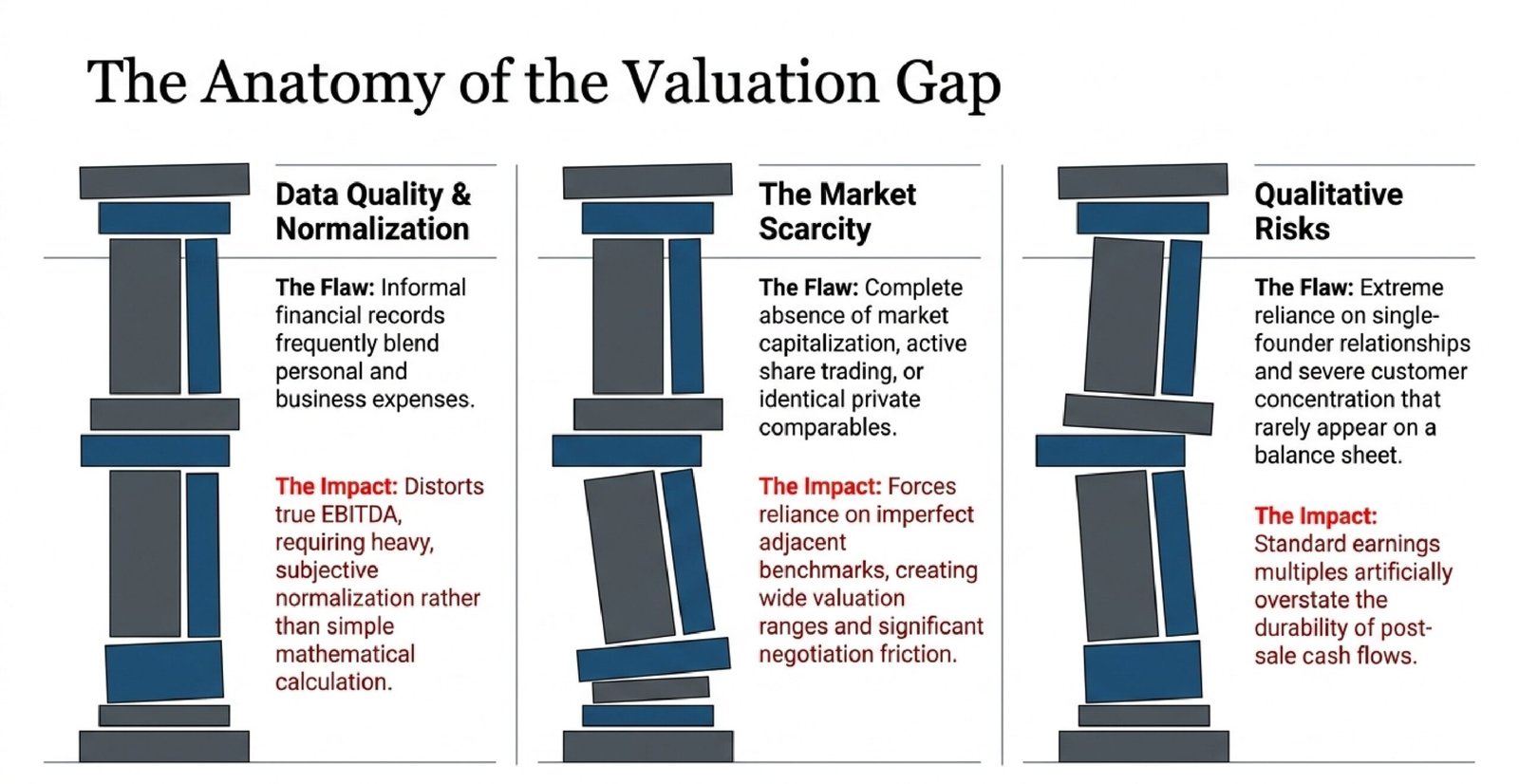
The first hurdle for every valuation engagement for a privately held business is data quality. Many SMEs don’t keep any records for investor reporting – they keep records only for tax purposes, which may mix revenue recognition, expense classification and owner compensation, making it hard to see what the company is truly profitable on. Small paper items like a shop owner’s personal car lease recorded as a business expense or a family member’s salary that is taking place in secret, yet still being counted in the books, can shift an EBITDA by 10% or more. This is one of the most frequently asked SME valuation challenges that the analyst faces, as it involves a judgment call, rather than a formula, and two experts can come up with two different valuations based on the same set of books. Just add cash transactions that don’t go through the accounting books, inventory errors and discrepancies, and audited statements that are often unavailable, and the valuator is no longer reading a book of financial history, but composing a new one. For a junior professional, this is the time that the real learning occurs because it gets them into a habit of questioning the numbers rather than taking them on their own and it shows them the value of judgment under what appears on the surface to be strictly a quantitative exercise. The first few months of studying valuation work, seasoned practitioners say, is actually an education in bookkeeping and human behavior before it turns into an education in finance theory.

Add to that, there is no reliable external reference point. SMEs don’t typically have market cap, trading multiples or analyst forecasts to build a valuation around, as publicly traded businesses do. In private deals, the terms are generally nondisclosure, and even when multiples exist, the business may be different in size, geographic area, and/or growth phase, which makes the multiples not as meaningful as they would be to draw a conclusion. In fact, this lack of comparables is a fundamental aspect of small business valuation that comes from the valuator’s assumptions and is why there are often differences between the buyer, the seller, and the advisor on the negotiating table. It takes a disciplined analyst to catch these gaps early, instead of covering them with a single “confident multiple,” and it’s a skill that should be developed early in life. To compensate for this, some practitioners expand their set of comparables to include neighbouring sectors or neighbouring markets, and then apply a discount to reflect the mismatch; they then clearly mark the adjustment to reflect that it is a discount that they added on, rather than a real market figure.

The table below provides a quick reference for some of the most common SME valuation challenges and their impact on the quality of a final valuation figure, to serve as a handy reference for junior analysts when dealing with their respective engagements. 

Table 1: Common SME Valuation Challenges and Their Impact on Business Valuation Accuracy
Challenge Why It Matters Typical Impact
Informal financial records Revenue and expenses often blended with personal use Distorted EBITDA, unreliable earnings base
Limited comparable data Few disclosed private transactions to benchmark against Wide valuation range, weak benchmarking
Owner or key-person dependency Business value tied heavily to one individual Overstated post-sale cash flow
Customer concentration Revenue reliant on a small number of clients Risk understated in standard multiples
Inconsistent discount rate assumptions No standard risk premium for small firms Valuation gaps between analysts

What Are the Biggest SME Valuation Challenges Affecting Business Valuation Accuracy?

Many of the risks associated with valuing a small business are not even captured within the financial statements. Many SMEs rely on one single entrepreneur for customer relationships, supplier terms or technical knowledge, and this is not reflected in the balance sheet in any way. As the result of the leaving or unavailability of that person, some models produce sudden drops in revenue within months, while most valuation models assume that the future cash flow is certain and continues as expected no matter who is in charge of the business. Likewise, a business that generates sixty percent of its income from two or three customers is at risk that can not be expressed with a single earnings multiple, no matter how carefully the earnings multiple is selected. These qualitative factors are not easy to measure consistently, and the lack of consistency is a common occurrence in Small Business Valuation engagements – even when presented with identical financial statements, no two analysts weigh key-person or concentration risk alike. There are also informal contracts: many SMEs do not have long-term contractual agreements, but rather short, renewable contracts—without much solid documentation to fall back upon—so a valuator needs to rely on his or her judgment to determine how long such arrangements are likely to last.

The added complexity of method selection makes the picture more complicated. Multi-year forecasts of discounted cash flow analysis are necessary, but many SME owners do not have reliable multi-year projections and the analyst must make up his/her assumptions from scratch and address them if challenged. Market-multiple approaches, on the other hand, rely on identifying similar companies similar in size, which are also few and far between at private businesses, and asset-based approaches may undervalue the relationships that do not show up on the balance sheet. The determination of an appropriate discount rate is also a controversial topic because there is no uniformity in the practices or jurisdictions regarding the determination of the liquidity or size risk premiums applied to small businesses. Two credible valuators with two credible methods can thus arrive at figures that vary by twenty per cent or more, reducing the level of confidence in Business Valuation Accuracy and increasing the difficulty of reaching an agreement on a fair transaction price by the stakeholders. It is a complex series of SME valuation challenges which cannot be completely addressed by a single formula and, for this reason, professional valuers do not usually work with the figure alone and many would prefer to give a figure within a range, the boundaries of which are known and acceptable to both parties. 

What Are the Biggest SME Valuation Challenges — and How Can Five Key Steps Help?

SME Valuation Challenges doesn’t need a complicated framework, it needs discipline and consistency in all engagements. The following five steps are the practices of seasoned finance teams to ensure business valuation accuracy in a real transaction and can be helpful to anyone new to Small Business Valuation who wishes to develop good practices in the early stages and avoid developing bad ones later.

  1. ormalize the financials. Consider owner compensation, related-party transactions and one-off expenses before calculating any multiple – to ensure that the earnings base is reflective of ongoing operations rather than personal or unusual items.
  2.  Validate the valuation with at least two different approaches. Compare the market based multiple to the discounted cash flow or asset based figure to make sure that they fall in the same ballpark, and if they do not, investigate carefully.
  3. Document every assumption. Document the discount rate, growth rate, and the set that was used so that the valuation can be explained, examined, and reconsidered later without having to second-guess the reason for its original use.
  4. Evaluate the risk of key persons and risk for customers explicitly. Create a transparent risk adjustment, not within the discount rate so as to allow stakeholders to understand what is affecting the ultimate discount rate.
  5. Engage an impartial reviewer. A second set of eyes will spot bias and increase overall accuracy before reaching a client or buyer, and it is a habit to stick with even under deadline pressure. 

What Are the Biggest SME Valuation Challenges Seen in Real Case Studies?

Let’s look at a simple case study from the real world: After years of consistent reported growth, a family owned furniture factory based in Vietnam is considering selling a significant share of its business to a regional buyer. The founders provided five years of tax statements which clearly demonstrated a continuing pattern of growth, but when analyzed more closely, almost 18 percent of the profit reported was from sales of equipment at a discount to a sister company that was also owned by the same family. After the analyst adjusted these transactions, the adjusted EBITDA was a materially worse number, and the initial asking price was based on unadjusted transactions and had to be lowered by about 15 percent, which was initially disappointing to the founders, until the analyst walked through the transactions line by line. This case is a classic example of SME Valuation Challenges based on informal financial structuring, and illustrates the need to examine the earnings base, rather than the multiple applied to it, first. It also provides evidence of the trend towards requesting supporting documentation (bank statements, supplier confirmations, etc.) from the buyer, instead of relying on management accounts as a final answer during initial discussions.

The second example relates to a logistics SME in Kenya which had grown rapidly by expansion of its fleet and was about to make a growth-equity investment. On the surface the company’s historic growth seemed appealing, but on a deeper dive, two customers made up more than 70 percent of the freight revenue, with no long-term contracts in place to guarantee the going-forward relationship. Investors initially valued the business based on a multiple generally found in diversified logistics companies, but then revised their offer to take into account the concentration risk, and applied a discount that better captured the company’s actual earnings stability and risk of losing a big customer. The episode highlights another fact that is part of the business valuation process: Qualitative risk factors can shift that final price by as much as, or more than, the financial multiple itself, even though the underlying spreadsheet may seem pretty precise. It helps to remember that both the process of doing “due diligence” and doing “valuation” are not discrete, but they are ongoing aspects of a deal, where what we learn during one phase can influence what we assume in the other. 

Table 2: Small Business Valuation Case Snapshots
Case Issue Uncovered Valuation Impact
Furniture manufacturer, Vietnam Related-party revenue inflation ~15% downward adjustment to asking price
Logistics SME, Kenya Customer concentration risk Discounted multiple applied by investors

What Are the Biggest SME Valuation Challenges to Learn From in Practice?

It is one of the clear lessons of repeated engagements that the numbers provided by the owner is a starting point and never an end. A spreadsheet given to a Junior by Management is often not ready to be trusted as it may need to be normalized, checked against bank statements/supplier invoices and against industry standards. One of the quickest ways to inherit someone’s optimism is to skip this verification step, and it’s one of the most preventable SME Valuation Challenges that analysts face to get an engagement done as soon as possible. It’s a small discipline: if you don’t ask a certain question before taking it for granted, you will never be a reliable analyst, but rather one who would just go along with whatever is fed to him. Having a simple checklist of some of the more common items that might need to be adjusted, for example, owner salary, related party transactions, and one-off expenses, makes this verification process a regular process on every engagement and not an afterthought cramped for time near a deadline.

The second lesson is on communication. Whilst the number is important, it is just as important to provide a clear explanation of the methodology and include an explanation of the various adjustments that were applied to the number that helped to keep the deal on track, as the number itself. Those who express their reasoning and assumptions in writing and explain their reasoning to clients are less likely to have conflicts and are able to establish more durable client relationships, not only for the sake of the client, but for the practitioner’s own credibility when working in a competitive field. Over time, repeat referrals are more likely to be the result of a technique that allows the professional Small Business Valuation Expert to develop the ability to apply judgement to each engagement, rather than a formula. Junior professionals who find it easy to communicate with the client in plain terms and not by relying on jargon will likely gain the trust of the client and of professionals who are reviewing their work. 

Conclusion: Turning SME Valuation Challenges Into Actionable Insights

The private company’s price is never simply a matter of calculation, but a compromise between imperfect information, the subjective decision-making of the two groups at the negotiating table and the hopes of the parties. The challenges described above – financial records are not in order, there are not enough comparable records; key-person risk / customer risk; inconsistent methodology – are not going away, but can be addressed with some good habits and patience in order to get to a first draft of a set of accounts. Rushes-to-one and one under deadline yields in financials are the ones that are not defensible, because those who normalize financials early, cross-check several valuation methods, and then have a second set of eyes read the valuation, put together more defensible numbers. For younger analysts and job applicants developing experience in this area, it is best to take every Small Business Valuation assignment as an opportunity to sharpen these habits, instead of simply delivering a spreadsheet and moving onto the next assignment. Improving Business Valuation Accuracy is not so much about what formula you might use, as it is what questions you ask of the data, the owner and the market before you settle on a number that others will rely on. Ultimately, that’s the discipline that makes a technically sound valuation one a buyer and seller can count on and that transforms a young analyst into a valuator whose judgment others want to rely on. To get started, normalize the earnings base first, triangulate with more than one method, put down all the assumptions in plain language, break out the key-person risk and customer risk, and get a second pair of eyes to eyeball the final number before it leaves your desk. It’s not difficult to do each of these steps on its own, but when taken together it’s the difference between a valuation that stands up to a negotiation and one that falls apart as soon as it’s put to the test by a seemingly tough question about how it was constructed. 
Frequently Asked Questions

Q1. Why is valuing an SME more difficult than valuing a large corporation?

SMEs typically have limited financial history, fewer comparable market transactions, and higher business risk. Their value is also more influenced by owner involvement, making professional judgment essential during the valuation process.

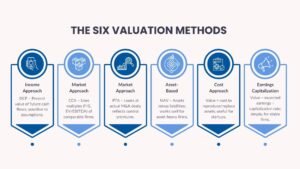
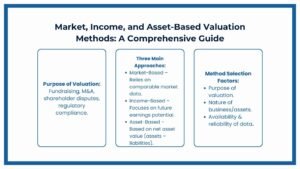
There is no single best method. Valuation professionals generally consider the Income Approach, Market Approach, and Asset-Based Approach before selecting the most appropriate methodology based on the company’s circumstances and purpose of valuation.

Typical documents include historical financial statements, management accounts, business plans, financial forecasts, customer information, details of assets and liabilities, shareholder agreements, and information about intellectual property or key contracts.

Important value drivers include sustainable earnings, cash flow, growth potential, industry outlook, customer diversification, management quality, competitive advantages, and business risks.

Many businesses obtain a valuation before fundraising, business sales, mergers, shareholder transactions, succession planning, or major financing. High-growth companies may also benefit from periodic valuations to support strategic planning and investment decisions.

What Are the Biggest SME Valuation Challenges?

Though the vast majority of economies are built on the shoulders of small and medium sized enterprises, yet one of the most longstanding challenges in corporate finance is putting these enterprises in a price basket. In the world of junior analysts, accountants and finance professionals seeking to establish a career in valuation, knowing the SME valuation challenges that exist between a defensible number and a guess is vital, as it can stall a sale, loan application or investment round before it even gets off the ground. Business valuation accuracy is more difficult and more easily questioned by an SME compared to a listed company because they often do not possess multi-year financial statements (audited), share trading (active) or industry analysts to track performance. This article explores why small business valuation work is so challenging, how practitioners can minimize errors, real-world examples of potential errors and what lessons practitioners take from this work for their next engagements. 

What Are the Biggest SME Valuation Challenges?

What Are the Biggest SME Valuation Challenges in Financial Reporting?

The first hurdle for every valuation engagement for a privately held business is data quality. Many SMEs don’t keep any records for investor reporting – they keep records only for tax purposes, which may mix revenue recognition, expense classification and owner compensation, making it hard to see what the company is truly profitable on. Small paper items like a shop owner’s personal car lease recorded as a business expense or a family member’s salary that is taking place in secret, yet still being counted in the books, can shift an EBITDA by 10% or more. This is one of the most frequently asked SME valuation challenges that the analyst faces, as it involves a judgment call, rather than a formula, and two experts can come up with two different valuations based on the same set of books. Just add cash transactions that don’t go through the accounting books, inventory errors and discrepancies, and audited statements that are often unavailable, and the valuator is no longer reading a book of financial history, but composing a new one. For a junior professional, this is the time that the real learning occurs because it gets them into a habit of questioning the numbers rather than taking them on their own and it shows them the value of judgment under what appears on the surface to be strictly a quantitative exercise. The first few months of studying valuation work, seasoned practitioners say, is actually an education in bookkeeping and human behavior before it turns into an education in finance theory.

Add to that, there is no reliable external reference point. SMEs don’t typically have market cap, trading multiples or analyst forecasts to build a valuation around, as publicly traded businesses do. In private deals, the terms are generally nondisclosure, and even when multiples exist, the business may be different in size, geographic area, and/or growth phase, which makes the multiples not as meaningful as they would be to draw a conclusion. In fact, this lack of comparables is a fundamental aspect of small business valuation that comes from the valuator’s assumptions and is why there are often differences between the buyer, the seller, and the advisor on the negotiating table. It takes a disciplined analyst to catch these gaps early, instead of covering them with a single “confident multiple,” and it’s a skill that should be developed early in life. To compensate for this, some practitioners expand their set of comparables to include neighbouring sectors or neighbouring markets, and then apply a discount to reflect the mismatch; they then clearly mark the adjustment to reflect that it is a discount that they added on, rather than a real market figure.

The table below provides a quick reference for some of the most common SME valuation challenges and their impact on the quality of a final valuation figure, to serve as a handy reference for junior analysts when dealing with their respective engagements. 

Table 1: Common SME Valuation Challenges and Their Impact on Business Valuation Accuracy
Challenge Why It Matters Typical Impact
Informal financial records Revenue and expenses often blended with personal use Distorted EBITDA, unreliable earnings base
Limited comparable data Few disclosed private transactions to benchmark against Wide valuation range, weak benchmarking
Owner or key-person dependency Business value tied heavily to one individual Overstated post-sale cash flow
Customer concentration Revenue reliant on a small number of clients Risk understated in standard multiples
Inconsistent discount rate assumptions No standard risk premium for small firms Valuation gaps between analysts

What Are the Biggest SME Valuation Challenges Affecting Business Valuation Accuracy?

Many of the risks associated with valuing a small business are not even captured within the financial statements. Many SMEs rely on one single entrepreneur for customer relationships, supplier terms or technical knowledge, and this is not reflected in the balance sheet in any way. As the result of the leaving or unavailability of that person, some models produce sudden drops in revenue within months, while most valuation models assume that the future cash flow is certain and continues as expected no matter who is in charge of the business. Likewise, a business that generates sixty percent of its income from two or three customers is at risk that can not be expressed with a single earnings multiple, no matter how carefully the earnings multiple is selected. These qualitative factors are not easy to measure consistently, and the lack of consistency is a common occurrence in Small Business Valuation engagements – even when presented with identical financial statements, no two analysts weigh key-person or concentration risk alike. There are also informal contracts: many SMEs do not have long-term contractual agreements, but rather short, renewable contracts—without much solid documentation to fall back upon—so a valuator needs to rely on his or her judgment to determine how long such arrangements are likely to last.

The added complexity of method selection makes the picture more complicated. Multi-year forecasts of discounted cash flow analysis are necessary, but many SME owners do not have reliable multi-year projections and the analyst must make up his/her assumptions from scratch and address them if challenged. Market-multiple approaches, on the other hand, rely on identifying similar companies similar in size, which are also few and far between at private businesses, and asset-based approaches may undervalue the relationships that do not show up on the balance sheet. The determination of an appropriate discount rate is also a controversial topic because there is no uniformity in the practices or jurisdictions regarding the determination of the liquidity or size risk premiums applied to small businesses. Two credible valuators with two credible methods can thus arrive at figures that vary by twenty per cent or more, reducing the level of confidence in Business Valuation Accuracy and increasing the difficulty of reaching an agreement on a fair transaction price by the stakeholders. It is a complex series of SME valuation challenges which cannot be completely addressed by a single formula and, for this reason, professional valuers do not usually work with the figure alone and many would prefer to give a figure within a range, the boundaries of which are known and acceptable to both parties. 

What Are the Biggest SME Valuation Challenges — and How Can Five Key Steps Help?

SME Valuation Challenges doesn’t need a complicated framework, it needs discipline and consistency in all engagements. The following five steps are the practices of seasoned finance teams to ensure business valuation accuracy in a real transaction and can be helpful to anyone new to Small Business Valuation who wishes to develop good practices in the early stages and avoid developing bad ones later.

  1. ormalize the financials. Consider owner compensation, related-party transactions and one-off expenses before calculating any multiple – to ensure that the earnings base is reflective of ongoing operations rather than personal or unusual items.
  2.  Validate the valuation with at least two different approaches. Compare the market based multiple to the discounted cash flow or asset based figure to make sure that they fall in the same ballpark, and if they do not, investigate carefully.
  3. Document every assumption. Document the discount rate, growth rate, and the set that was used so that the valuation can be explained, examined, and reconsidered later without having to second-guess the reason for its original use.
  4. Evaluate the risk of key persons and risk for customers explicitly. Create a transparent risk adjustment, not within the discount rate so as to allow stakeholders to understand what is affecting the ultimate discount rate.
  5. Engage an impartial reviewer. A second set of eyes will spot bias and increase overall accuracy before reaching a client or buyer, and it is a habit to stick with even under deadline pressure. 

What Are the Biggest SME Valuation Challenges Seen in Real Case Studies?

Let’s look at a simple case study from the real world: After years of consistent reported growth, a family owned furniture factory based in Vietnam is considering selling a significant share of its business to a regional buyer. The founders provided five years of tax statements which clearly demonstrated a continuing pattern of growth, but when analyzed more closely, almost 18 percent of the profit reported was from sales of equipment at a discount to a sister company that was also owned by the same family. After the analyst adjusted these transactions, the adjusted EBITDA was a materially worse number, and the initial asking price was based on unadjusted transactions and had to be lowered by about 15 percent, which was initially disappointing to the founders, until the analyst walked through the transactions line by line. This case is a classic example of SME Valuation Challenges based on informal financial structuring, and illustrates the need to examine the earnings base, rather than the multiple applied to it, first. It also provides evidence of the trend towards requesting supporting documentation (bank statements, supplier confirmations, etc.) from the buyer, instead of relying on management accounts as a final answer during initial discussions.

The second example relates to a logistics SME in Kenya which had grown rapidly by expansion of its fleet and was about to make a growth-equity investment. On the surface the company’s historic growth seemed appealing, but on a deeper dive, two customers made up more than 70 percent of the freight revenue, with no long-term contracts in place to guarantee the going-forward relationship. Investors initially valued the business based on a multiple generally found in diversified logistics companies, but then revised their offer to take into account the concentration risk, and applied a discount that better captured the company’s actual earnings stability and risk of losing a big customer. The episode highlights another fact that is part of the business valuation process: Qualitative risk factors can shift that final price by as much as, or more than, the financial multiple itself, even though the underlying spreadsheet may seem pretty precise. It helps to remember that both the process of doing “due diligence” and doing “valuation” are not discrete, but they are ongoing aspects of a deal, where what we learn during one phase can influence what we assume in the other. 

Table 2: Small Business Valuation Case Snapshots
Case Issue Uncovered Valuation Impact
Furniture manufacturer, Vietnam Related-party revenue inflation ~15% downward adjustment to asking price
Logistics SME, Kenya Customer concentration risk Discounted multiple applied by investors

What Are the Biggest SME Valuation Challenges to Learn From in Practice?

It is one of the clear lessons of repeated engagements that the numbers provided by the owner is a starting point and never an end. A spreadsheet given to a Junior by Management is often not ready to be trusted as it may need to be normalized, checked against bank statements/supplier invoices and against industry standards. One of the quickest ways to inherit someone’s optimism is to skip this verification step, and it’s one of the most preventable SME Valuation Challenges that analysts face to get an engagement done as soon as possible. It’s a small discipline: if you don’t ask a certain question before taking it for granted, you will never be a reliable analyst, but rather one who would just go along with whatever is fed to him. Having a simple checklist of some of the more common items that might need to be adjusted, for example, owner salary, related party transactions, and one-off expenses, makes this verification process a regular process on every engagement and not an afterthought cramped for time near a deadline.

The second lesson is on communication. Whilst the number is important, it is just as important to provide a clear explanation of the methodology and include an explanation of the various adjustments that were applied to the number that helped to keep the deal on track, as the number itself. Those who express their reasoning and assumptions in writing and explain their reasoning to clients are less likely to have conflicts and are able to establish more durable client relationships, not only for the sake of the client, but for the practitioner’s own credibility when working in a competitive field. Over time, repeat referrals are more likely to be the result of a technique that allows the professional Small Business Valuation Expert to develop the ability to apply judgement to each engagement, rather than a formula. Junior professionals who find it easy to communicate with the client in plain terms and not by relying on jargon will likely gain the trust of the client and of professionals who are reviewing their work. 

Conclusion: Turning SME Valuation Challenges Into Actionable Insights

The private company’s price is never simply a matter of calculation, but a compromise between imperfect information, the subjective decision-making of the two groups at the negotiating table and the hopes of the parties. The challenges described above – financial records are not in order, there are not enough comparable records; key-person risk / customer risk; inconsistent methodology – are not going away, but can be addressed with some good habits and patience in order to get to a first draft of a set of accounts. Rushes-to-one and one under deadline yields in financials are the ones that are not defensible, because those who normalize financials early, cross-check several valuation methods, and then have a second set of eyes read the valuation, put together more defensible numbers. For younger analysts and job applicants developing experience in this area, it is best to take every Small Business Valuation assignment as an opportunity to sharpen these habits, instead of simply delivering a spreadsheet and moving onto the next assignment. Improving Business Valuation Accuracy is not so much about what formula you might use, as it is what questions you ask of the data, the owner and the market before you settle on a number that others will rely on. Ultimately, that’s the discipline that makes a technically sound valuation one a buyer and seller can count on and that transforms a young analyst into a valuator whose judgment others want to rely on. To get started, normalize the earnings base first, triangulate with more than one method, put down all the assumptions in plain language, break out the key-person risk and customer risk, and get a second pair of eyes to eyeball the final number before it leaves your desk. It’s not difficult to do each of these steps on its own, but when taken together it’s the difference between a valuation that stands up to a negotiation and one that falls apart as soon as it’s put to the test by a seemingly tough question about how it was constructed. 
Frequently Asked Questions

Q1. Why is valuing an SME more difficult than valuing a large corporation?

SMEs typically have limited financial history, fewer comparable market transactions, and higher business risk. Their value is also more influenced by owner involvement, making professional judgment essential during the valuation process.

There is no single best method. Valuation professionals generally consider the Income Approach, Market Approach, and Asset-Based Approach before selecting the most appropriate methodology based on the company’s circumstances and purpose of valuation.

Typical documents include historical financial statements, management accounts, business plans, financial forecasts, customer information, details of assets and liabilities, shareholder agreements, and information about intellectual property or key contracts.

Important value drivers include sustainable earnings, cash flow, growth potential, industry outlook, customer diversification, management quality, competitive advantages, and business risks.

Many businesses obtain a valuation before fundraising, business sales, mergers, shareholder transactions, succession planning, or major financing. High-growth companies may also benefit from periodic valuations to support strategic planning and investment decisions.

Related Posts

Everything You Need to Know About Company Valuation with Valueteam

Valueteam delivers precise company valuation services to support fundraising, mergers, acquisitions, and strategic decision-making.