Which Valuation Method Is Best?
Understanding Which Valuation Method Is Best?
The question that all the founders, finance people, and job seekers who must go before boards for an interview will come across in some form or another is, “How much is a business worth?” The truth is there isn’t one best method for doing business valuation; it depends on the size of the business, the industry, the stage of growth and the reasons for the business valuation. The value of a tech start up, which may be projected to generate no profits at all, differs from the value of an older manufacturing company with a huge warehouse of machines. The value of a business that is taking a bank loan is different from the value of one that is aiming to be sold, a merger completed, or an ownership transfer within the business. Knowing the pros and cons of each method is one of the best skills that any finance pro can develop as it will come up a lot in job interviews, client meetings and even real deal negotiations, and is likely to be the answer a client will be looking for—when the client is stressed and needs an answer that’s more than just a textbook definition. It outlines the principles of each method, provides examples of how to apply them in real life business scenarios, identifies pitfalls that are common to most professionals’ journeys, and tells you a repeatable process for making intelligent decisions about which one to use – no matter where you’re at in your career. At the end, not only should you be able to say what each method is used for, but why a hiring manager or a client would put their faith in one number over the other.
What Is the Best Business Valuation Method for a Given Situation?
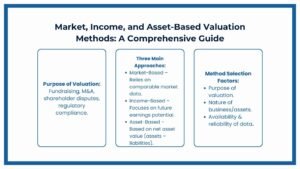
No single approach to business valuation is best for all businesses and in all situations; if worded otherwise by professionals, they are likely to be oversimplifying the actual decision. To summarize, valuation practitioners generally use three large categories of valuation — the income, market and asset approaches — and the best approach is really the one that is most representative of the way a business creates and sustains value for the owner. A software company that has recurring subscription sales is typically valued by its future cash flow expectations – it’s not a property-based business. On the other hand, a logistics firm with trucks, land and warehouses tends to be more asset-heavy as a significant portion of its value resides in tangible assets that can be seen and touched, as opposed to goodwill or expectations of future growth and market share.
Digging deeper, the income approach is the most typical approach that is developed as a Discounted Cash Flow (DCF) model, which is based on projected future income and discounted to present value in consideration of the risk and cost of capital. This approach requires sound and transparent reasoning, not a single bold assumption, because small discrepancies in the growth rate or discount rate assumptions can make all the difference. The market approach involves analyzing the market price of the business by using a multiple like price to earnings or enterprise value / ebitda to derive a market price from another company that is similar to the one being valued. The asset-based approach, on the other hand, consists of a total fair value of all assets owned by the company minus liabilities to derive a net worth, which is easier to justify but may be inadequate without further analysis. Junior analysts are frequently asked to perform multiple analyses and compare and contrast the results, since a single number can lead to misunderstandings for investors and analysts, particularly in volatile markets or when the company does not have many industry peers that can be compared. In practice, many advisory teams will report a range of possible figures, rather than a single number – because the interpretation of two or three methods is rarely going to be exactly the same, and a range is probably a more honest and defensible answer than an exact figure. Having a range, again, demonstrates maturity to a client or interviewer as it indicates that valuation is a process of informed judgment rather than a right and wrong answer.
How Does Asset-Based Business Valuation Work in Practice?
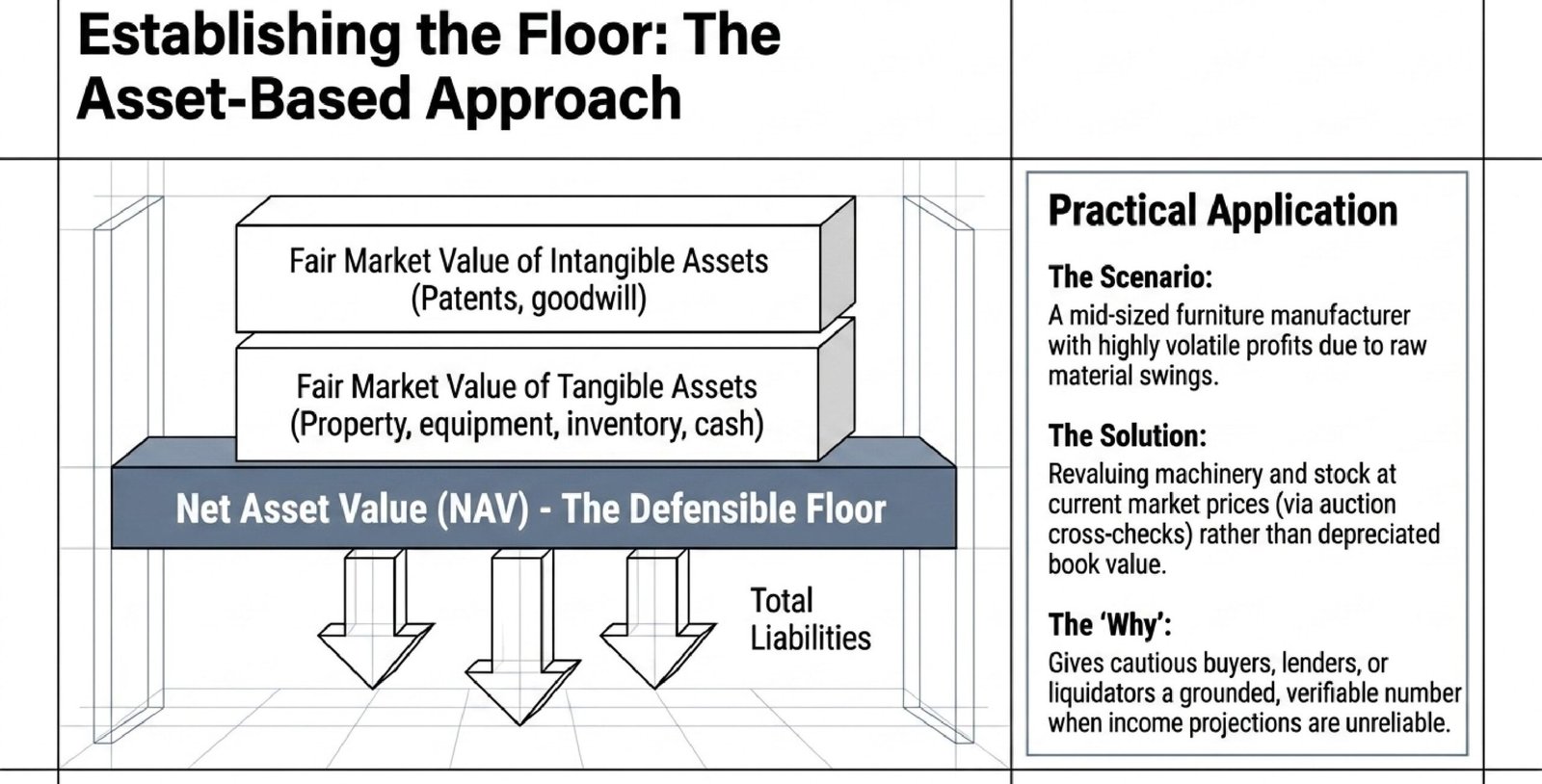
Conceptually, asset-based business valuation is the simplest of the three approaches, hence this is one reason why it’s typically the first approach taught to junior analysts. It determines the worth of a company by adding up the sum of all the fair market value of the company’s tangible and intangible assets, which include property, equipment, inventory, cash, patents and goodwill, and deducting the total liabilities from the sum to arrive at the net asset value. It is especially prevalent in asset-rich businesses such as manufacturing, real estate and holding companies and is frequently referred to as a ” floor value” in the context of liquidation, where the issue isn’t what future profits a business might generate, it’s rather how much cash could be recovered if the business closed its doors today and sold all its assets at current market value. It’s also commonly employed by lenders, as a bank giving a loan is more interested with the value of the collateral that it can recover than in the lending institutions’ positive forecasts. Another reason why all finance professionals need to be familiar with this method, even though it isn’t widely used as a primary method of valuation, is that accountants and auditors rely on it when preparing financial statements that involve disclosures of “fair value” accounting.
Suppose a medium-sized furniture company is looking to sell a portion of its company to an individual investor. The company’s profits varied sharply over the last three years because of the volatility in commodity prices and because the income projections were based on the prices of commodity inputs, which a conservative buyer didn’t want but could only be sold on the basis of. The finance team, instead, constructed an asset based business valuation by revaluing the assets—factory building, machinery and raw material stock—at current market value, rather than at their depreciated book value which was well below the assets’ open market value. The team also looked at the prices of similar equipment as offered on recent auctions or resale listings, to validate equipment values that could have seemed arbitrary, and to add credibility to the numbers. While this valuation approach may result in an understated valuation, since both sides were now armed with a defensible number to use in negotiations, the result was still useful. Finally, the investor and the founder reached an agreement for a base price that is based on the asset value and a separate earn-out which incorporates the upside the balance sheet didn’t capture.
Comparing the Three Core Business Valuation Approaches
| Method | Best suited for | Main limitation |
| Income (DCF) | Companies with predictable, growing cash flow | Highly sensitive to growth and discount rate assumptions |
| Market (Comparables) | Businesses with active, similar peer transactions | Few true comparables for niche or unique businesses |
| Asset-based business valuation | Asset-heavy firms, holding companies, liquidation cases | Undervalues brand, talent, and future earning potential |
What Are the Five Key Steps in a Reliable Valuation Process?
Whatever the eventual decision is, a well-defined procedure can prevent the two most frequent errors analysts make: making overly optimistic assumptions, and failing to consider the real application of the final numbers by the people receiving them. The five steps are repeated in just about every credible valuation engagement, regardless of whether it is conducted by a boutique advisory firm, an in-house finance team or a solo consultant on a small client, and the steps are sequential. It is never easier to skip a step; in practice, it is generally just a step down the stream where it will cost more and be harder to do in the future.
The first step is to define the purpose of the valuation, as a valuation made for a funding round will differ significantly from a valuation made for a tax filing or an insurance claim or for a divorce settlement, and there are differing levels of expectations for each context. Second, get financial data that is clean and verified and at least 3 years old since it will be used for every method that follows, regardless of how complex the model may appear on paper, if the data is not fully verified with inconsistencies. Third, choose a valuation method that is appropriate for the company’s circumstances, specifically for its industry, size and data availability, rather than choosing the model that is most-often used, or most easily programmed in an Excel spreadsheet. Fourth, adjust the output, for example, to include or exclude one-off expenses, to include related party transactions and/or to revalue assets to current market value, such that the output reflects economic reality, not accounting conventions. Fifth, compare the result with another calculation method and explain all of the assumptions clearly as they may be questioned by an interlocutor who is not a financial professional, even if the mathematical calculations are quite nice. Those who adopt these five steps in their valuation early are more likely to complete the engagements with confidence, as the process itself gives them confidence, even in the case of a company they have never worked with, or one that is exceptionally complex.
Why Is Business Valuation for SMEs Different From Valuing Large Companies?
Valuing a business for an SME is a unique process, one that is seldom featured in textbook cases involving a large, publicly listed company. However, the financial data of small and medium-sized enterprises is likely to be less complete, lack years of audited financial history and be more dependent on the personal relationships or reputation of the owner than to established processes which could endure any ownership change. The income approach is even more challenging because predicting likely future cash flows becomes more risky when the income is generated by just one or two customers, and the market approach is similarly problematic because it is not simple to identify truly comparable private companies when transaction information is not usually published for smaller deals. Typically, there are no “rules of thumb” for these engagements, and analysts are forced to make their own decisions much more often than in a larger, more well-documented client, leading to the need for much more time to establish trust with an owner who has never had their business rigorously analyzed before.
An example of this is a family-run logistics company looking to sell some assets and raise a growth investor. There was no distinction between the founder’s personal and business expenses, and a lot of his business was based on his own network, not on contractually binding and transferable business arrangements that would continue after his departure. Before any method could be applied with any real credibility, the valuation team had to first “normalize” the financials by removing any owner expenses, and then estimating a market rate replacement salary for the owner’s compensation. They also held extensive discussions with the owner on the nature of the relationship, meaning contractual as opposed to personal, as this directly impacted upon how much of the income could be reasonably anticipated to continue following the sale. The take-home point is also a recurring one in business valuations for SMEs: very much before the valuation model is constructed, there is cleaning up of messy data and teasing out any hidden owner dependency—both of which are unglamorous and yet practical skills that will shine through in interviews and early career experiences. It’s also a skill that can’t be replaced entirely by a formula or software template because it requires the ability to ask some of the right questions and listen for subtleties in the answers that an owner gives.
Business Valuation for SMEs: Common Adjustments Before Applying Any Method
| Adjustment | Why it matters |
| Separating owner’s personal expenses from business costs | Prevents understated profitability |
| Adding a market-rate owner salary if underpaid | Reflects true operating cost if a replacement were hired |
| Reviewing customer concentration | Signals revenue risk not visible in raw financials |
What Are the Benefits and Challenges of Choosing a Valuation Method?
Every technique has its clear advantages when applied appropriately. The income approach is appealing to those investors who like to invest in a company’s future and not its history, and it makes management to tell a story of growth with solid numbers that support it. The market approach is also easy to explain and is based on actual transactions that are observable, so it is easy to convince buyers that external validation is provided, not just a theoretical model based on assumptions they will not be able to verify. In distress situations, where the need for a business sale, finance or insurance may make it tempting to believe that a higher valuation is the true value, but is not supported by a defensible floor, or where businesses’ earnings are too erratic to be valued responsibly and with stability, asset-based business valuation provides a stable reference point for all parties.
But the problems are just as significant to be understood before investing in a method. There is a lot of flexibility in how these types of income-based models can change with a slight shift in growth rate or in the assumptions about the discount rate, making them fairly easy to manipulate (deliberately or otherwise—it can happen on accident) while being hard for people without deep training to sanity-check. But market-based comparisons are rendered impossible when there aren’t enough equivalent deals to compare, as is often the case in niche industries and less liquid markets where the most current transaction information is not available. Meanwhile, asset-based approaches can overlook the intangible assets of a business, such as brand loyalty, proprietary processes and a strong management team, that can be valuable but difficult to quantify, resulting in an undervalued business. There are trade-offs behind any single number, and it’s a junior analyst’s job to not only recognize them, but to not rely on them without analyzing them as a whole.
Conclusion: Choosing the Right Method With Confidence
While there is no short-cut to replace sound judgment in choosing an approach to valuation, it will be greatly simplified once the purpose, industry and data available are clearly established at the beginning. An income-based model, along with a market comparison can often be the most complete picture, especially for a growing tech company; for an asset-heavy business or one in financial distress, an asset-based business valuation can serve as a sound base for a defensible value, one that is relied upon by both parties, though it may need to be paired with other valuation methods later on. But the real trick to business valuation of SMEs is to clean and normalize the data before any formula is ever applied—after all, the better the numbers that go into the model, the more reliable the model will be, and there is no way to make up a bad starting set of numbers! The one thing that any new person to this field can take away from the situation is this – forget any one single approach, always state your assumptions clearly and simply and always be prepared to explain, in simple terms, why the number you’ve arrived at is valid for the person who sits outside finance. You will have a combination of technical technique and a clear, easy to understand communication that you will be well ahead of most of your peers at the same stage in their career.