Valuation Consultant Jakarta for Business Valuation Services
Introduction to Valuation Consultant Jakarta for Business Valuation Services
Jakarta is the hub of the Indonesian corporate finance. It is also the centre of the most significant business valuation engagements as it is the main centre of investing, trading and regulation in the country. The deal that a mid-size consumer goods company in Tangerang is planning a private equity transaction, or a publicly-traded energy group in the capital requires an independent fairness opinion of a related-party transaction, the work is almost always sent through a Valuation Consultant Jakarta firm with the local knowledge, regulatory credentials, and methodological rigor to generate a defensible report.
As a junior or mid-level practitioner in corporate finance, investment banking or management consulting it is a career differentiator to comprehend how jakarta valuation consulting services work,including the set up of an engagement to the ultimate delivery of the final report. The level of demand of qualified professionals in the space has increased steadily as the Indonesian deal market has continued to grow, the number of pre-IPO companies in Indonesia has continued to grow and aggressive tax enforcement by the Directorate General of Taxes (DGT).
The article presents a practical, grounded overview of what business valuation consultant professionals based in Jakarta do, how the business engagements are organized, what is problematic in the Jakarta market in particular and how professionals joining the field or stepping up the ladder can develop the necessary expertise.
Scope and Drivers of the Jakarta Valuation Market
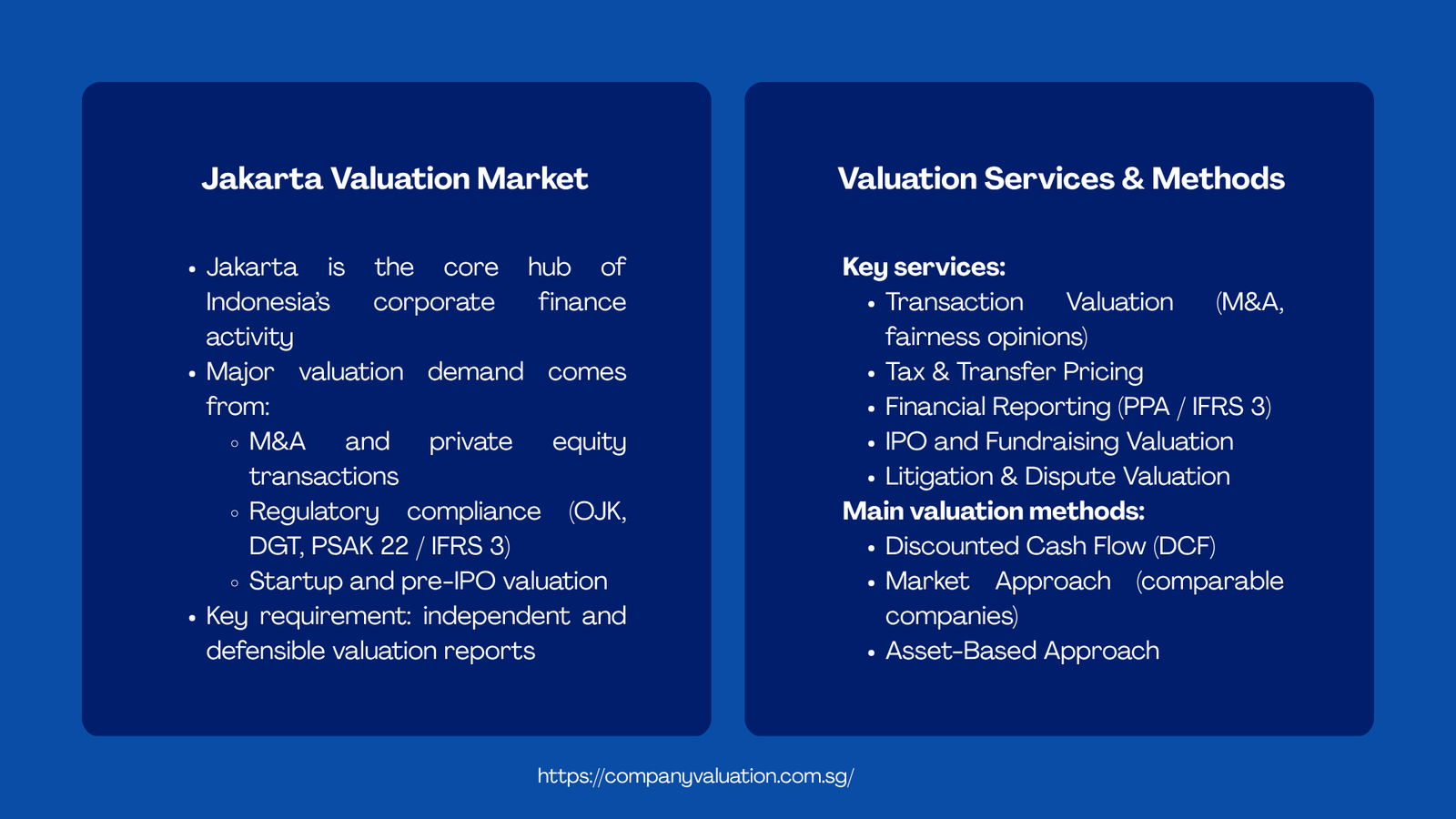
The valuation market in Jakarta is influenced by three sources of demand overlapping. The former is transaction-based: mergers, acquisitions, private placements and sale of stakes which involve a need to have an independent value opinion to assist in price negotiations or meet regulatory requirements. The second is compliance-based, OJK requires listed companies, transfer pricing documentation requirements of DGT regulations and financial reporting requirements of PSAK 22 (the Indonesian version of IFRS 3) which allocates purchase price under an acquisition. The third, and the fastest-growing, is startup and growth-stage company valuations – a direct reflection of the emerging landscape of the Indonesia technology and consumer sector.
All these demand streams require various valuation skills and methodological focus, yet they all have the same underlying need; a credible and well-documented Jakarta Valuation Consulting Services engagement by a licensed professional. The table below provides an overview of the major type of services that a typical valuation consultant Jakarta firm performs and the regulatory framework in which each one of them is located.
Tabel 1 : Valuation Consultant Jakarta for Business Valuation Services: Business Valuation Service Types and Regulatory Context
| Service Type | Primary Purpose | Typical Client | Regulatory Link |
|---|---|---|---|
| Transaction Valuation | Price discovery for M&A, stake sales | Founders, strategic buyers, private equity. | OJK Reg. 35/2020 (listed co.) |
| Tax & Transfer Pricing | Arm-length pricing of intra-group transactions. | Multinationals, conglomerates | DGT / PMK guidelines |
| Financial Reporting (PPA) | The allocation of purchase price after the acquisition. | Listed & large private companies | PSAK 22 / IFRS 3 |
| Litigation & Dispute | Disputes among shareholders, divorce, arbitration. | Law firms, courts, individuals | Court / arbitration order |
| Fundraising / IPO Readiness | Pre-IPO fair value, equity story. | Startups, growth-stage companies | IDX listing requirements |
Being familiar with what type of service to use in a particular situation is a good place to begin with junior professionals. An employee requesting a quick valuation could actually require a transfer pricing study, a purchase price allocation, or an entire DCF investor deck – and each of those has a different scope, timeframe, and cost structure. Some form of clarity on purpose is the most crucial consideration in making it right in the expectations of clients at the beginning of any business valuation consultant Jakarta engagement.
5 Core Processes in Business Valuation – Valuation Consultant Jakarta for Business Valuation Services
The engagement process of jakarta valuation consulting services is a familiar sequence, irrespective of the type of services. Experts with the know-how of every step, the kind of judgment it entails, are in a better position to play their part, be it an analyst, as a lead valuator, or a manager, as a manager in charge of a junior staff.1. Scopes and purpose: Write down – The engagement team should be in agreement with the client on the purpose of the valuation (transaction, compliance, reporting, or even litigation), the standard of value (fair market value, fair value, or investment value), and the valuation date, before any analysis commences.
- Define scope and purpose in writing — Before any analysis begins, the engagement team must agree with the client on the valuation purpose (transaction, compliance, reporting, or litigation), the standard of value (fair market value, fair value, or investment value), and the valuation date. The three parameters will be the driving force of all the following decisions in the engagement. Any confusion in this would give rise to duplication in the future.2. Construct the data base with integrity – It takes integrity to give integrity.
- Build the data foundation rigorously — Reliable output requires reliable input. This involves the request of at least three years of audited financial statements, management accounts of the current period, full asset register, all material contracts and any management forecasts. In the case of family-owned Jakarta businesses, which remain the most common type of business in most industries, this stage will tend to provide insights into the informal accounting that will have to be un-entangled before further analysis can occur.3. Use the appropriate methodology to the situation – The Discounted Cash Flow method will be the most common going-concern valuation in Jakarta.
- Apply the right methodology for the context — The Discounted Cash Flow method is the primary approach for most going-concern valuations in Jakarta. The Market Approach is the cross-check, based on the publicly listed peers of the IDX or where the local comparables are few, on ASEAN exchanges. In the case of Assets intensive businesses like property, plantations or infrastructure, the Asset Approach has much more weight. The methodology adopted by a report is justified by the credible report itself as opposed to using it as a default.4. Building WACC using Indonesia-specific inputs- The most questionable part of any DCF-based valuation is the discount rate.
- Construct the WACC with Indonesia-specific inputs — The discount rate is the most scrutinised element of any DCF-based valuation. Jakarta affairs WACC accumulation should include an Indonesia country risk premium – normally between 2.5 and 4.5 per cent depending upon industry and foreign exposure of the company. One of the most frequent mistakes that the regulators and opposing counsel recognize when reviewing is the use of a generic global WACC without such an adjustment.5. Produce a report that can withstand criticism – The report must not be a mere show of figures.
- Deliver a report that survives scrutiny — The final report is not simply a presentation of numbers. It should provide the methodology, all assumptions made explicit, sensitivity analysis of how the values vary with different growth rate and discount rate scenarios, must be signed by a MAPPI-licensed or otherwise credentialled professional. Reports that are to be used to submit to OJK or litigation setting are formally reviewed, and reports that are to be used to make an internal decision should be as rigorous as possible.
Understanding the Four-Step Engagement Process – Valuation Consultant Jakarta for Business Valuation Services
This is one of the most helpful things that a junior professional can do in the initial stages of their career by observing how an experienced valuation consultant Jakarta organizes their time and communication within an engagement. The four-step model below incorporates the steps undertaken by most reputable firms in Jakarta, in conducting their valuation work, and will be useful as a guide to those taking part in or supervising valuation work, first time.
Table 2: Valuation Consultant Jakarta for Business Valuation Services: Four-Step Engagement Framework — What Happens and Why It Matters
| Step | Phase | What Happens | Professional Tip |
|---|---|---|---|
| 1 | Scope & Briefing | The purpose and standard of value, as well as the date of valuation and the form of deliverable are all written. | Demand a written engagement letter – oral scopes change. |
| 2 | Data & Due Diligence | Financials in the form of audits, contracts, asset registers, and management forecasts and industry benchmarks are gathered and analysed. | Missing flag information beforehand; after the fact surprises slow down the whole interaction. |
| 3 | Modelling & Analysis | Primary approach (usually DCF) and cross-check approach (comps) are constructed; WACC is constructed using Indonesia country risk premium. | Record all assumptions – auditors and auditors will enquire. |
| 4 | Report & Review | Final report signed by MAPPI-licensed valuator and submitted; draft of the report shared with client; feedback taken into account. | Don’t overlook the internal quality check stage – mistakes detected later are very expensive. |
Practically, Step 2 is always the experience where engagements are faced with. A pharmaceutical distribution company based in Jakarta, that was planning to sell a minority stake to a regional strategic investor in 2023, in the preparation of data collection, found that the financial statements prepared in the previous three years were made on a cash basis as opposed to accrual basis. It took another three weeks of rebuilds by the business valuation consultant Jakarta team before the normalization process could be initiated at all. Junior professional learning is direct: quality of data drives time and cost drives quality of data drives time.
Key Challenges, Tests, and Lessons in Practice – Valuation Consultant Jakarta for Business Valuation Services
The valuation market in Jakarta is not insignificantly different than in more developed capital markets, and it is this insight into the distinction that makes a good practitioner in the field of jakarta valuation consulting services. The table below is based on typical trends based on actual Jakarta interactions in manufacturing, consumer, technology and property industries.
Table 3: Valuation Consultant Jakarta for Business Valuation Services: Common Challenges in Jakarta Valuation Engagements
| Challenge | Why It Arises in Jakarta Engagements | How Experienced Consultants Respond |
|---|---|---|
| Inconsistent financial records | Informal accounts are kept by many Jakarta SMEs and family groups or personal and business expenses are mixed. | Conduct at least three years normalization; have all add-backs documented and supported. |
| Thin comparable company data | IDX has limited number of peers compared to regional exchanges; some of the sectors of trading are too thin to count. | Enlarge peer set to companies listed on ASEAN; use explicit size and liquidity discounts. |
| Rupiah volatility in DCF inputs | The IDR fluctuation also has an impact on WACC country risk premium and replacement cost of imported assets. | Present value of both IDR and USD; Stress-test WACC within a range of 200 bps. |
| Client unfamiliarity with discounts | Founders are usually opposed to minority discount (DLOC) or unmarketability (DLOM) adjustments. | Educate early, with a one-page plain-language explainer, prior to the draft report being disseminated. |
| OJK / MAPPI review timelines | The regulatory audit on listed-company deals introduces weeks of time that customers can hardly afford. | Create a four-week regulatory buffer on any project timeline since the beginning. |
An example of such is in the Indonesian technology industry. In 2024, a Jakarta-based fintech firm was aiming to raise a fundraising round through a valuation of Series C to help it be financed by a pan-Asian private equity fund. The independent valuation consultant Jakarta firm engaged by the company and the internal investment team of the fund took a lot of time deliberating over the terminal growth rate used in the DCF – the company management projected 18 percent annual growth in its revenues over a five years forecast, whereas the team of the fund used a much more conservative estimate. The answer was not provided by the model itself but rather by comparing the historical development of the company with a group of similar fintech companies in Indonesia and Southeast Asia, resulting in an agreeable middle ground, which both parties could agree upon. It is a natural aspect of serious Business Valuation Consultant Jakarta work and those who can negotiate through this sort of rigour in a relaxed manner, with evidence and not assertion, are truly valuable.
A second trend to be noted is connected with transfer pricing valuations. Since the DGT has been upping its investigation of intra-group dealings, a number of the Jakarta-based affiliates of local conglomerates have experienced post-filing difficulties on the valuation of the intellectual property licensed by their parents. In a consumer goods company in Bekasi, the original transfer pricing study of the company had benchmarked the royalty rate of the company on the global comparatives without an Indonesia specific adjustment. The audit team of DGT disapproved the audit and a company finally sought the services of a jakarta valuation consulting services company to prepare a new analysis based on a local comparable uncontrolled transaction approach. The amended research withstood re-examination. The moral is that regulatory context does not provide a footnote to the Indonesian valuation work – it is a fundamental design constraint.
Table 4: Valuation Consultant Jakarta for Business Valuation Services: Typical Timeline for a Business Valuation Engagement in Jakarta
| Phase | Typical Duration | Key Deliverable |
|---|---|---|
Scope agreement / data request | 3–5 business days | Signed engagement letter/data checklist |
| Data gathering & due diligence | 2–4 weeks | Normalized financial model, industry overview |
| Valuation modelling | 2–3 weeks | comparable company analysis, DCF model |
| Draft report preparation | 1–2 weeks | Draft to be reviewed by partners |
| Client review & revisions | 1–2 weeks | Final draft with client comments |
| Finalization & regulatory filing | 2–6 weeks (if OJK required) | Signed final report signed by MAPPI certifier |
Career Path to Becoming a Valuation Professional in Jakarta – Valuation Consultant Jakarta for Business Valuation Services
The credentialing environment is evident to those professionals interested in specialising in business valuation consultant Jakarta work. The basic domestic qualification is the Masyarakat Profesi Penilai Indonesia (MAPPI) credential, and is a requirement to sign reports that are utilized in submissions to OJK or in Indonesian courts. To practitioners with expectations of performing cross-border business or interacting with international investors frequently, the Chartered Financial Analyst (CFA) designation or the American Society of Appraisers Business Valuation (ASA-BV) credential designation is worth some credibility.
In addition to qualifications, breadth of sector exposure and depth of regulatory knowledge are some of the factors that determine career advancement in Jakarta valuation consulting. A professional with a history of a dispute with the DGT over transfer pricing, s/he prepared a purchase price allocation under the PSAK 22 supporting a listed company, and s/he contributed a pre-IPO valuation to an IDX listing will have a truly hard to duplicate professional profile. Structured entry points are available in the advisory divisions of the Big Four accounting firms, mid-size Indonesian advisory houses and in the corporate finance divisions of the major Indonesian banks.
Another observation is that the services of jakarta valuation consulting are becoming more and more of a spill over to other functional areas. Professionals who have valuation backgrounds are now regularly employed by investment committees at the private equity funds and family offices to provide an internal benchmark to external advisory work. Individuals with the ability to generate and assess a valuation report, not only with the mechanics but the underlying assumptions of any number, take a truly rare place in the talent market of Jakarta.
Conclusion: Valuation Consultant Jakarta for Business Valuation Services – Stepped Procedures of Professionals at All Levels
Business valuation in Jakarta is a profession that is technically and commercially significant. In the case of junior professionals, the acquisition of competency needs to be done in parallel; it needs a working knowledge of methodology, exposure to the actual engagement processes, and the practice of reading reports and the assumptions underlying them in a real sense of critical scrutiny. At the level of the mid-level professional, the lever is depth: further into the complexity of regulation, sector subtleties and the bargaining nature which dictates whether a valuation conclusion can indeed pass the test of scrutiny.
The Jakarta market of valuation consultants will only expand as the Indonesian deal market increases, its regulatory framework becomes tighter and its startup market creates a greater number of companies that need credible, independent valuation of their companies. Early investment in the basic skills by the professionals who are conversant with the particularities of the business and regulatory climate of Jakarta will be in a good position to fulfill that demand.